Each of the “second wave” liquefaction/LNG export projects along the U.S. Gulf Coast now closing in on a Final Investment Decision (FID) believes it has an edge — that special something that will enable it to cross the finish line ahead of its competitors. Things like a prime location, access to an existing network of natural gas pipelines, lower capital costs, or going with smaller “midscale” liquefaction trains instead of traditional big ones. Some tout the experience and depth of their executive teams, while others claim that thinking outside the box is key. Time will soon tell which two or three (or four) projects advance to FID. Today, we continue our series on the next round of liquefaction/LNG export terminals “coming up” with a look at NextDecade’s plan for the Rio Grande LNG project in Brownsville, TX, which would export large volumes of Permian and Eagle Ford gas.
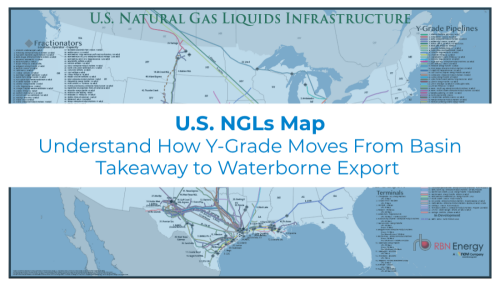
Visualize the infrastructure behind U.S. NGL movement.
The U.S. NGLs Map provides a comprehensive view of the transport, processing, and export networks moving NGLs across the U.S.
By this time next year, there’s a good chance that at least one new greenfield liquefaction/LNG export project will get the financial go-ahead and start construction. And, given the expectations that global LNG demand will keep growing and that U.S. shale plays like the Permian and the Marcellus/Utica will remain highly competitive sources of gas supply, it would be a fair bet that we’ll see several projects under way by the end of 2020. This blog series is a primer on the projects that appear to be in the running. We set the stage in Part 1, where we reviewed the dramatic shift in U.S. expectations regarding LNG a few years back. Through the 1990s and the first two-thirds of the 2000s, U.S. natural gas production was close to flat, so the general thinking was that U.S. gas output had peaked, and that over time, increasing amounts of LNG would need to be imported to keep pace with gas demand. It became clear by 2010-11, however, that the Shale Revolution — and the resulting boom in U.S. gas production — had eliminated the need for LNG imports. In a flash, many of the companies that had just finished building LNG import terminals started exploring the possibility of adding liquefaction plants at those sites to export LNG instead. Since then, six liquefaction/LNG export projects advanced to FID and construction — and five liquefaction trains (four at Cheniere Energy’s Sabine Pass in southwestern Louisiana and one at Dominion’s Cove Point in Maryland) with a combined capacity of more than 23 million tonnes per annum (MMtpa) are up and running. (We track the status of LNG projects with FIDs in RBN’s new LNG Voyager Report — click here for more information.)
We started our second-wave project review in Part 2, where we did a deep dive on Tellurian’s Driftwood LNG, a proposed 27.6-million metric tons per annum (MMtpa) liquefaction/LNG export terminal in Louisiana’s Calcasieu Parish, south of Lake Charles. In contrast to the large-scale liquefaction trains now operating at Sabine Pass and Cove Point and under construction along the Gulf Coast (generally with capacities of 4 MMtpa or more each), Driftwood LNG will consist of as many as 20 smaller, modular-based trains (1.38 MMtpa each). Also, Tellurian is acquiring natural gas reserves that will be tapped to produce gas for the LNG project, and it is developing two 2-Bcf/d long-haul pipelines — and a 96-mile, 4-Bcf/d connector pipe — to deliver most of the natural gas that the Driftwood trains will demand. To help finance its project, Tellurian is seeking a handful of customers/partners that would take a combined 60% to 75% equity interest in a holding company that will own all those assets, which will give the customers/partners equity LNG at the tailgate of the liquefaction trains at cost (an estimated $3.00/MMBtu). In Part 3, we turned our attention to Venture Global’s plan for two large projects, also along the Louisiana coast: the 10-MMtpa Calcasieu Pass project in Cameron Parish (south of Lake Charles) and, after that, the 20-MMtpa Plaquemines project along the Mississippi River southeast of New Orleans. Venture Global is “going small” too, planning a total of nine liquefaction “blocks” at Calcasieu Pass, each with two 0.6-MMtpa liquefaction trains, for a total of about 11 MMtpa of capacity. The modular design of the trains is aimed at accelerating the pace of construction and minimizing project costs. (The Plaquemines project will have 18 liquefaction blocks, again each with two 0.6-MMtpa trains.) Unlike Tellurian, however, Venture Global is taking the same approach to project financing taken by the first round of U.S. liquefaction/LNG export projects, namely lining up a number of long-term, “take-or-pay” Sales and Purchase Agreements (SPAs) with international LNG traders, foreign utilities and other major LNG buyers. (Venture Global announced on September 7 that it has just lined up a new, 1-MMtpa SPA with Repsol.)
About the song
"Coming Up" is a song written, recorded and produced by Paul McCartney for his 1980 solo studio album, McCartney II. The single was released in April 1980; it quickly rose to #2 on the UK singles chart; a live version of the song with Wings went to #1 on the U.S. Billboard Hot 100 at the same time. In the music video of "Coming Up," Paul and his wife Linda play various roles as members of a band identified on the kick drum as "The Plastic Macs," an homage to John Lennon's Plastic Ono Band. On the album, Paul plays bass, guitar, keyboards, drums and sings all the lead vocals. Linda McCartney assists with the backing harmonies.
Sir James Paul McCartney is an English singer-songwriter, multi-instrumentalist, and composer. He gained worldwide fame as the bassist and singer for the Beatles. His songwriting partnership with John Lennon was the most successful of the post-World War II era. McCartney is a two-time inductee into the Rock and Roll Hall of Fame — in 1988 with the Beatles and in 1999 as a solo artist. He also is the recipient of an Academy Award (in 1971, for the score of the movie version of “Let It Be”) and 18 Grammy Awards. He has written or co-written 32 songs that topped the Billboard Hot 100, and is rock and roll’s only billionaire. Paul was knighted by Queen Elizabeth II in 1997.