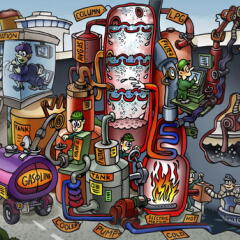
Sharply declining refinery demand for crude oil was a key driver in the historic collapse in near-term futures prices for WTI at Cushing earlier this week. With stay-at-home directives in place in most of the industrialized world, U.S. — and global — demand for motor gasoline and jet fuel has plummeted to levels not seen in decades. These changes in refined-products demand, which may continue for months, already are having significant impacts on U.S. refineries — not just in how much crude oil they need but in operators’ decisions on whether to adjust their crude slates and ramp down or alter their operations. Their urgent challenge is to revise their yields to something close to the appropriate volumes of gasoline, diesel and jet fuel. Today, we begin a blog series on the U.S. refining sector and what refiners can — and can’t — do to adapt to these extraordinary times.
You’d be hard-pressed to find an energy company of any sort that hasn’t been deeply affected by the events of the past few weeks, including the recent collapse in front-month and second-month futures prices for WTI at Cushing. As we said in Figure It Out, the old expectations regarding production volumes, pipeline flows, exports and commodity prices have been discarded. Producers, midstreamers and others have been adjusting to “the new normal”: an era of reduced output, fiercer competition and lower prices. Refineries are by no means exempt from the market convulsions now under way. In Strange Brew, we explained that even before the initial coronavirus outbreak in China started to grab headlines around New Year’s Day, refineries in the fourth quarter of 2019 and first two months of 2020 had been incentivized to shift their refined products output toward diesel, which can be used to help make IMO 2020-compliant low-sulfur bunker. Now, with the COVID-19 pandemic all but shutting down North American and European economies — and slashing gasoline and jet fuel demand in the process — the price signals are even stronger. Put simply, refineries are doing everything they can to reduce their overall output, minimize their gasoline and jet fuel production in particular, and enter what you might call “max diesel mode.”

Canadian crude output is rising, requiring new export routes. As traditional pathways face constraints, the U.S. Rockies—especially the Guernsey, WY hub—are emerging as key corridors for moving Canadian heavy crude to downstream markets, including the Gulf Coast.
That raises a critically important question: How much operational flexibility does a refinery really have? The simple answer is that there are a number of things that a refinery operator could do in response to a situation like the one facing the refining sector today:
About the song
"Baby Break It Down" was written by Mick Jagger and Keith Richards and appears as the 13th song on The Rolling Stones' 22nd American studio album, Voodoo Lounge. Recorded between September 1993 and April 1994 at Ronnie Wood's house in Ireland and Windmill Lane Studios in Dublin, the album was released in July 1994. Produced by Don Was with Mick Jagger and Keith Richards, it was the first album for the group in five years, since The Stones released Steel Wheels in 1989. Voodoo Lounge would also be the first Stones album without Bill Wyman, who had been the band's bassist since its inception. Personnel on the LP were: Mick Jagger (lead vocals, guitar), Keith Richards (guitars, backing vocals), Ronnie Wood (guitars, pedal steel, backing vocals), Charlie Watts (drums, percussion), Darryl Jones (bass), Chuck Leavell (keyboards), and Bernard Fowler and Bobby Womack (backing vocals). Six singles were released from the album, which went to #2 on the Billboard Top 200 Albums chart. It has been certified 2x Platinum by the Recording Industry Association of America. Voodoo Lounge won a Grammy Award in 1995 for Best Rock Album. The album's title was derived from Keith Richards, who while vacationing in Barbados named the terrace of his house "Voodoo's Lounge" after his adopted cat — named Voodoo — claimed it as his playground.
The Rolling Stones are a British rock band formed in London in 1962. They have sold more than 200 million records worldwide. The band has released 30 studio albums, 28 live albums, 26 compilation albums, three EPs and 120 singles. They have won one Billboard Music Award, four Grammy Awards, three MTV Video Music Awards and two World Music Awards. The Rolling Stones are members of the Rock and Roll Hall of Fame and the UK Music Hall of Fame. Original members Jagger, Richards and Watts — along with longtime member Ronnie Wood — still record and tour. The Rolling Stones’ upcoming No Filter tour of North America has been postponed, however, due to the ongoing global COVID pandemic.