By mid-May, the U.S. would typically be a couple of weeks into “summer refining season,” a monthslong period when refineries and refined product terminals are required to supply gasoline with lower Reid vapor pressure (RVP) — and a lot less butane. However, an emergency fuel waiver by the Environmental Protection Agency (EPA) is allowing them to market gasoline with an RVP of up to 10 pounds per square inch (psi) for E10 and E15 gasoline. In addition, the waiver streamlines compliance, making it easier for midstream operators to blend butane up to the RVP limit. As we discuss in today’s RBN blog, the waiver — temporary but likely to be extended — may well increase summertime gasoline supply and improve refinery and blender economics.
We’ll begin with a two-part warning, not to scare anyone off, but just to prepare you. First, producing and blending gasoline is complicated; second, government regulation of gasoline specifications only adds to that complexity.
As we said a couple of years ago in Wasting Away in Butane Blendingville, gasoline is among the most complex hydrocarbon products out there, with as many as a dozen specs — each with its own characteristics, such as octane, RVP, distillation points, aromatics, olefins, etc. — that when combined need to meet the exacting standards of regulators and, at the same time, turn as big a financial return as possible. And, to keep things interesting, federal and state regulations ratchet down the allowable RVP levels each spring and ratchet them up in late summer (often to different levels in different markets, and even at different dates).
Because of varying summer temperatures across the country and because certain parts of the U.S. face more serious challenges regarding smog than others, the EPA over the years has designated areas where even stricter summertime limits are enforced. Some states, like California, New York and Illinois — established even lower RVP caps of their own (with the EPA’s blessing) to address specific pollution concerns.
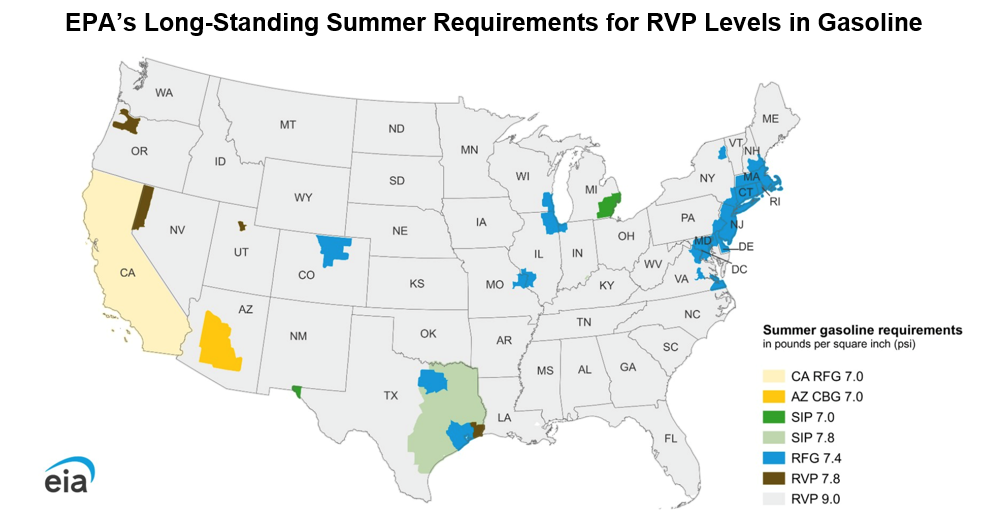
Figure 1. EPA’s Long-Standing Summer Requirements for RVP Levels in Gasoline. Source: EIA
VLGC Freight Rate to Japan Hits All-Time High
The impact of the war in Iran, and the effective closure of the Strait of Hormuz have certainly impacted crude oil and LNG markets, but the LPG market hasn't gotten away unscathed by a long shot. Longer transit times, both laden and unladen due to increased Asian demand and congestion at the Panama Canal have sent the spot VLGC freight rate from Houston to Chiba, Japan to record highs.
About the song
“Summertime” was written by George Gershwin in 1934 for the 1935 opera. Porgy and Bess. The lyrics were written by DuBose Heyward, the author of the novel Porgy, on which the opera was based. The song appears several times during the opera. It initially ran on Broadway for 124 performances, and has been performed all over the world since then. “Summertime” was first recorded by Abbie Mitchell in 1935, with George Gershwin on piano and accompanied by an orchestra. The 1959 motion picture of Porgy and Bess featured the song sung by Loulie Jean Norman. The refrain of “Summertime, and the livin’ is easy” sets the mood and timbre of the tune. It has been covered by countless artists, including Billie Holiday, Louis Armstrong with Ella Fitzgerald, Big Brother & The Holding Company (with Janis Joplin), Billy Stewart, and Fun Boy Three. Janis Joplin’s scorching performance of the song with Big Brother & The Holding Company at the Monterey Pop Festival in June 1967 introduced the song to a new generation.
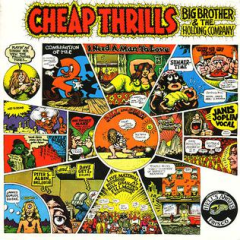
Cheap Thrills was the second studio album by Big Brother & The Holding Company. Sadly, after the huge success of this album, Joplin was convinced by her record company to abandon the band and become a solo artist. Joplin and Big Brother came up through the ranks together. They were sparked by great arrangements and fiery organic live performances that reflected a group that lived and performed together at the dawn of the music revolution in San Francisco. The album was recorded in the spring of 1968 at Columbia Records Studios in Hollywood and New York City and Winterland Ballroom in San Francisco. Robert Crumb did the cover artwork for Cheap Thrills for free, stating: “I don’t want Columbia’s filthy lucre.” Produced by John Simon, the album was released in August 1968 and went to #1 on the Billboard 200 Albums chart. It has been certified 2X Platinum by the Recording Industry Association of America. One single was released from the LP. Personnel on the record were: Janis Joplin (vocals), Sam Andrew (guitar, bass, backing vocals), James Gurley (guitar), Peter Albin (bass), and Dave Getz (drums).
George Gershwin was an American composer and pianist whose songs encompassed jazz, pop and classical music. He composed 10 orchestral works, two solo piano works, two operas, 19 musicals, and six film scores. He won an Academy Award, a Congressional Gold Medal and a Pulitzer Prize, and is a member of the Jewish-American Hall of Fame. George and Ira Gershwin have a star on the Hollywood Walk of Fame. UCLA established the George and Ira Gershwin Lifetime Achievement Award to honor the two brothers. George Gershwin died in Hollywood in July 1937 of a brain tumor at 38.
Janis Joplin died in Hollywood of a drug overdose in October 1970 at 27. Big Brother guitarist James Gurley died in Palm Desert, CA, in December 2009 at 69.
"About the Song" -- written by Mickey McMahan , RBN Director of Musicology