Just a few years ago, the possibility of overseas ethane exports was almost incomprehensible. Lack of infrastructure, high handling costs, no suitable ships and minimal market demand made ethane exports seem extremely unlikely. But then the shale gas boom transformed the ethane market. Now U.S. ethane production greatly exceeds demand and each day hundreds of thousands of barrels of ethane are being rejected into the natural gas stream. Consequently a few pioneers are hammering through the challenges associated with overseas ethane exports, including the construction of specialized tankage, loading facilities, ships and unloading facilities. And international chemical companies are spending hundreds of millions of dollars to modify olefin crackers to use the cheap feedstock. Now the first of those pioneers has made it to the new ethane frontier. In today's blog we examine the impact of imminent ethane exports from the Energy Transfer/Sunoco Terminal at Marcus Hook, PA.
We’ve posted many blogs about the shale gas boom and the implications of ethane production greatly exceeding demand. Back in 2013 we covered the growing supply of ethane in aggregate across the U.S. and the economic implications in The Ethane Asylum: Big Time Ethane Rejection In The Shale Gas World along with the specific challenges created by the growing supply of ethane in the Northeast (No Particular Place To Go? What Will Happen To The Tsunami Of Marcellus/Utica Ethane Production?). We’ve also covered the growing list of projects developed to soak up all of the cheap ethane; from expansions and debottlenecks at existing petrochemical facilities to new-build ethane-only world-scale crackers and the first inkling of ethane exports in Changes In Longitudes—Ethane Exports To Europe. That turned into a series of ethane export blogs, covering the challenges associated with exporting ethane on the water and the barriers that needed to be overcome for ethane exports to work in significant volumes including: (1) loading and unloading terminal infrastructure, (2) shipping, (3) pricing, and (4) petrochemical demand. See Changes In Longitudes — The Four Barriers To Ethane Export and Changes In Longitudes — More Barriers To Ethane Exports for additional details on the obstacles that had to be overcome for today’s advancement to be possible.

Now the day has finally arrived. Or pretty close to it. The infrastructure needed to move Marcellus/Utica ethane to offshore markets is in place. Mariner East 1 pipeline is moving a mixed ethane/propane stream from West Virginia, Ohio and Western Pennsylvania producers to the Marcus Hook Terminal, about 20 miles west of Philadelphia, PA on the Delaware River. There it is processed in a deethanizer to separate ethane from propane and then the ethane is stored in a 300,000-barrel cryogenic (super cold) ethane storage tank before loading on ships. Those ships are ready and waiting for their first ethane voyages. Chemical company Ineos contracted with ship owner Evergas for 8 Dragon Class ships tailored to meet the specific needs of this project. They are some of the most flexible and advanced multi-gas carriers yet to be built at 27,500 cbm. Click here to see a great Evergas video about the building of the first of these ethane carriers. The vessels will provide Ineos with a flexible solution for their ethane supplies with the option of transporting LNG, LPG as well as petrochemical gases including ethylene. Four of these vessels, JS Ineos Insight, JS Ineos Intrepid, JS Ineos Ingenuity, and JS Ineos Inspiration are already on the water moving propane and butane. The other four tankers are scheduled for delivery through mid-2017. According to press announcements, either the JS Ineos Inspiration or the JS Ineos Intrepid (picture below) will have the honors of lifting the first ethane cargo from Marcus Hook. According to MarineTraffic.com, a tanker tracking site, the Intrepid has been at the dock and waiting for several days. You can check out the vessel position at the MarineTraffic site. The first INEOS ethane cargo is expected to go to the Ineos plant in Rafnes, Norway.
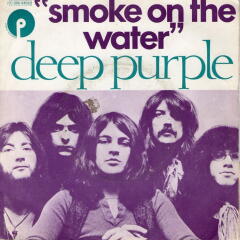
About the song
“Smoke on the Water” was written by Ritchie Blackmore, Ian Gillan, Roger Glover, Jon Lord, and Ian Paice (Deep Purple). It appears as the first song on side two of Deep Purple’s sixth studio album, Machine Head. Released as a single in May 1973, it went to #4 on the Billboard Hot 100 Singles chart and has been certified Gold by the Recording Industry Association of America (RIAA). The song features the riff from Ritchie Blackmore’s guitar that still has parents of rock and roll guitar students shouting “TURN IT DOWN” over 50 years after its release. Also noteworthy on the recording is Jon Lord’s distinctive grinding growl from his Hammond B3 organ, achieved by overdriving its Leslie speakers with a 100-watt Marshall plexi amp. The song’s lyrics chronicle the struggles the band had recording Machine Head. The Montreux Casino, which the band had originally booked to record with the Rolling Stones mobile truck, burned to the ground while Frank Zappa and The Mothers were playing a concert there. “Funky Claude” referred to in the song was Claude Nobs, a producer friend of the band who lived in Montreux and helped kids escape to safety from the fire. The band eventually ended up recording the album in the mostly deserted Grand Hotel de Territet in Switzerland, converting the hallways and stairwells into a recording studio, utilizing the abandoned hotel's mattresses for sound baffles. “A few red lights and a few old beds, we made a place to sweat,” refers to this situation in the song. Personnel on the record were: Ritchie Blackmore (guitar), Ian Gillan (vocals), Jon Lord (Hammond B3 organ), Roger Glover (bass), and Ian Paice (drums).
Machine Head was recorded in December 1971 at the Grand Hotel in Switzerland with the Rolling Stones mobile studio. Produced by Deep Purple, it was released in March 1972 and went to #7 on the Billboard 200 Albums chart. It has been certified 2x Platinum by the RIAA. Four singles were released from the LP.
Deep Purple are an English rock band formed in London in 1968 by guitarist Ritchie Blackmore, vocalist Rod Evans, keyboardist Jon Lord, drummer Ian Paice, and bassist Nick Simper. Fifteen members have passed through the band since its inception. They have released 22 studio albums, 43 live albums, 28 compilation albums, and 53 singles. They have sold more than 100 million records worldwide and are considered pioneers in hard rock and heavy metal music. Deep Purple was inducted into the Rock and Roll Hall of Fame in April 2016. Founding member Ian Paice, along with longtime members Ian Gillan and Roger Glover, with Don Airey and Simon McBride, currently tour as Deep Purple. Keyboardist Jon Lord died in 2012, and Tommy Bolin (guitarist in 1975-76) died in 1976.