Cargo ships move more than 80% of the world’s internationally traded goods, making them essential to the global economy, but they’ve traditionally been fueled by heavy fuel oil or marine gasoil, both of which are emissions-intensive. With 60,000 or so ships in service, they account for an estimated 2.8% of global greenhouse gas (GHG) emissions, a percentage the International Maritime Organization (IMO) would like to reduce. At the 80th session of the IMO’s Maritime Environment Protection Committee (MEPC) in July, the group adopted a provisional agreement to eliminate GHG emissions from shipping by a date as close to 2050 as possible, with intermediate goals for emissions reduction by 2030 and 2040. Clearly, radical innovations will be required to meet the IMO’s goals. In today’s RBN blog, we look at some of the initiatives directed at emissions reduction in shipping and the challenges to (and opportunities for) operational improvements, especially regarding LNG carriers.

The replay of our Fall 2026 School of Energy (September 9 & 10, Houston) is now available online!
Learn from RBN experts, participate in hands-on Excel modeling, connect with industry peers, and gain a stronger understanding of today's interconnected energy markets.
The trajectory toward the IMO’s goal will largely be influenced by the shipping industry’s response to the introduction of the Carbon Intensity Index (CII) from the start of 2023. The index, expressed as grams of carbon dioxide (CO2) per deadweight ton nautical mile, is divided into five categories (A through E), whereby vessels with a CII rating below a C (that is, D or E) for a specified period must take steps to improve their efficiency via a corrective action plan. The range of allowable CII numbers reduces over time, requiring improved efficiency and serving to hasten the recycling of the least-efficient vessels.
So how can ship owners comply with the ever-tightening CII requirements? One immediate option is to reduce vessel speed. For modern LNG carriers, a reduction in speed of 1 knot (about 1.15 miles per hour) can reduce fuel consumption by up to 6%. However, many ships are designed to operate at high speeds, such that reducing speed can result in suboptimal performance of the hull. An example is the bulbous bow that protrudes forward from the vessel and is designed to create a pattern of water flow along the hull that reduces drag. This has led some shipowners, notably container ship operators, to undertake “nose jobs” on some of their vessels to revise the bow shapes (see photo below) so the ships cut through the water more efficiently at the more fuel-efficient, lower speeds.
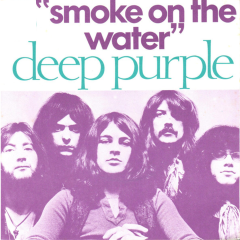
About the song
“Smoke on the Water” was written by Ritchie Blackmore, Ian Gillan, Roger Glover, Jon Lord, and Ian Paice (Deep Purple). It appears as the first song on side two of Deep Purple’s sixth studio album, Machine Head. Released as a single in May 1973, it went to #4 on the Billboard Hot 100 Singles chart and has been certified Gold by the Recording Industry Association of America (RIAA). The song features the riff from Ritchie Blackmore’s guitar that still has parents of rock and roll guitar students shouting “TURN IT DOWN” over 50 years after its release. Also noteworthy on the recording is Jon Lord’s distinctive grinding growl from his Hammond B3 organ, achieved by overdriving its Leslie speakers with a 100-watt Marshall plexi amp. The song’s lyrics chronicle the struggles the band had recording Machine Head. The Montreux Casino, which the band had originally booked to record with the Rolling Stones mobile truck, burned to the ground while Frank Zappa and The Mothers were playing a concert there. “Funky Claude” referred to in the song was Claude Nobs, a producer friend of the band who lived in Montreux and helped kids escape to safety from the fire. The band eventually ended up recording the album in the mostly deserted Grand Hotel de Territet in Switzerland, converting the hallways and stairwells into a recording studio, utilizing the abandoned hotel's mattresses for sound baffles. “A few red lights and a few old beds, we made a place to sweat,” refers to this situation in the song. Personnel on the record were: Ritchie Blackmore (guitar), Ian Gillan (vocals), Jon Lord (Hammond B3 organ), Roger Glover (bass), and Ian Paice (drums).
Machine Head was recorded in December 1971 at the Grand Hotel in Switzerland with the Rolling Stones mobile studio. Produced by Deep Purple, it was released in March 1972 and went to #7 on the Billboard 200 Albums chart. It has been certified 2x Platinum by the RIAA. Four singles were released from the LP.
Deep Purple are an English rock band formed in London in 1968 by guitarist Ritchie Blackmore, vocalist Rod Evans, keyboardist Jon Lord, drummer Ian Paice, and bassist Nick Simper. Fifteen members have passed through the band since its inception. They have released 22 studio albums, 43 live albums, 28 compilation albums, and 53 singles. They have sold more than 100 million records worldwide and are considered pioneers in hard rock and heavy metal music. Deep Purple was inducted into the Rock and Roll Hall of Fame in April 2016. Founding member Ian Paice, along with longtime members Ian Gillan and Roger Glover, with Don Airey and Simon McBride, currently tour as Deep Purple. Keyboardist Jon Lord died in 2012, and Tommy Bolin (guitarist in 1975-76) died in 1976.