


This week the first Gulf Coast ethane export cargo will depart Morgan’s Point, Enterprise Products Partners’ new export terminal on the Houston Ship Channel. This is a history-making event for at least three reasons. First, it inaugurates ethane exports from the Gulf Coast, only five months after the first-ever U.S. overseas ethane exports out of Sunoco Logistics’ Marcus Hook, PA, terminal. Second, it launches a battle for Mont Belvieu ethane, to be fought between ethane exporters and new ethane-only steam crackers (ethylene plants) that will be coming online along the Texas/Louisiana coast over the next couple of years. And third, Morgan’s Point is not just another export terminal. It is a location steeped in Texas history, known in the 1830s as New Washington, with an important role in the Battle of San Jacinto – decisive battle of the Texas Revolution -- and legend has it, inextricably tied to the Texas anthem “The Yellow Rose of Texas.” In today’s blog we examine the upcoming fight between ethane exporters and U.S. crackers.
We spend a lot of time talking about ethane in the RBN blogosphere, not only because it is a fascinating hydrocarbon market, but also because it will be driving what will happen with all of the natural gas liquids (NGLs) – and, for that matter, “wet” (high-Btu) natural gas –– for years to come. That’s because the Shale Revolution led to huge increases in wet natural gas production and, with that, far more ethane than the U.S. petrochemical market was prepared to consume. That, in turn, resulted in massive ethane “rejection” – or leaving ethane in the gas stream and selling ethane at gas prices rather than selling it as a “purity” product for use as a cracker feedstock (see The Ethane Asylum). Oversupply drove ethane prices down, and that inspired petrochemical companies to announce projects to debottleneck/expand/convert existing plants to use more ethane and to build several new multi-billion-dollar ethane only crackers, most of which are expected to come on line over the next two years (see Beyond Hypothermia). But others have been eyeing cheap U.S. ethane too – the overseas cracker market. Six to seven years ago those international players initiated serious discussions with U.S. producers and midstream companies to do what had never been done before – put ships of ethane on the water. That finally happened on March 9, 2016, when the JS Ineos Intrepid departed Sunoco’s Marcus Hook, PA terminal (near Philadelphia) with the first overseas ethane cargo; it arrived at the INEOS petrochemical plant in Rafnes, Norway 10 days later (see Boat on the Water).
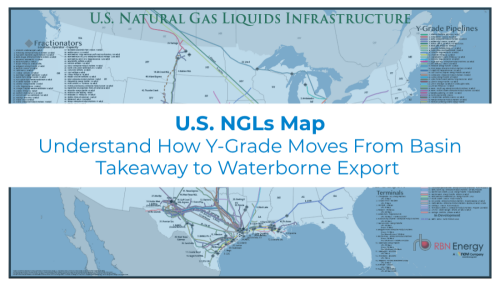
Visualize the infrastructure behind U.S. NGL movement.
The U.S. NGLs Map provides a comprehensive view of the transport, processing, and export networks moving NGLs across the U.S.
That was another big step for Marcellus/Utica producers, who in the early years of the Shale Revolution had no outlet for their extracted ethane whatsoever – it all needed to be rejected. The initial steps involved two ethane pipelines out of the wet Marcellus and Utica regions: Energy Transfer Partners/Sunoco’s Mariner West Pipeline to Sarnia, ON, and Enterprise Products Partners’ Appalachian-to-Texas (ATEX) Pipeline to Mont Belvieu, TX. Then, earlier this year (2016), Sunoco started moving ethane on its Mariner East Pipeline from the Marcellus/Utica to Marcus Hook. (The first in-region use of ethane is slated to occur by the early 2020s, when Shell Chemicals completes its planned cracker in Beaver County, PA, near Pittsburgh –– see Ain’t Wastin’ Time No More and Only Time Will (Sh)ell).
So far since March (2016), a total of 3.8 million barrels (MMbbl) of ethane (or about 25 Mb/d) has departed from Marcus Hook on six different ships, all headed to the INEOS cracker in Norway (see Figure 1). The JS Ineos Ingenuity (green bar segments in April, May and June) will be showing up at Marcus Hook again today to load another ethane cargo. How do we know that? At RBN we track all these ethane-carrying vessels each day, just like we do ships carrying exported liquefied petroleum gas (LPG; propane and butane), and we have a new report in the works that will provide detailed ship movements along with the economic rationale for those movements. (More information on this will be coming soon.)







Comments
what are your thoughts on the recent propane cargo cancellations? Will lower propane prices in 2017/2018 put a cieling on ethane much lower than your 50 cent forecast? thank you.
In reply to Propane cieling by Eugene Khmelnik
Our outlook for ethane is 2018, so a lot can happen between now and then. But the ethane price is dependent on a lot of things, not the least of which is the price of competing feedstocks, including propane. If prices for propane stay cheap (which will depend on the prices of crude & naphtha, weather and other factors), then ethane prices will be cheaper. But there is not a 1:1 correlation. There are many other moving parts involved.