The details of a trade deal between the U.S. and China, announced June 26 by Commerce Secretary Howard Lutnick and confirmed by China, remain sparse. Once they are finalized, the requirement for U.S. exporters to obtain a Bureau of Industry and Security (BIS) license to send ethane to China should be lifted, but the effect on trade flows is already apparent. In today’s RBN blog, we review the impact of the BIS license requirement, the still-pending imposition of fees on vessels owned or operated by China, and the risk that comes with using the energy industry as a bargaining chip in trade talks.
Let’s look at the impact of the requirement for export licenses to start. Enterprise Products announced May 29 that it had received a notice from the BIS stating that ethane exports to China posed an “unacceptable risk of use or diversion to a military end use” and that they would require specific licenses per cargo in order to be delivered. Energy Transfer said in a filing with the Securities and Exchange Commission (SEC) on June 3 that it had received a similar letter. (For more on the impact of the BIS licenses, see Hey, Hey, What Can I Do and Whatcha Gonna Do When C2 Says Goodbye.)
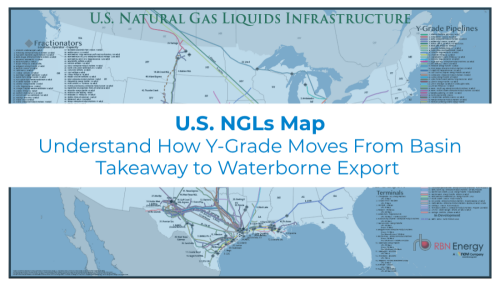
Visualize the infrastructure behind U.S. NGL movement.
The U.S. NGLs Map provides a comprehensive view of the transport, processing, and export networks moving NGLs across the U.S.
It looked like the industry was going to dodge a big bullet when, on June 10, China and the U.S. reached a tentative agreement aimed at defusing the latest round of trade tensions between the two countries. According to reports, the agreement included revised tariff rates, a six-month relaxation of Chinese export license requirements for rare-earth elements (especially magnets) and a reciprocal easing of U.S. export restrictions on semiconductor technology. Dropping the BIS license requirement for ethane was also part of the deal, although the initial announcement did not lead the BIS to start issuing licenses. As of June 27, that agreement appears to have been signed, although licenses have not yet been granted for ethane exports to China. Reuters reported June 25 that companies will be allowed to load ships and send them to China, just not unload them, a potential indication that the license requirement may be coming to an end. Satellite Chemical USA and Vinmar both received letters last week allowing them to load vessels bound for China but denying them the ability to unload without permission.
The Trump administration has increasingly used U.S. energy — especially commitments to purchase U.S.-sourced LNG — as an element in trade negotiations (see Road to Alaska), and it appears to have used the withholding of ethane as a cudgel during talks with China in a way that it hasn’t before (more on that in a bit). The impact of the license requirement can be clearly seen in the export data.
With the negotiations between the U.S. and China continuing in June, U.S. ethane exports slowed significantly. Figure 1 below shows U.S. ethane exports by stated destination for January through the first half of June, with the vast majority headed to Asia (purple bar sections), followed by Europe (teal bar sections) and Latin America (orange bar sections). It’s important to note that the destination is what’s indicated by ship-tracking data and may not be the actual final destination, as most of the vessels that departed in June and were headed to Asia have not arrived yet. In addition, there are ethane vessels in the Gulf that are laden and awaiting orders. According to Kpler data, there are at least three laden ethane vessels sailing in circles off the coast of China. What’s important, however, is that at least for the first half of June, exports were down to around 280 Mb/d from the previous peak in April of more than 480 Mb/d. When they left the port, about 180 Mb/d of the ethane was slated to go to Asia. Some of those vessels will be headed toward India, but volumes “headed” to China will not be allowed to unload there — at least not yet. If the barrels are unable to be unloaded, the nature of the ethane market means that most of these U.S. volumes will not find a home outside of China, and China will not be able to source its ethane from elsewhere.
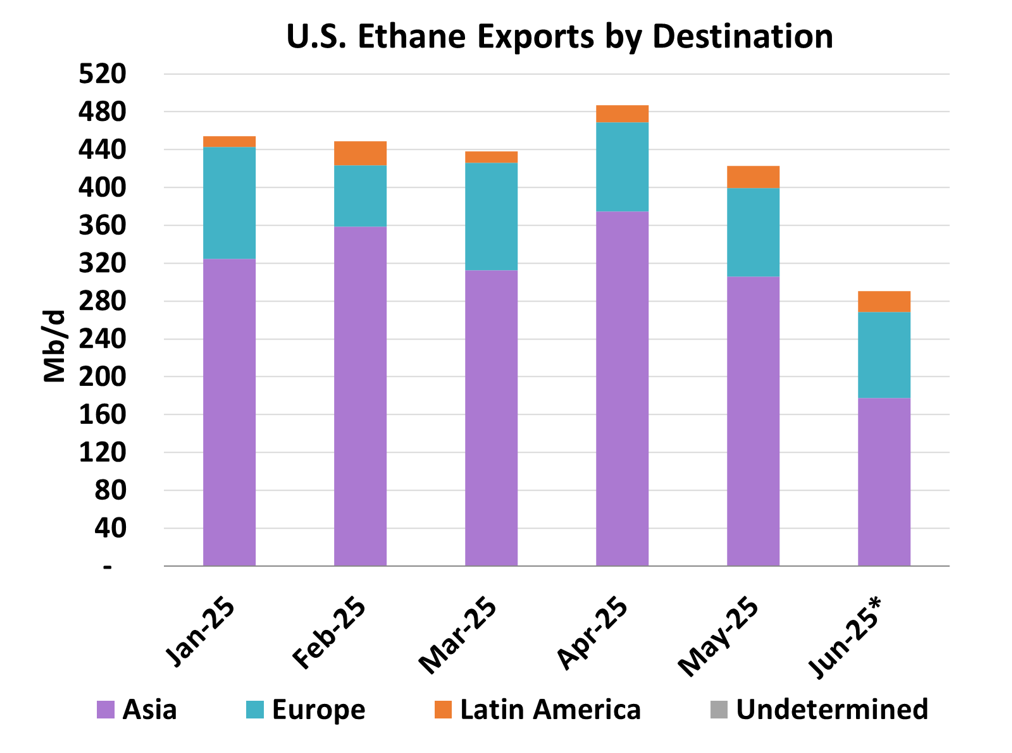
Figure 1: Ethane Exports by Destination. Source: RBN * Data is for first half of June
About the song
“Weapon of Choice” was written by Norman Cook (Fatboy Slim), Ashley William Slater, Bootsy Collins, Sylvester Stewart, Andres Titus and William K. McLean. It appears as the eighth song on Fatboy Slim’s third studio album, Halfway Between the Gutter and the Stars. The song features vocals from Bootsy Collins, with Collins’ normal vocals panned hard right in the mix, and a distorted version panned hard left. The tune samples Sly & the Family Stone’s “Into My Own Thing,” The Chambers Brothers’ “All Strung Out About You,” and “Word Play” by The X-Ecutioners. A video directed by Spike Jonze features incredible dancing from Christopher Walken, putting his previous tap dance training to full use in a dance routine through a hotel lobby that brings Fred Astaire-style choreography into the modern age. Receiving massive rotation on MTV, it won multiple MTV Video Music Awards and the 2002 Grammy Award for Best Music Video. (As a side note, your RBN Managing Director of Musicology had the pleasure of playing the guitar licks and the hands of Christopher Walken in Wayne's World II.) “Weapon of Choice” was released as a single in April 2001 and went to #33 on the Billboard Alternative Airplay Singles chart. Personnel on the record were: Fatboy Slim (production, beats, sampling, synthesizers) and Bootsy Collins (vocals).
Somewhere Between the Gutter and the Stars was recorded in 2000 at Fatboy Slim’s studio in Brighton, England. Produced by Fatboy Slim, it was released in November 2000 and went to #11 on the Billboard Top Dance/Electronic and #31 on the Billboard 200 Albums charts. The title of the album refers to the Oscar Wilde quote, “We are all in the gutter, but some of us are looking at the stars.” The album features contributions from Macy Gray, Bootsy Collins, Roland Clark and Roger Sanchez. Four singles were released from the LP.
Fatboy Slim (Norman Cook) is an English musician, DJ and music producer who helped establish the big-beat genre of electronic dance music. He started his professional career as bassist for The Housemartins, the British indie rock group who scored a #1 UK single with their cover of “Caravan of Love” in December 1986. He started producing electronic dance music in 1990. He has released four studio albums, three live albums, two compilation albums, a soundtrack album, five EPs, and 28 singles. He has won an ASCAP Award, two Brit Awards, a Grammy Award, and nine MTV Video Music Awards. His last release was the single “Role Model,” released in June 2024. He is now focused on live DJ performances and will be a DJ at several music festivals in Europe this summer.