The U.S. government recently released the final rules for the Section 301 fees proposed earlier this year, intended to address the dominance of China’s shipbuilding industry. According to the new rules, exports on Chinese-owned, -operated or -built vessels are mostly excluded — great news for U.S. energy producers and exporters, especially in the NGL sector. In addition, things are starting to change in the LPG markets due to the U.S./China tariff war. Propane vessels are being diverted, at least one ethane cargo has been scrapped, and China is reportedly looking into exempting ethane from its 125% import tariff. In today’s RBN blog, we look at what the latest developments mean for the U.S. energy industry.
The replay of our Fall 2026 School of Energy (September 9 & 10, Houston) is now available online!
Learn from RBN experts, participate in hands-on Excel modeling, connect with industry peers, and gain a stronger understanding of today's interconnected energy markets.
Back in 2015, the Department of Defense was concerned about growing vulnerabilities in U.S. supply chains and commissioned a detailed study through its Office of Industrial Policy (OIP) to assess the state of global shipbuilding. What they found wasn’t exactly subtle: China had launched an aggressive, state-led campaign to dominate every segment of the maritime value chain. In essence, China had built a vertically integrated juggernaut through a potent mix of subsidies, financing, domestic protectionism and long-term industrial planning. Shipyards. Containers. Port cranes. All backed by a policy machine designed to knock out foreign competition. The U.S., meanwhile, had let much of its commercial shipbuilding capacity wither. The OIP report concluded that economic and national security implications were worrisome and should be addressed.
The study didn’t lead to immediate policy action but didn’t vanish either. It kept circulating, quietly shaping how folks in Washington, DC, thought about China’s maritime strategy. Fast-forward to 2023, when a coalition of labor unions used that same study as the backbone of a formal petition to the U.S. Trade Representative (USTR). Their ask? A Section 301 investigation into China’s practices in shipbuilding, marine logistics and port infrastructure. A Section 301 petition is a formal request under the Trade Act of 1974 that allows the USTR to probe whether a foreign country's trade practices are unfair or discriminatory and create barriers to U.S. commerce. If the investigation supports that view, the U.S. government can respond with trade measures such as tariffs, import restrictions, or other penalties to encourage policy changes.
The USTR took up the case in April 2024, launching a full-scale investigation that dove deep into decades of industrial policy and its real-world fallout. The results of the Section 301 investigation into China’s maritime, logistics and shipbuilding sectors were released on January 16, in the closing days of the Biden administration. The findings confirmed the earlier study and concluded that China’s actions had caused material harm to U.S. shipbuilders, maritime suppliers and related sectors, while creating strategic vulnerabilities across the supply chain. The release set the stage for retaliatory measures and industrial policy initiatives to counter China’s influence and rebuild domestic maritime strength.
About the song
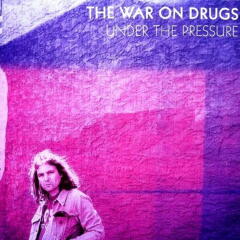
“Under the Pressure” was written by Adam Granduciel and appears as the first song on The War on Drugs’ third studio album, Lost in the Dream. The eight-minute, 52-second-song is based on vocalist and principal songwriter Granduciel’s depression after breaking up with his girlfriend and being left alone in the city. Released as the second single from the album, it failed to make the Billboard charts but has an astounding 70 million streams on Spotify. The song also appears on The War on Drugs’ two live LPs. Personnel on the record were: Adam Granduciel (lead vocals, guitar, keyboards), Dave Hartley (bass), Charlie Hall (drums, percussion), Jon Natchez (baritone sax), Robbie Bennett (keyboards), and Michael Johnson (ARP 2600).
Lost in the Dream was recorded between August 2012 and November 2013 at Uniform Recording; Minor Street; University Arts; Adam Granduciel’s house in Philadelphia; Echo Mountain in Asheville, NC; Fidelitorium in Kernersville, NC; Rare Book Room in Brooklyn, NY; Water Music in Hoboken, NJ; and Public Hi-Fi in Austin TX. Produced by Adam Granduciel, the album was released in March 2014 and went to #6 on the Billboard Top Alternative and #26 on the Billboard 200 Albums charts. Five singles were released from the LP.
The War on Drugs is an American rock band formed in Philadelphia in 2005 by Adam Granduciel and consists of Granduciel on vocals and guitar, bassist Dave Hartley, keyboardist Robbie Bennett, Drummer Charlie Hall, saxophonist Jon Natchez, guitarist Anthony LaMarca, and percussionist/keyboardist Eliza Hardy Jones. They released their debut album, Wagonwheel Blues, in 2008. They have released five studio albums, three live albums, two EPs, and 18 singles. They have won one Grammy Award. Twelve members have passed through the band since its formation. Adam Granduciel has produced albums for Sam Fender, Craig Finn, and Purling Hiss. The War on Drugs continues to record and tour and will be appearing at two music festivals in May.