Starting on April 10, China will enact an 84% reciprocal tariff on imports of U.S. goods. This increase was in response to the 104% tariff that the U.S. placed on imports of Chinese goods, which was subsequently raised to 125% by President Trump on April 9. China is likely to retaliate further. Unlike China’s February retaliatory tariffs of 10%-15% on U.S. oil and LNG, this time NGLs and all energy products are included. These higher tariffs have the potential to destroy propane and ethane exports from the U.S. In today’s RBN blog, we look at the potential impact of China’s reciprocal tariffs on the propane and ethane markets.
Note: This blog was reworked on April 9 to reflect the increased tariffs on U.S. goods into China and the lower prices and fees for LPG and ethane.

Join industry leaders in Calgary on October 29 for market insights, technical presentations, Duvernay inventory analysis, an expert panel, and networking focused on the next chapter of Canadian energy.
Like all of President Trump’s tariff wars, this front has been subject to rapid escalation. On February 1, he signed Executive Order 14195, imposing a 10% tariff on all Chinese imports, which took effect on February 4. That same day, China imposed a wide range of retaliatory tariffs against the U.S., including a 15% tariff on LNG and a 10% tariff on oil. At that point, there was no action on other energy products, so propane and ethane, along with other NGLs, were effectively exempt. But that was not the end of it. On March 4, the president increased the tariffs by another 10%. In retaliation, China announced a 15% tariff on U.S. goods. Then, as part of the “Liberation Day” proclamations of April 2, the U.S. tariff on Chinese goods was increased by another 34%, making the total tariff rate 54%. China followed with a retaliatory 34% tariff on all goods imported from the U.S., including oil, LNG, and all energy products.
The situation escalated again on April 8, when President Trump formalized a further increase of 50% on imports of Chinese goods to the U.S., to go into effect April 9 if China did not rescind its most recent increase, pushing the total tariff rate to 104%. China vowed not to back down. As proof of that, China announced an additional 50% tariff on U.S. imports on April 9, bringing the total tariff to 84%. On April 9, President Trump announced a pause on retaliatory tariffs for all countries except China, whose tariff he further increased to 125%. China is likely to increase its own retaliatory tariff on April 10.
China imports very little crude oil from the U.S., and those volumes can easily be rerouted so that other countries replace U.S. barrels. China also does not import much LNG or refined products from the U.S. However, liquified petroleum gas, or LPG (propane and butane), plays a much larger role, ranking as the second-highest import into China by value, exceeded only by electronic products.
As a result, the tariffs have the potential to be a major disruptive force in global NGL markets. The U.S. sends about 20% of its propane exports to China. Most of that is used in the production of propylene via propane dehydrogenation (PDH). An 84% tariff on U.S. propane will devastate PDH economics, likely forcing China to drastically cut imports of U.S. propane. That, in turn, will place serious downward pressure on U.S. propane prices. China will try to replace as much U.S. supply as possible, but doing so would require uneconomic cargo rerouting — only possible if U.S. propane prices drop significantly at the point of origin to remain competitive.
The outlook for ethane is even more dire — at least for China. Chinese petrochemical crackers that use ethane as a feedstock rely exclusively on U.S. volumes. The tariffs will make U.S. ethane uneconomical, and these facilities will face two choices: absorb the cost or shut down. If shutdowns occur, the U.S. won’t be able to export those ethane volumes and will have to reject the surplus molecules into the natural gas stream. Almost 50% of U.S. ethane exports go to China, all used in ethylene production. The U.S. is China’s only possible source of ethane imports as it is the only country that exports waterborne ethane.
With that background out of the way, let’s look a little closer at the impacts on LPG and ethane.
LPG – Propane and Butane
China was the second-largest importer of U.S. propane in 2024 at 311 Mb/d (red bar in left graph in Figure 1 below). The amount of butane in 2024 was much smaller at 26 Mb/d, or 5% of total U.S. exports, making China the sixth-largest importer of U.S. butane (red bar in right graph). Total U.S. exports of LPG to China were 337 Mb/d.
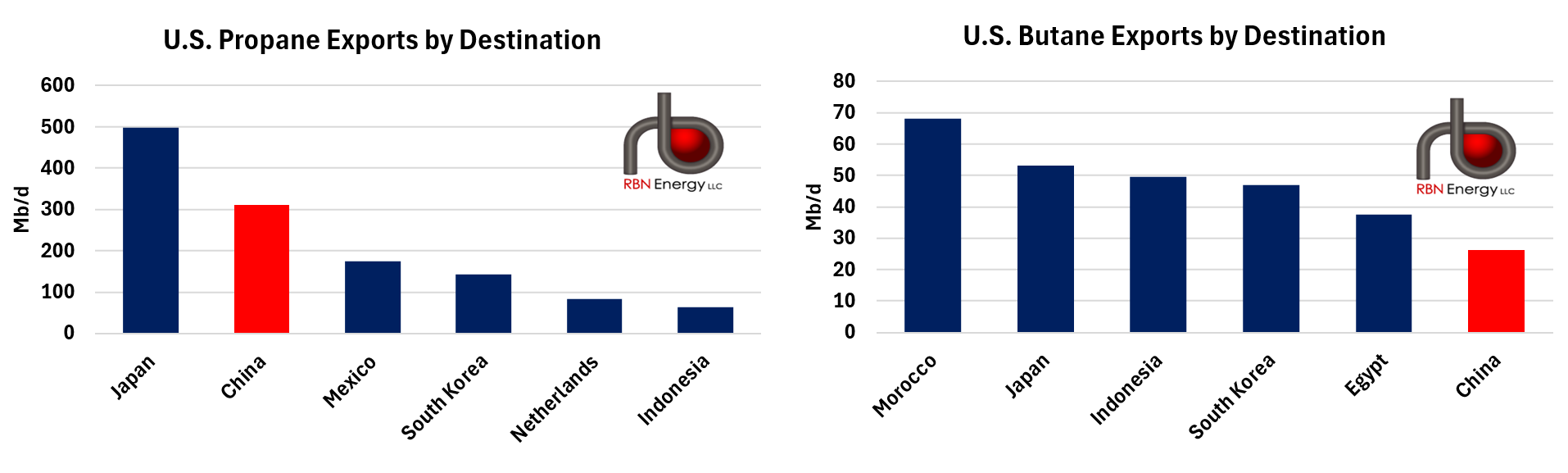
Figure 1. U.S. Propane and Butane Exports by Destination. Source: EIA
About the song
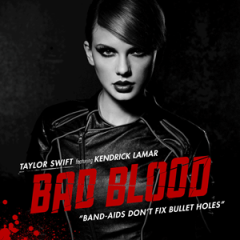
“Bad Blood” was written by Taylor Swift, Max Martin, Shellback and Kendrick Lamar. It appears as the eighth song on Taylor Swift’s fifth studio album, 1989. A remix of the song, featuring Kendrick Lamar rapping on the verses, was made and released as a single in May 2015 and went to #1 on the Billboard Hot 100 Singles chart. It has been certified 6x Platinum by the Recording Industry Association of America. A video, directed by Joseph Kahn and produced by Swift, featuring Swift and a huge cast starring in a sci-fi action movie theme, was released and won a Grammy Award for Best Music Video and MTV Video Music Awards for Video of the Year and Best Collaboration. Personnel on the record were: Taylor Swift (lead, backing vocals), Dan Burns (drum programming, synthesizers, synth bass), Matt Billingslea (drums, drum programming), Amos Heller (bass), Derek Garten (programming), Kendrick Lamar (rap vocals), and Ilya Salmanzadeh, Christopher Rowe (backing vocals).
The album, 1989, was recorded during 2014 at Conway Recording in Los Angeles, Jungle City and Lamby's House in New York City, Pain in the Art in Nashville, MXM in Stockholm, Elevator Nobody in Gothenburg, and The Hideaway in London. Produced by Taylor Swift, Max Martin, Shellback, Jack Antonoff, Ryan Tedder, Noel Zancanella, Ali Payami, Nathan Chapman, Imogen Heap, and Mattman & Robin, it was released in October 2014 and went to #3 on the Billboard 200 Albums chart. It has been certified 9x Platinum by the RIAA. Seven singles were released from the LP.
Taylor Swift is an American singer, songwriter and record producer. She is the highest-grossing touring artist and the first billionaire female music artist. She released her first LP, Taylor Swift, in 2006. She has released 11 studio albums, four live albums, five EPs, and 62 singles. She has sold more than 114 million records worldwide. She has won eight ACM Awards, 40 American Music Awards, 49 Billboard Music Awards, two Brit Awards, 12 CMA Awards, 14 Grammy Awards, and 30 MTV Video Music Awards. She has appeared in numerous television shows and films. Swift continues to record and tour.