The Dakota Access Pipeline isn’t the only interstate liquids pipe facing an uncertain future. The fate of Enbridge’s Line 5, which batches either light crude oil or a propane/butanes mix from Superior, WI, through Michigan and into Ontario, also hangs in the balance as the company renews its battle with Michigan’s top elected officials to keep the 67-year-old pipeline open and its effort win regulatory approval to replace the pipe’s most important water crossing. Line 5 supporters say that closing the 540-Mb/d pipeline would slash supplies to residential and commercial propane consumers in the Great Lakes State, steam crackers in Ontario, and refineries and gasoline blenders in three states and two Canadian provinces. Critics of Line 5 counter that there are plenty of supply alternatives. Today we discuss the pipeline, what it transports, and who it serves, as well as challenges it faces.
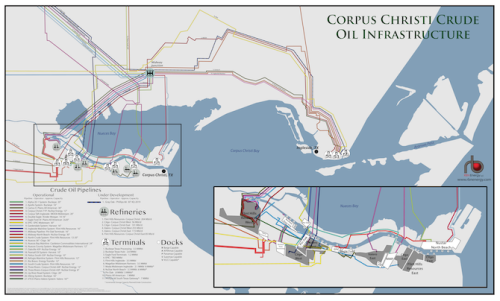
Gain insight and clarity into one of the United States’ most strategic Crude Oil Export Markets with RBN Energy’s Corpus Christi Crude Oil Infrastructure wall map.
Line 5 is part of Enbridge’s much larger Mainline/Lakehead pipeline system from Western Canada to the U.S. heartland. The company’s Superior terminal in northwestern Wisconsin is the end point for the system’s Lines 1, 3, and 4 from Edmonton, AB; Line 67 from Hardisty, AB; and Line 2B from Cromer, MB (all shown as the yellow line in Figure 1) — and has the capacity to handle 2.8 MMb/d of incoming and outgoing liquids (most of them light, medium or heavy crudes). Line 5 (dark blue line) runs from Superior through Michigan’s Upper Peninsula (UP), across the Straits of Mackinac (the last syllable is pronounced “aw”), and Michigan’s Lower Peninsula, which instead of being called the LP is known as “the mitten” because of its shape. (Interesting fact: Michiganders who live on the UP are called “yoopers,” and yoopers call the folks who live in the mitten “trolls” because they live “under” the Mackinac Bridge. Get it?) At the Straits of Mackinac (small red oval) — the four-mile-wide water passage between Lake Michigan and Lake Huron — the 30-inch-diameter, single-pipe Line 5 splits into two 20-inch-diameter, parallel pipes that are anchored along the straits’ lakebed. (More on that crossing in a moment.) The eastern end of Line 5 goes under the St. Clair River to the petrochemical hub in Sarnia, ON.

About the song
"I've Got to Have You" was written by Kris Kristofferson and appears as the fifth song on side two of Carly Simon's second studio album, Anticipation. "I've Got to Have You" was released as a single in Australia in late 1971, where it went to the Top 10 in the charts. Personnel on the record were: Carly Simon (vocals, acoustic guitar, piano), Paul Glanz (piano), Jim Ryan (electric and acoustic guitars, electric bass), John Ryan (acoustic bass), Andy Newmark (drums, percussion), and Del Newman (horn and string arrangements).
Anticipation was recorded in late-summer 1971 at Morgan Studios in London, with ex-Yardbirds bassist Paul Samwell-Smith producing. The album was released in November 1971, and went to #30 on the Billboard Top 200 Albums chart. The title song to the album was released as a single in November 1971 and went to #13 on the Billboard Hot 100 Singles chart. The song was supposedly written about Cat Stevens, whom Simon was opening shows for and dating at the time. In 1973, Heinz ketchup used the tune for a series of successful television ads, giving the song and the album new life. Two singles were released from the LP.
Carly Simon is an American singer-songwriter and author. Her father was Richard L. Simon, the co-founder of the Simon & Schuster publishing company; from 1972 to 1983, she was married to singer-songwriter James Taylor. She has released 23 studio albums, one live album, nine compilation albums, and 41 singles. Simon has had 24 charting singles, and has won one Academy Award, one Golden Globe Award, and three Grammy Awards. She is a member of the Grammy Hall of Fame and the Songwriters Hall of Fame, and holds an Honorary Doctor of Music Degree from Berklee College of Music. She still performs occasionally.