The battle over the future of Enbridge’s Line 5 light crude oil pipeline through Michigan is heating up. In recent weeks, Michigan’s new attorney general filed suit to throw out the 1953 easement the state granted to allow the pipeline to be laid under the Straits of Mackinac — the narrow waterway between Michigan’s upper and lower peninsulas — and to block implementation of an agreement Enbridge and the state’s then-governor reached last fall to replace the section of Line 5 under the straits by the mid-2020s. Enbridge is pressing ahead, maintaining that the existing pipeline is safe and the 2018 agreement is legal and fully enforceable. All that raises two questions: just how important is Line 5 to the Michigan and Eastern Canadian refineries, and what would those refineries do if the pipeline were to cease operations? Today, we discuss recent developments and examine the issues at hand.
Enbridge’s Line 5, part of the Canadian midstream company’s much larger Mainline/Lakehead crude oil pipeline system, has been an important conduit for moving Western Canadian and Bakken crude oil and NGLs across Michigan’s upper and lower peninsulas — and into Ontario — for more than 65 years. Line 5 (purple line in Figure 1) is one of multiple Enbridge pipelines out of the company’s terminal in Superior, WI. The 540-Mb/d pipeline transports “batches” of either light crude, light synthetic crude or mixed NGLs 645 miles east/southeast through Michigan to Sarnia, ON. The crude oils and NGLs are sourced primarily in Western Canada (but also in the Bakken) and are bound for Michigan, Ontario and Quebec. At the Straits of Mackinac (dashed red oval) — the four-mile-wide water passage between Michigan’s upper and lower peninsulas (and Lake Michigan and Lake Huron) — the 30-inch-diameter, single-pipe Line 5 splits into two 20-inch-diameter, parallel pipes that are anchored along the straits’ lakebed.
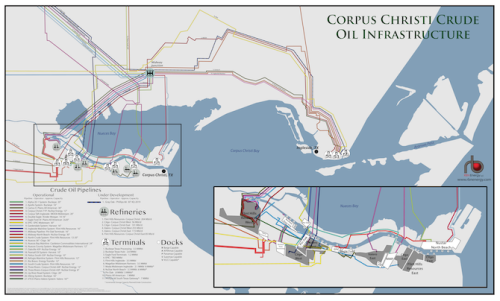
Gain insight and clarity into one of the United States’ most strategic Crude Oil Export Markets with RBN Energy’s Corpus Christi Crude Oil Infrastructure wall map.
Enbridge has been under increasing pressure from environmental groups to shut Line 5 since 2010 (see Tunnel of Crude), when a rupture on the company’s Line 78 (formerly Line 6B, neon-green line in Figure 1) across southern Michigan resulted in a major oil spill into a tributary of the Kalamazoo River. In recent years, Enbridge had been working with Michigan state officials on steps to help minimize the risk of a rupture on Line 5, especially the underwater section at the Straits of Mackinac. In November 2017, Enbridge and the state agreed that the midstream company would replace the Line 5 section under the St. Clair River (between Michigan and Ontario) as soon as permits for the project are in hand. (Canada National Energy Board, or NEB, approved plans for the project last Friday, July 12.) The company and state also committed to completing a detailed analysis of options for replacing the pipe’s Straits of Mackinac section, and to taking a series of steps to ensure the safe operation in the interim — including a plan under which Enbridge will temporarily shut down the straits portion of Line 5 during sustained periods of adverse weather (waves eight feet or higher).
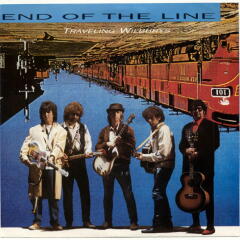
About the song
"End of the Line" was written by George Harrison, along with fellow Traveling Wilburys Bob Dylan, Tom Petty, Jeff Lynne and Roy Orbison. It was the final cut on their debut album, Traveling Wilburys Vol. 1, and the second single from the album, released in January 1989. Personnel on the record were: George Harrison (lead and backing vocals, acoustic and electric guitars, slide guitar), Tom Petty (lead and backing vocals, bass, acoustic guitar), Jeff Lynne (lead and backing vocals, acoustic and electric guitars), Roy Orbison (lead and backing vocals, acoustic guitar), Bob Dylan (lead and backing vocals) and Jim Keltner (drums). The video for "End of the Line" featured the Wilburys traveling on a train, with Roy Orbison's guitar shown rocking in a chair during his vocal parts as a tribute to Orbison, who died suddenly in December 1988, before the video was made.
Traveling Wilburys Vol. 1 was the debut album of American/British supergroup the Traveling Wilburys. Formed in Los Angeles in April 1988, the group included George Harrison, Bob Dylan, Tom Petty, Roy Orbison, and Jeff Lynne. Produced by Otis Wilbury (Jeff Lynne) and Nelson Wilbury (George Harrison), the album was recorded in the spring of 1988 at Dave Stewart Studios and Lucky Studios in Los Angeles, and Harrison's FPSHOT studio at Friar Park in England. It was released in October 1988, and went to #3 on the Billboard Top 200 Albums chart. The album won a Grammy Award for Best Rock Performance by a Duo or Group. The surviving members of the Traveling Wilburys made a second album — humorously entitled Traveling Wilburys Vol. 3 — which they released in October 1990. It went to #9 on the Billboard Top 200 Albums chart. No follow-up albums were released after this one, and the Traveling Wilburys never toured as a group. George Harrison passed away in 2001, and Tom Petty in 2017. A box-set collection of the two albums, including a DVD, was released by the Harrison estate in 2007. Bob Dylan still records and tours as a solo artist, as does Jeff Lynne with Jeff Lynne's ELO, a successor to the old Electric Light Orchestra, which Lynne had helped to form in 1970.