After a roughly three-year wait for a critical state permit, Enbridge’s Great Lakes Tunnel and Pipe Replacement project for its Line 5 pipeline across the Straits of Mackinac in Michigan has taken a step forward. The Army Corps of Engineers’ permits for the tunnel project would seem to be the only major obstacle standing in the way of construction, but there may well be more challenges ahead. Like a few other oil and gas projects — namely, Mountain Valley Pipeline (MVP) and Dakota Access Pipeline (DAPL) — Line 5 has become entangled in controversy, including local opposition worried that a spill would irreparably damage their surroundings and spoil the state’s natural resources. In today’s RBN blog, we take a closer look at the Line 5 project, its next steps, and the opposition it continues to encounter.
Visualize the infrastructure behind U.S. NGL movement.
The U.S. NGLs Map provides a comprehensive view of the transport, processing, and export networks moving NGLs across the U.S.
In operation for some seven decades, the 645-mile Line 5 (green-edged yellow line in Figure 1 below) can haul up to 540 Mb/d of light crude and NGLs like propane from Canada (with some volumes coming from the Bakken). It’s part of Enbridge’s sprawling Mainline/Lakehead system, which supplies liquids, either directly or indirectly, to refineries and petrochemical plants in Eastern Canada and the U.S. Midwest to make an array of consumer fuels and other products. Line 5 was built to remove oil-carrying tanker traffic from the Great Lakes and Enbridge says the system has averted the need for thousands of tanker trucks and hundreds of rail cars that would otherwise have to traverse Michigan to reach their destinations.
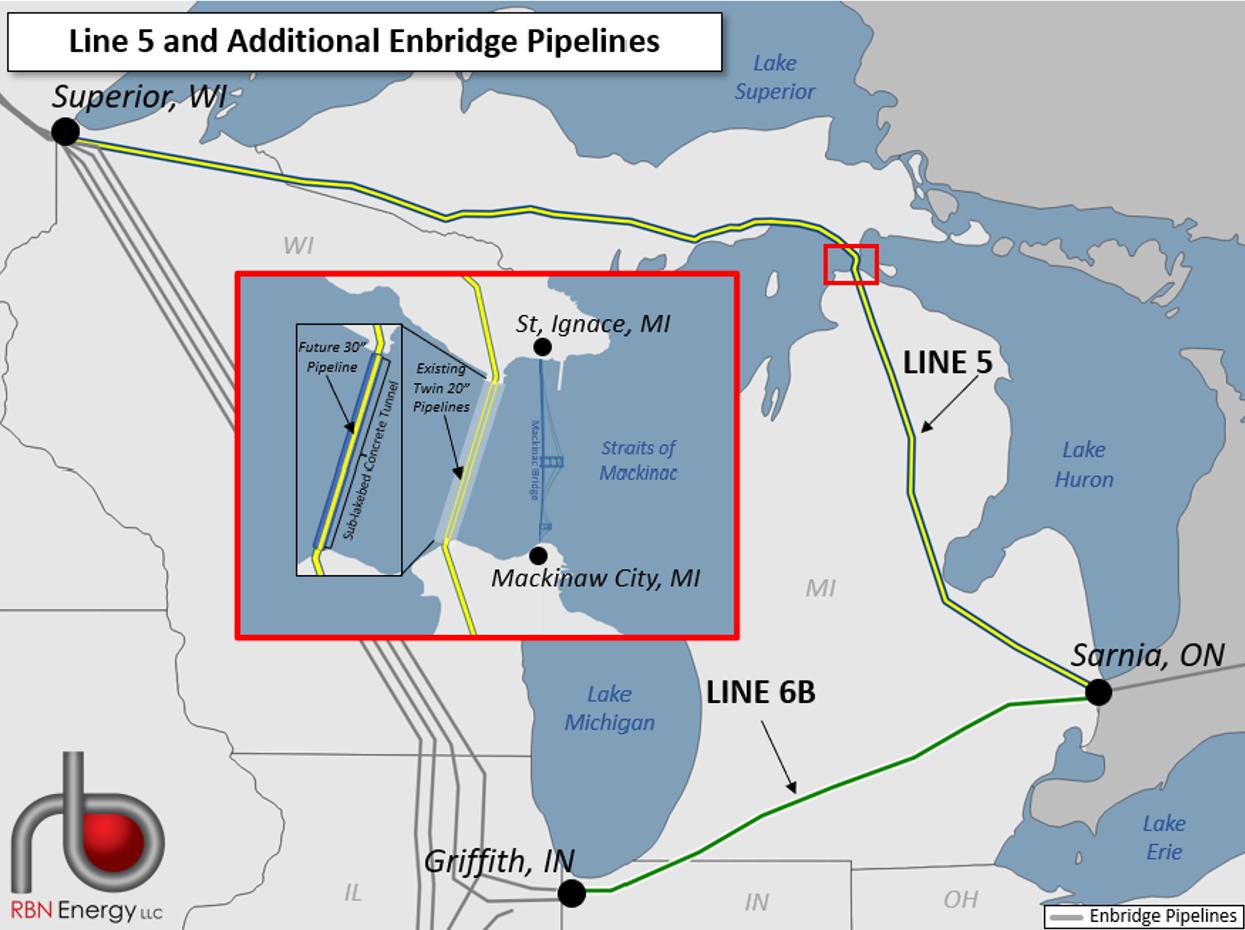
Figure 1. Enbridge’s Line 5 Stretches from Superior, WI, to Sarnia, ON. Source: RBN
About the song
“Down to the Waterline” was written by Mark Knopfler and appears as the first song on side one of Dire Straits’ debut album, Dire Straits. It was released as the B-side of “Water of Love” in October 1978. The lyrics describe Knopfler's memories of walking with his teenage girlfriend along the River Tyne. Personnel on the record were: Mark Knopfler (lead vocal, lead, rhythm guitar), David Knopfler (rhythm guitar, backing vocals), John Illsey (bass, backing vocals), and Pick Withers (drums).
The album, Dire Straits, was recorded in February and March 1978 at Basing Street in London with Muff Winwood producing. Released in October 1978, it went to #2 on the Billboard Hot 100 Albums chart and has been certified 2x platinum by the Recording Industry Association of America. Two singles were released from the LP.
Dire Straits was a British rock band formed in London in 1977 by Mark Knopfler, David Knopfler, John Illsley and Pick Withers. The band was active from 1977 to 1980 and again from 1990 to 1995 before splitting up for the second and final time. Their first single, the J.J. Cale guitar-influenced “Sultans of Swing,” helped break the band into the mainstream, reaching the Top 10 in the UK and U.S. They released six studio albums, three live albums, two EPs, and 23 singles, selling over 100 million records worldwide. They won three Brit Awards, four Grammy Awards and two MTV Video Music Awards and were inducted into the Rock and Roll Hall of Fame in 2018. Mark Knopfler continues to record and perform as a successful solo artist. He has released nine studio albums, two compilation albums, 22 soundtrack albums, two EPs, and 22 singles.