Last week, Hurricane Delta became the latest of a string of hurricanes and tropical storms that have assaulted the Gulf Coast this year and disrupted energy production in the Gulf of Mexico — and energy exports. A number of major storms made direct hits or glancing blows to crude export centers like Corpus Christi, Houston, Beaumont, and Louisiana, forcing marine terminals to either slow down their carrier-loading operations or shut down for a few days at a time. That led to a yo-yoing of weekly export volumes: way down one week, way up the next. Despite the short-term dislocations, however, total export volumes since the hurricane season started on June 1 are actually up slightly from the first five months of 2020, a testament to the resilience not only of the export market but to the marine terminals themselves. Today, we discuss how hurricanes and tropical storms have been affecting export-terminal activity.
There is no denying that 2020 has been a brutal year for U.S. crude oil producers. As we chronicle each week in RBN’s Crude Oil Gusher report, the U.S. was producing about 13 MMb/d during the first three months of this year — all-time-record volumes, and 30% more than the Pre-Shale Revolution peak back in 1970. But, as we know all too well, then came COVID-19, stay-at-home orders, demand destruction, E&P capital-spending cuts, and a production pullback the likes of which the U.S. had never seen. U.S. crude oil production now stands at about 10.5 MMb/d, or 20% below the first-quarter peak — in fact, it has been below 11 MMb/d for all but a few weeks since May, and RBN expects production to remain close to current levels through the end of this year and into 2021. The Permian — the U.S.’s premier production area — hasn’t been faring much better than the U.S. as a whole. Readers of our Crude Oil Permian report will know that the basin’s production peaked at 4.79 MMb/d in March, then plummeted by 15% to 4.06 MMb/d in May; since then, production has stayed close to flat, averaging 4.15 Mb/d over the past three months.

Crude Oil TradeView provides up-to-date data and insights into the behavior of differentials for 33 crude assessments across North America. Each week, it also walks you through the reasoning of why differentials widen, narrow, flip (premium vs. discount), or blow out.
Even the offshore Gulf of Mexico (GOM), which is normally viewed as a steady-as-she-goes crude oil producer, has experienced more than its share of volatility this year, but only partly due to COVID-19 and its effects. GOM production, which topped 2 MMb/d for the first time ever in August 2019, dropped by 300 Mb/d, or 16%, from March to April of this year as producers shut down wells in response to sharply lower oil prices. The first major cyclone to affect offshore production was Tropical Storm Cristobal, which caused 34% of production to be taken offline. Then, in late August, more than 80% of GOM production was shut down in anticipation of Hurricane Laura (dashed red line in Figure 1). Following Laura, storms continued to batter the Gulf Coast with named storms running through all the letters of the alphabet and breaking into the Greeks. Last week, Hurricane Delta became the 10th named storm to make landfall this season, breaking a record set more than a century ago, in 1916. And Delta was a doozy for the oil patch. More than 90% of GOM production was closed up in advance of the hurricane. (By yesterday, 24% of GOM production was still offline, according to the U.S. Bureau of Safety and Environmental Enforcement (BSEE) — just to pile on, it seems, the coronavirus also plays a role here, as mandatory quarantine measures designed to protect workers create logistical challenges in re-staffing those offshore rigs.)
About the song
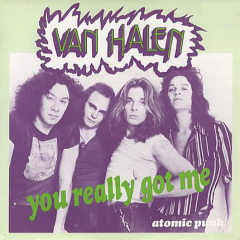
"You Really Got Me" was written by Ray Davies, and was the third single released by his band, The Kinks. The song went to #7 on the Billboard Hot 100 Singles chart when it was released in 1964. It was covered by Van Halen, and appears as the third song on the first side of their debut album, Van Halen. The album, which was released in February 1978, starts off with "Runnin' with the Devil," featuring an original sound like no one else out there at that time. Next is "Eruption," an almost two-minute guitar instrumental tour de force by Eddie Van Halen that let guitar players everywhere know that the game had changed. "Eruption" segues into Van Halen's cover of "You Really Got Me," a heavier version of a song that was very heavy for when it was released by The Kinks 14 years earlier. Released as the first single from Van Halen's album, the song went to #36 on the Billboard Hot 100 Singles chart. Personnel on the record were: David Lee Roth (lead vocals), Eddie Van Halen (guitar, backing vocals), Michael Anthony (bass, backing vocals), and Alex Van Halen (drums).
Van Halen was recorded between August and October 1977 at Sunset Sound Recorders in Hollywood, with Ted Templeman producing. The album went to #19 on the Billboard Top 200 Albums chart. It has been certified Diamond (over ten million copies sold) by the Recording Industry Association of America. Five singles were released from the LP.
Van Halen was an American rock band formed in Pasadena, CA, in 1972. Eight members have passed through its ranks, with Eddie and Alex Van Halen being the members in the band for the full ride. Gene Simmons from KISS discovered the band, and financed their first demo, which was played repeatedly on Los Angeles DJ/scenester Rodney Bingenheimer's radio show in LA. Warner Brothers Records head Mo Ostin, along with producer Ted Templeman, saw the band at the Starwood in Hollywood in 1977, and signed them to a deal with Warner Brothers.
Two guitarists were setting the LA clubs on fire in the mid-1970s with their flamboyant use of the whammy bar and right-hand tapping technique. They were Eddie Van Halen, and Randy Rhoads, who the general public would become aware of in 1980 as the guitarist on Ozzy Osbourne's debut solo album, Blizzard of Oz.
Van Halen released 12 studio albums, two live albums, two compilation albums, and 56 singles. They have sold over 80 million records worldwide; have won one American Music Award, one Grammy Award, four MTV Video Music Awards; and are members of the Rock and Roll Hall of Fame. Eddie Van Halen passed away in October 2020 at the age of 65.