


As the world economy tries to dust itself off after COVID, increased demand for transportation fuels coupled with tight supplies has become a pain. The shortage escalated to crisis levels this spring and summer when, in response to Russia’s invasion of Ukraine, sanctions eliminated Russian exports of crude oil and intermediate feedstocks to the U.S. and severely reduced flows to Europe. While Russia has been able to find some alternate markets, its overall product exports are down significantly. Adding to these product-supply reductions are policy decisions by Putin’s allies in China to reduce their product exports to a trickle. Chinese exports had been an important part of regional supply in recent years, but authorities there have decided to decrease the number and size of export quotas issued, leaving many refineries in China operating at rates well below their capabilities. In today’s RBN blog, we take a closer look at how developments in Russia and China have played a major role in the current global shortage of refined products.

The Future of Fuels bi-annual report by RBN's Refined Fuels Analytics provides an in-depth analysis of the U.S. and global refinery industries, focusing on crude oil and fuel market dynamics, supply and demand, alternative fuels, refinery capacities, and price forecasts to help stakeholders navigate the evolving energy landscape.
In recent blogs we have discussed a number of factors that have led to the ongoing global tightness in refined products supply: U.S. refinery shutdowns, refinery closures elsewhere in the world, and IMO 2020 impacts. And as we said at the outset, developments in Russia and China –– the U.S. and Europe's primary geopolitical opponents — are only adding to these pressures. Russia has long been a significant exporter of finished refined products (mostly diesel) and intermediates (vacuum gasoil, naphtha, and resid/fuel oil). While Europe has been the primary destination for most of the finished products and also an important consumer of intermediates, Russian VGO and resid had grown to be an important source of feedstock for a number of U.S. refineries as well.
If you weren’t aware of Europe’s dependency on Russia for its energy needs prior to March of this year, you probably are now. We’ve previously discussed the impact of the loss of Russian natural gas (see Everything Has Changed). As far as crude oil goes, in 2018, Russia shipped around 1 MMb/d directly to Europe (excluding the Commonwealth of Independent States, or CIS, which includes eight countries that, with Russia, used to be part of the USSR) via the Druzhba pipeline before flows were reduced in 2019 due to a contamination issue and in 2020 and 2021 due to COVID. Russia expected Druzhba pipeline exports to again exceed 900 Mb/d this year, but actual exports will undoubtedly be much lower (likely in the neighborhood of an annual average of 400-600 Mb/d) due to the impact of sanctions as well as Western companies deciding to self-sanction. Russia used to export another 1.5 MMb/d to 2 MMb/d of crude oil via waterborne routes to Europe (again, excluding CIS countries) prior to the onset of the pandemic. These waterborne exports were easy to quickly reroute to other countries (mostly India and China), but rerouting the Druzhba flows was a bit more difficult.
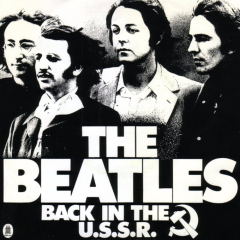
About the song
“Back in the USSR” was written by Paul McCartney and attributed to the songwriting team of Lennon-McCartney. It appears as the first song on side one on The Beatles’ ninth studio album, the double album The Beatles (also known as “The White Album”). The song parodies Chuck Berry’s “Back in the USA” and also gives a nod to The Beach Boys’ “California Girls.” The song was recorded as a three-piece since Ringo Starr had temporarily left the band due to tensions in the studio while recording the album. It was recorded at EMI Studios in London in August 1968. Personnel on the record were: Paul McCartney (lead, backing vocals, piano, bass, drums, lead guitar, percussion), John Lennon (backing vocals, rhythm guitar, six-string bass, drums, percussion), and George Harrison (backing vocals, rhythm, lead guitar, bass, drums, percussion).
The Beatles was recorded between May and October 1968 at EMI Studios in London, with George Martin producing. Released in November 1968, it went to #1 on the Billboard 200 Albums chart and has been certified 24x Platinum by the Recording Industry Association of America. The first approximately 5 million copies of the LP had “The Beatles” embossed on the front cover and had a serial number. Ringo Starr's personal copy of the record with serial number 0000001 sold for $790,000 at auction. No singles were released from The Beatles in the U.K. or the U.S.
The Beatles were an English rock band formed in Liverpool in 1960. With John Lennon, Paul McCartney, George Harrison and Ringo Starr, the band came to be regarded as the most influential band in history — one that changed the culture of the Western world. They released 17 studio albums, six live albums, 54 compilation albums, 36 EPs and 63 singles and have sold over 600 million records worldwide. The Beatles starred in four motion pictures and won one Academy Award, four Brit Awards, seven Grammy Awards, 15 Ivor Novello Awards and three World Music Awards. They are members of the Rock and Roll Hall of Fame as a band and individually, as well as the UK Music Hall of Fame, the Vocal Group Hall of Fame and the Grammy Hall of Fame, and have a Grammy Lifetime Achievement Award. They received MBEs from Queen Elizabeth II in 1965. The Beatles broke up in 1970. All members of The Beatles went on to have successful solo careers. John Lennon was shot dead in December 1980, and George Harrison died in November 2001. Paul McCartney and Ringo Starr continue to record and tour as solo artists.





Comments
Thanks for this Robert, full of useful information and insights as always. 2 questions about India: what is the reason for their new excise taxes? How might these taxes affect the supply of fuel or fuel blendstocks in the US?