Production cuts by Saudi Arabia and other OPEC producers have had a profound effect on Asian refiners’ crude oil procurement by opening the door to more U.S., Canadian and North Sea crude deliveries to the Far East and South Asia. Of the four major Asian refining countries, China has seen the largest drop in imports of East of Suez crude, which includes oil produced in the Middle East, the Asia-Pacific region, Australasia and far-east Russia, but India, Japan and South Korea have experienced declines as well. What’s going on? And what does it mean for Atlantic Basin crude producers? Today, we discuss recent changes in global crude price differentials and Asian crude import slates, which include more imports from the U.S.
OPEC and 10 non-OPEC (NOPEC) countries are now in the eighth month of crude oil production cuts aimed at bringing worldwide oil supply and demand into balance and, of course, at helping to prop up crude prices (see Won’t Get Fooled Again for more on the initial six-month agreement, which has since been extended). Producer compliance with the production cuts hasn’t been perfect — according to the latest International Energy Agency (IEA) data, OPEC compliance slipped to 78% in June from 95% in May, while NOPEC compliance edged up to 82% — and rising production in U.S. shale plays has partially offset the effect of OPEC/NOPEC cuts on the global supply/demand balance. But crude prices haven’t tanked and in fact are generally within a buck or two of $50/bbl (all in U.S. dollars), depending on the benchmark. Not bad, considering where prices could be if global supply were far higher.

This blog was written by FGE’s Den Syahril Mohamed. FGE is a preeminent global oil and gas consultancy which provides leading independent research, analysis, consultation, and advisory services to a large and diverse client base across the world. In 2015, FGE and RBN formed a strategic alliance to expand the client and consulting services of both companies. FGE is based in London and operates offices in Singapore, Tokyo, Beijing, Dubai, Hawaii, and has satellite offices in California and Mumbai.
OPEC and NOPEC production cuts have also been affecting crude oil sourcing by Asian refiners. To varying degrees, the four largest refining countries in Asia — China, India, Japan and South Korea — traditionally have been heavily reliant on East of Suez crude, and particularly on crude from the Middle East. Production cuts have underpinned strong Dubai crude pricing (the Persian Gulf benchmark crude price) and tightened heavy crude supplies to Asia. The dated Brent/Dubai price differential has stayed below $1/bbl for almost all of this year (2017; blue line in Figure 1), providing attractive economics for shipping Atlantic Basin crudes to Asia.
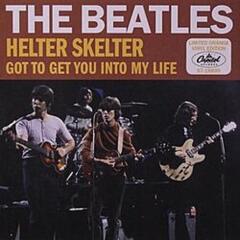
About the song
“Helter Skelter” was written by Paul McCartney and credited to Lennon-McCartney. It appears as the sixth song on side three of The Beatles’ ninth studio album, The Beatles, commonly referred to as “the White Album.” McCartney intended to write a song as heavy and loud as possible. He was inspired by The Who’s 1967 single, “I Can See for Miles.” He succeeded in producing a song that preceded heavy metal. The song has been covered by artists such as Motley Crue, Siouxsie & the Banshees, Aerosmith, and Oasis. Charles Manson felt the song held a message of impending apocalypse, when in fact it was written about a British fairgrounds attraction ride. Personnel on the record were: Paul McCartney (lead vocals, lead guitar), John Lennon (six-string bass), George Harrison (guitar, guitar slides), Ringo Starr (drums; “I’ve got blisters on my fingers” shout at the end).
The Beatles (White Album) was recorded at Abbey Road and Trident studios in London between May and October 1968. The double LP was produced by George Martin and released in November 1968. It went to #1 on the Billboard 200 Albums chart and has been certified 24X Platinum by the Recording Industry Association of America. No singles were released from the LP.
The Beatles were an English rock band formed in Liverpool in 1960. The core lineup of John Lennon, Paul McCartney, George Harrison and Ringo Starr would go on to change the direction of modern music and pop culture. They released 17 studio albums, five live albums, 52 compilation albums, 36 EPs and 63 singles and have sold more than 600 million records worldwide. They have won an Academy Award, seven Grammy Awards, 15 Ivor Novello Awards and a Lifetime Achievement Grammy Award and are members of the Rock and Roll Hall of Fame as a group and individually. In 1965, Queen Elizabeth II appointed each member an MBE. Paul McCartney and Ringo Starr have been knighted. The Beatles were featured in four motion pictures and 10 documentaries. John Lennon was assassinated in 1980 and George Harrison died in 2001. Paul McCartney and Ringo Starr continue to record and tour as solo artists. Paul McCartney will be on his Got Back Tour in the U.S. and Canada this fall and Ringo Starr will be on his Ringo Starr and His All Starr Band Tour in the U.S. in September.