LPG export terminals along the Gulf Coast account for more than nine of every 10 barrels of propane and normal butane that are shipped from the U.S. to foreign buyers. That makes perfect sense, given the terminals’ proximity to major NGL production areas like the Permian, the Eagle Ford and SCOOP/STACK, and to the world-class fractionation hub in Mont Belvieu, TX. But, increasingly, LPG terminals on the East and West coasts, are growing in significance. On the Atlantic side, Marcus Hook, near Philadelphia, is enabling more and more volumes of Marcellus/Utica-sourced propane and butane to reach overseas markets. And, as we discuss in today’s blog, West Coast exports are on the rise as well, with Petrogas’s Ferndale terminal in Washington state providing a straight shot across the Pacific to Asia for propane and butane fractionated in Western Canada, plus a good bit more LPG export capacity under development in British Columbia.
This is the fourth and final episode in this series on rising LPG export volumes and the race to develop new export terminal capacity to handle still-higher volumes of propane and normal butane — two NGL purity products generally referred to as LPG — into the early 2020s. We set the stage in Part 1, where we noted that the U.S. flipped from being a net importer to a net exporter of LPG in 2012, and that waterborne LPG exports subsequently soared to more than 1.1 MMb/d (in 2018). The vast majority of those volumes — about 92% of last year’s total — are being sent out of the half-dozen LPG terminals in coastal Texas and Louisiana. The rest of the exports-by-ship are flowing through a total of three smaller terminals in the Mid-Atlantic region and Pacific Northwest. We concluded Part 1 with a review of the Gulf Coast’s — and the U.S.’s — largest LPG export facility: the Enterprise Hydrocarbon Terminal (EHT), which is located on the Houston Ship Channel and whose capacity is in the midst of being expanded to 720 Mb/d from the current 545 Mb/d. According to our NGL Voyager report, EHT sent out an average of 447 Mb/d of LPG last year, or about 40% of total U.S. LPG exports by ship.
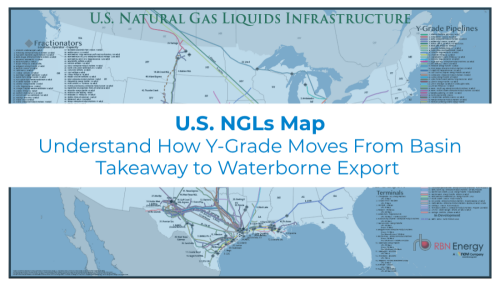
Visualize the infrastructure behind U.S. NGL movement.
The U.S. NGLs Map provides a comprehensive view of the transport, processing, and export networks moving NGLs across the U.S.
In Part 2, we looked at the three other large Gulf Coast LPG export terminals: Targa Resources’ Galena Park Marine Terminal, also along the Houston Ship Channel, Phillips 66’s Freeport LPG Export Terminal down the coast in Freeport, TX, and Energy Transfer’s export facility in Nederland, TX. These facilities sent out a total of 578 Mb/d on average in 2018, including 233 Mb/d from Galena Park, 173 Mb/d from Freeport and 172 Mb/d from Nederland. Part 3 discussed four smaller LPG export terminals: two along the Gulf Coast and two in the Mid-Atlantic region. The busiest of these, with 2018 export volumes averaging about 60 Mb/d, is Energy Transfer’s Marcus Hook Industrial Complex near Philadelphia, which is located at the terminus of the company’s newly expanded Mariner East NGL pipeline system.

About the song
"Between the Devil and the Deep Blue Sea" was written by Harold Arlen (music) and Ted Koehler (lyrics) in 1931. It was first performed at the Cotton Club show "Rhythmania" in 1931. Cab Calloway released the first recording of the song, also in 1931. Many artists have recorded the tune over the years, including Louis Armstrong, Bing Crosby, Peggy Lee, Ella Fitzgerald and George Harrison. It was most recently featured in the 2013 Broadway show "After Midnight."
George Harrison's version appeared as the 10th cut on his 2002 album, Brainwashed. It was Harrison's 12th and final studio solo album, released posthumously in November 2002, almost a year after his passing at the age of 58. It was the only song on the album not penned by Harrison. The primary personnel on Brainwashed were George Harrison, his close friend Jeff Lynne, his son Dhani Harrison, and long-time drummer and friend Jim Keltner. The record was produced by George and Dhani Harrison, and Jeff Lynne. It made it to #18 on the Billboard Top 200 Albums chart, and was certified gold by the Recording Industry Association of America.
George Harrison was an English musician, singer-songwriter, and music and film producer who achieved worldwide fame and success as a member of the Beatles.