LPG exports out of Gulf Coast marine terminals averaged 1 MMb/d in 2018, a gain of 12% from 2017 and 35% from 2016. And, with U.S. NGL production rising steadily, 2019 is looking to be another banner year for LPG shipments to overseas buyers. The increasing volume of propane and normal butane — the NGL purity products generally referenced as LPG — is filling up the existing export capacity of the Gulf Coast’s six LPG terminals and spurring the development of a number of expansion projects. Today, we continue our blog series on propane and butane export facilities along the Gulf, West and East coasts, and what’s driving the build-out of these assets.
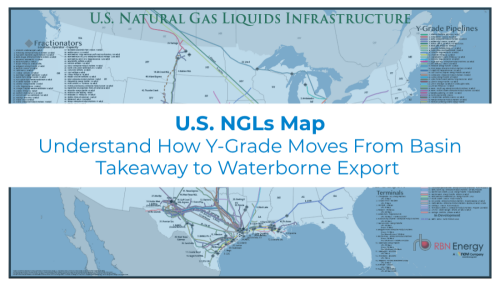
Visualize the infrastructure behind U.S. NGL movement.
The U.S. NGLs Map provides a comprehensive view of the transport, processing, and export networks moving NGLs across the U.S.
As we said in Part 1, the U.S. flipped from being a net LPG importer to a net exporter seven years ago, in 2012. Since then, exports by ship have skyrocketed to more than 1.1 MMb/d in 2018, with the vast majority of that volume (about 92%, as of year-end 2018) being sent out of the half-dozen LPG terminals in coastal Texas and Louisiana. The rest of the exports-by-ship are flowing through either the Ferndale terminal in Washington State (red dot and lettering in Figure 1), the Marcus Hook facility near Philadelphia (green dot and lettering) or DCP Midstream’s Chesapeake terminal in Virginia (light blue dot and lettering). In the initial blog in this series, we also noted that the bulk of U.S. LPG exports have been bound for Asia and Latin America, with smaller but still-significant volumes sent to Europe, Africa and the Caribbean. We concluded Part 1 with a review of the Gulf Coast’s — and the U.S.’s — largest LPG export facility: the Enterprise Hydrocarbon Terminal (EHT; dark blue dot and lettering) on the Houston Ship Channel, whose capacity is in the midst of being expanded to 720 Mb/d from the current 545 Mb/d. EHT, which can also handle a number of other energy commodities, is connected by several pipelines to Enterprise Products Partners’ NGL fractionation and storage complex at Mont Belvieu; Enterprise owns all or part of nine existing fractionators (combined capacity, 755 Mb/d) at the hub and is building 300 Mb/d of additional fractionation capacity there that will come online in the first half of 2020.
About the song
"Between the Devil and the Deep Blue Sea" was written by Harold Arlen (music) and Ted Koehler (lyrics) in 1931. It was first performed at the Cotton Club show "Rhythmania" in 1931. Cab Calloway released the first recording of the song, also in 1931. Many artists have recorded the tune over the years, including Louis Armstrong, Bing Crosby, Peggy Lee, Ella Fitzgerald and George Harrison. It was most recently featured in the 2013 Broadway show "After Midnight."
George Harrison's version appeared as the 10th cut on his 2002 album, Brainwashed. It was Harrison's 12th and final studio solo album, released posthumously in November 2002, almost a year after his passing at the age of 58. It was the only song on the album not penned by Harrison. The primary personnel on Brainwashed were George Harrison, his close friend Jeff Lynne, his son Dhani Harrison, and long-time drummer and friend Jim Keltner. The record was produced by George and Dhani Harrison, and Jeff Lynne. It made it to #18 on the Billboard Top 200 Albums chart, and was certified gold by the Recording Industry Association of America.
George Harrison was an English musician, singer-songwriter, and music and film producer who achieved worldwide fame and success as a member of the Beatles.