Last month the Energy Information Administration (EIA) debuted a new monthly report detailing oil and gas drilling productivity in six of the largest US production basins. Rather than just being an “after the fact” report telling us what happened in the past, the new report provides a forecast of oil and gas production for the current and next month out in each of the six basins. The initial report indicates that oil production will increase by roughly 60 Mb/d in these basins during November with gas production increasing by 0.4 Bcf/d. The report also highlights continued improvement in rig productivity. Today we begin a series interpreting the new drilling rig productivity data.
We have previously described rapidly increasing US natural gas production from shale (see Golden Years) as well as oil production from shale and other tight resources (see Charge of the Light Brigade). Recent U.S. crude and gas growth has centered largely in a few key regions and has been driven by advances in the application of horizontal drilling and hydraulic fracturing technologies (see Tales of the Tight Sands Laterals). The growth in production has been accompanied by improvements in drilling productivity - described in our six part series on drilling economics (see The Truth is Out There). In fact drilling productivity is driving domestic production to such an extent that the EIA has developed a new approach to measuring it.
The EIA Drilling Productivity Report (DPR) provides region-specific insights into rig efficiency, new well productivity, decline rates at previously existing wells, and overall production trends. The report covers six regions (see map below). In 2011-12, these six regions accounted for 90 percent of domestic oil production growth and virtually all domestic natural gas production growth.
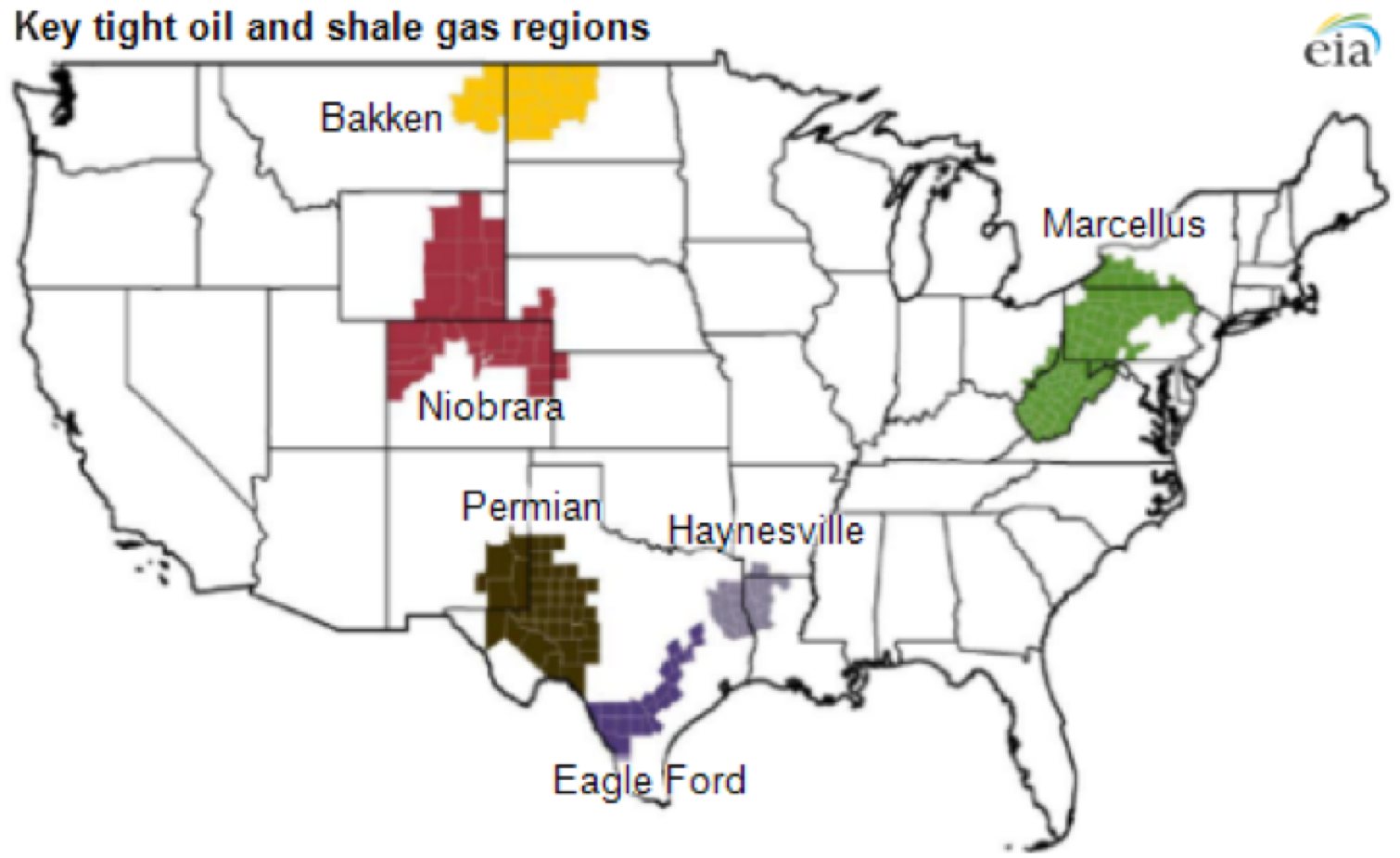
Source: EIA
The DPR estimates the current rate of growth or decline in production in each of these basins based on a number of indicators. These include the active rig count, drilling efficiency as well as the productivity of new wells, and production and depletion trends for previously producing wells. The data is intended to be more informative than traditional indicators such as simple oil and gas rig counts. The report also estimates rig productivity - a new measure that EIA has developed to better reflect continuing improvements in drilling rig efficiency. The rig productivity measure starts with an estimate of crude and natural gas output from new wells in a region during their first month in production. The rig productivity (calculated separately for oil and for gas) is the new well output divided by the number of drilling rigs in the region.
We will look at some of the regional data in the report in future episodes in this series but this time we have compiled two tables that summarize the production and rig productivity data provided in the report.
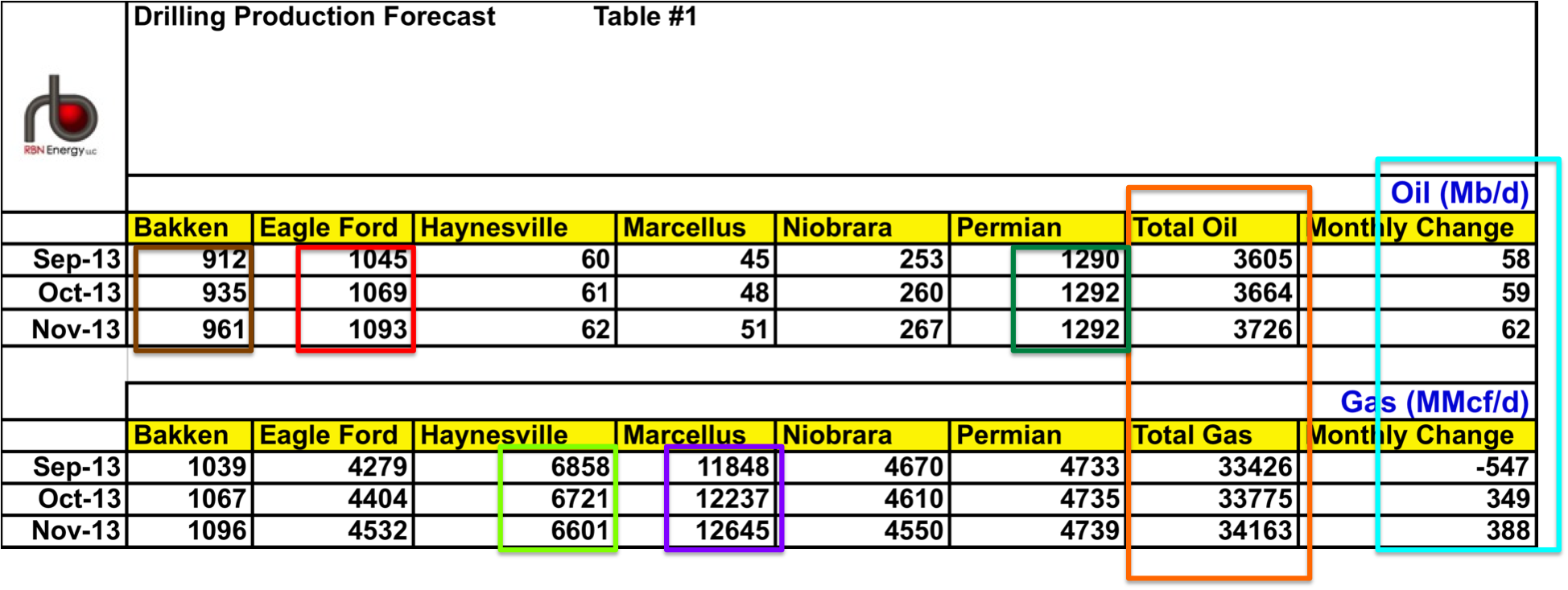
Table #1 below shows a summary of the production forecast data in the initial report for October 2013. The table is divided into two parts – the top half is for oil and the bottom half is for gas. Taking the oil data first, there are 8 column headings – one each for the production basins, a total column (orange box) and a monthly change column (light blue box). For each basin the table has three months worth of data extracted from the DPR. The data shows estimated monthly oil production in Mb/d for each basin that the EIA forecast. The forecast is based on prior month well data published by State agencies, current and prior month well drilling counts and average production from new and existing wells. Because production data reported by states can be significantly lagged, DPR uses rig count data along with trends in drilling productivity to make estimates of oil and gas production where data are not yet available. Since existing EIA monthly production reports have a three month lag the information in the DPR is more current than previously available – although likely subject to adjustment. The DPR provides history back to 2007.
Source: EIA and RBN Energy
The oil data shows that production in the Eagle Ford basin (red box) is expanding at a rate of over 25 Mb/d per month from 1045 Mb/d in September 2013 to 1093 Mb/d in November with Bakken production (brown box) expanding at similar rates, while the Permian basin is expanding more slowly (2 Mb/d per month – green box). The overall six-basin production estimate for November 2013 is 3.7 MMb/d (Total Oil column in the table) representing more than 50 percent of the latest published EIA total US crude production of ~7.5 MMb/d (July 2013). In the final column of the table we show the forecast monthly change in total production for all six basins, which is around 60 Mb/d for the latest three months in the DPR.

About the song
“(Your Love Keeps Lifting Me) Higher and Higher” was written by Gary Jackson and Carl Smith. It was recorded at Columbia Studio in Chicago in June 1967, with Jackie Wilson's vocals being recorded in a single take. The Carl Davis produced record was released as a single by Wilson in August 1967 and went to #1 on the Billboard R&B and #6 on the Hot 100 charts. The song was inducted into the Grammy Hall of Fame in 1999. It has been covered by several artists, with Rita Coolidge scoring a #2 on the Hot 100 in 1977. Bruce Springsteen and the E Street Band frequently use it in their live shows. A Jackie Wilson album titled Higher and Higher was released in November 1967 featuring the hit song. The album went to #26 on the Billboard R&B chart and #163 on the Billboard Top 200 Albums chart. Personnel on the record were: Jackie Wilson (lead vocals), James Jamerson (bass), Richard Allen, Maurice White (drums), Robert White (guitar), Johnny Griffith (keyboards), and The Andantes and Pat Lewis (background vocals).
Jackie Wilson (Jack Leroy Wilson Jr.) was an American soul singer and showman from Detroit. He was a tenor with a four-octave range. His voice and wild stage moves earned him the nickname “Mr. Excitement.” He released 25 studio albums, one live album, 10 compilation albums, and 78 singles. Wilson is a member of the Rock and Roll Hall of Fame, R&B Music Hall of Fame, and Michigan Rock and Roll Legends Hall of Fame. In September 1975, Wilson suffered a major heart attack on stage while singing his hit “Lonely Teardrops” at a Dick Clark rock and roll revue show. Lack of oxygen to the brain left him incapacitated and put in full-time care at the Medford Leas Retirement Center in Medford, NJ. Wilson died there in January 1984 at the age of 49. Motown founder Barry Gordy has stated that Wilson was “the greatest singer I've ever heard.”