


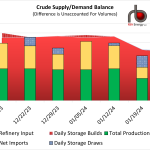
Most of the production that got knocked offline due to the previous week’s winter storm has come back online, recovering 700 Mb/d of the 1 MMb/d that was lost. However, refinery input continued to fall, losing an additional 430 Mb/d, for a drop of more than 1.8 MMb/d over the past two weeks. This is due to the recent winter-related outages having coincided with the start of the early maintenance season, with some refineries planning to come back online soon but a significant number expected to remain offline for several weeks. Finally, West Texas Intermediate (WTI) prices had a strong week, increasing from $73.25/bbl to $78.01/bbl, the largest weekly gain since October 2023.
Featured Articles


- Blog
Gimme Shelter - Wind, Flooding, Outages Add to Risks for Onshore Assets in Hurricane Season
Storms that form in the Gulf of Mexico (GOM) during hurricane season don’t just dissipate once they make landfall and can inflict havoc on onshore assets. Storm damage and flooding can delay plant restarts, but so can power outages, as we saw when Hurricane Beryl hit the Texas/Louisiana region in July. And while there were no major refining or production assets in the path of Hurricane Helene, which slammed into the Florida Panhandle on September 26, widespread damage illustrated the potential risk to onshore infrastructure. In today’s RBN blog, we will examine how hurricanes have disrupted onshore assets and explain why power restoration is often the Achilles’ heel in plans to resume normal operations.


- Blog
There's Floodin' Down in Texas - The Impact of Harvey on Crude Oil Markets
It has been a tragic week for the Gulf Coast, with months if not years of cleanup and rebuilding ahead of the region. But already, Houston, Corpus Christi, Port Arthur/Beaumont, Lake Charles and other affected areas are coming back online through the hard work of resilient Texans and Louisianans as well as aid coming in from across the country. And even though the energy industry is also moving quickly to put Hurricane Harvey in the rearview mirror, the damage and disruption have been extensive. It is still much too early to fully understand what has happened and how long the recovery is going to take. But with information that we can piece together from public statements, data analysis and conversations with knowledgeable market participants, it is possible to start developing an assessment of Harvey’s effects. That’s what we will tackle in today’s blog.


- Blog
Road to Nowhere, Part 2 - Oil Prices Have Moved Lower With SPR Releases, But Production Still Lags
The swift increases in crude oil and gasoline prices that followed Russia’s invasion of Ukraine in February — and the sanctions that were implemented soon thereafter — spurred a lot of concern that the U.S. and global economies would go into a tailspin. In response, government officials here and abroad turned to their strategic reserves as a way to quickly balance the market and rein in prices while buying time for additional oil production to come online. But U.S. production growth and rig activity have hit a wall since June, when releases from the Strategic Petroleum Reserve (SPR) started to pick up steam, reducing the prospects for a significant output increase this year. In today’s RBN blog, we examine the changes in the market since the major withdrawals were announced, how the hoped-for bridge to higher oil production has so far failed to materialize, and why it’s unlikely the government will turn to the SPR if prices spike again soon.
