China’s appetite for crude oil has been lower than expected this year, largely due to a slowing economy and the increased adoption of electric vehicles (EVs). And the U.S.’s #1 economic and geopolitical rival is in the midst of another transition that could further weaken crude oil demand: Heavy-duty trucking in China is increasingly being powered by LNG instead of diesel. In today’s RBN blog, we discuss the trend toward LNG-fueled trucking in China and what it could mean for LNG exporters in the U.S.

The Future of Fuels bi-annual report by RBN's Refined Fuels Analytics provides an in-depth analysis of the U.S. and global refinery industries, focusing on crude oil and fuel market dynamics, supply and demand, alternative fuels, refinery capacities, and price forecasts to help stakeholders navigate the evolving energy landscape.
In the first blog of this series, Trouble, we talked about how significant China’s oil demand has been for global markets for most of this century. However, the Chinese economy has been weakening for various reasons in recent years, including a crisis in its property market, which has caught up with its oil demand. The increased prevalence of EVs and high-speed rail has also put downward pressure on gasoline and jet fuel demand. Now, a slowdown in diesel consumption is at the forefront. Diesel has historically been a primary transportation fuel for trucks, trains, vessels and barges. It also fuels most equipment and vehicles used in construction and farming. Simply put, strong diesel demand has historically correlated with a country’s economic health.
China typically relies on local refineries for most of its diesel supply and is a net exporter. Diesel demand (black line and left axis in Figure 1 below) has recovered fully from the effects of the pandemic and has reached record levels, based on data from RBN’s Refined Fuels Analytics (RFA) practice. But while diesel demand is now approaching 4 MMb/d, annual growth rates (orange line and right axis) have slowed dramatically, the data shows, with 2024’s gain (dashed black oval) estimated at just 57 Mb/d, down from the record 427-Mb/d gain in 2023 (dashed green oval). Annual growth rates are expected to stagnate for the next several years, followed by actual declines in total demand by the early 2040s (right ends of black and orange lines). Why is this happening?
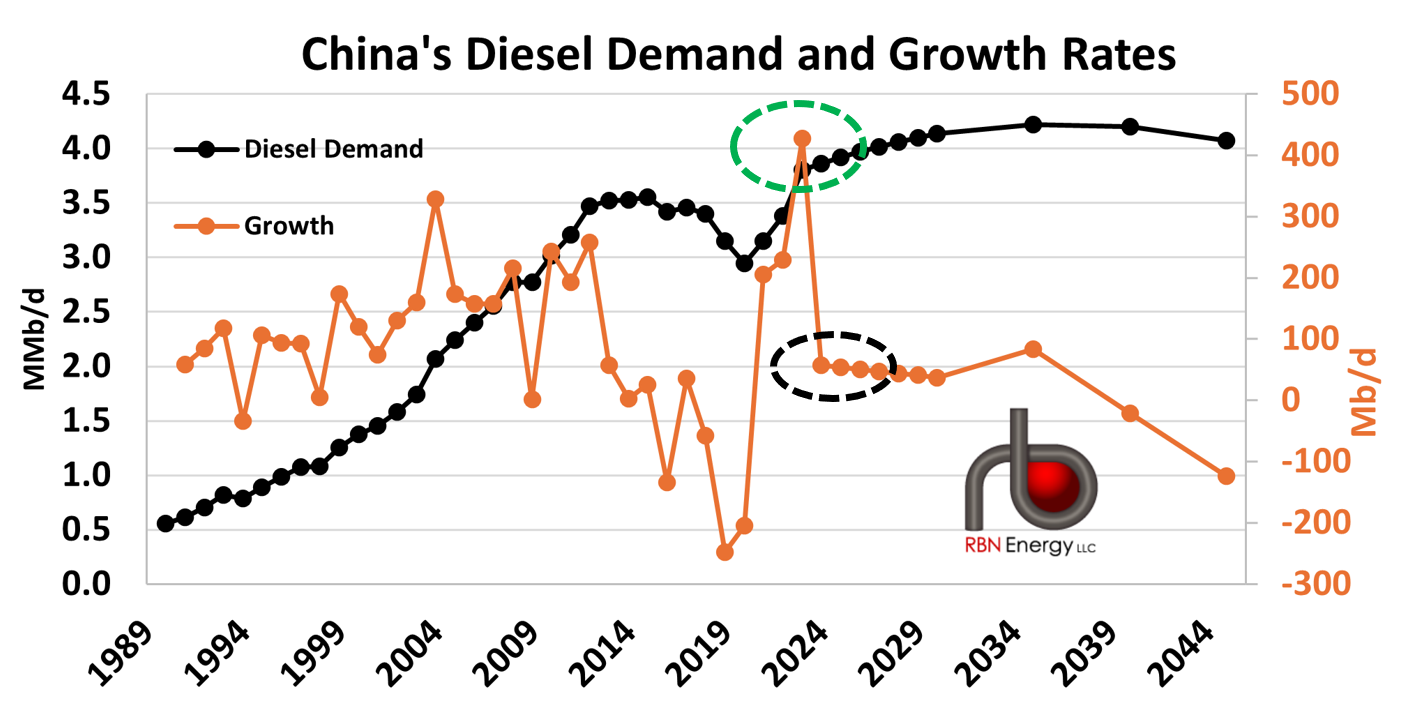
Figure 1. China’s Diesel Demand and Annual Growth Rates. Source: RBN’s Refined Fuels Analytics

About the song
James Van Heusen wrote the music for “High Hopes,” and Sammy Cahn wrote the lyrics. The song first appeared in the 1959 motion picture A Hole in the Head and was sung by Frank Sinatra and child actor Eddie Hodges. A single version of the song was recorded by Sinatra at Capitol Studio A in Hollywood in May 1959. It featured Sinatra with a children’s chorus and orchestral accompaniment provided and directed by Nelson Riddle. The credits on the label read “Frank Sinatra and a bunch of kids.” Released in June 1959, the single went to #30 on the Billboard Hot 100 Singles chart. Sammy Davis Jr. performed the song at the 32nd annual Academy Awards, where it won Best Original Song for its appearance in A Hole in the Head. The song became the theme for John F. Kennedy’s 1960 presidential campaign. Sinatra performed the song during Kennedy’s campaign run, adding the lyrics: “Everyone is voting for Jack, cause he’s got what all the rest lack. Everyone wants to back Jack, Jack is on the right track,” The song was included in the 1961 Sinatra album, All the Way.
The record’s personnel included Frank Sinatra (lead vocals), an uncredited children’s chorus, uncredited orchestra members, and Nelson Riddle (orchestrations and arrangements).
All the Way was recorded between May 1957 to September 1960. It was the fourth Capitol Records compilation album of Sinatra singles. It was released in April 1961. It featured Frank Sinatra on vocals and orchestrations and arrangements by Nelson Riddle. The collection was produced by Dave Cavanaugh.
Frank Sinatra was an American singer and actor known as the “Chairman of the Board” and “Ol’ Blue Eyes.” Sinatra had a remarkable career that spanned six decades. He started singing in clubs in his teens in the late 1930s and secured his first record deal with Columbia Records in 1943. He released 59 studio albums, two live albums, eight compilation albums, and 297 singles. He has sold more than 150 million records worldwide. He appeared in 63 motion pictures and numerous television shows. He received an Academy Award, 11 Grammy Awards, a Peabody Award, a Cecil B. DeMille Award, a Johnny Mercer Award, Kennedy Center Honors, a presidential Medal of Freedom, is a member of the Gaming Hall of Fame, and has three stars on the Hollywood Walk of Fame. Each year on Sinatra’s birthday (December 12), the Empire State Building lights up with blue lights in his honor. Sinatra died in Beverly Hills in May 1998 at the age of 82.