



The International Energy Agency (IEA) and others have lowered growth targets for global oil consumption in the short term, while traders began a sell-off in crude benchmarks before the recent recovery in oil prices. Their main concern? China, which has accounted for a large part of global demand growth, has recently seen a sharp drop in oil demand due in part to an economic slowdown as well as a sharp increase in electric vehicle (EV) adoption. In today’s RBN blog, we will examine what’s happening in China, what it means for global oil demand, and where additional demand growth might come from.
Oil demand from China, the world’s second-largest economy, has been a big deal for the market since the start of this century. China’s determination to grow its economy resulted in periods of rapid, double-digit GDP growth, boosting petroleum demand. In fact, for more than a decade, Chinese oil consumption accounted for more than half of global oil demand growth. China has also established a U.S.-style national oil reserve and buying for it has routinely lifted sentiment in the international oil market.

The replay of our Fall 2026 School of Energy (September 9 & 10, Houston) is now available online!
Learn from RBN experts, participate in hands-on Excel modeling, connect with industry peers, and gain a stronger understanding of today's interconnected energy markets.
In recent years, however, agencies like the International Monetary Fund (IMF) have warned of an economic slowdown in China. The weakening economy — including a crisis in the property market after numerous major developers filed for bankruptcy — has caught up with China’s oil consumption, according to the IEA, curbing oil demand growth globally in the short term. The Chinese government has recently announced stimulus measures and cut interest rates in an attempt to boost its economy but there are long-term concerns as well.
China’s transportation sector is evolving. There’s been a recent surge in EV sales (see blue bars in Figure 1 below) as the government continues its policy incentives to transition to a low-carbon economy and meet climate goals. (China plans to have its carbon dioxide (CO2) emissions peak by 2030 and hit carbon neutrality by 2060.) It helps that China dominates the supply chain for lithium-ion batteries and benefits from its vast manufacturing capacity for EV components, which we discussed in Tell It Like It Is. EVs or plug-in hybrids accounted for 53.5% of new vehicles sold in China in August, according to China Passenger Car Association data, up from about 7% just three years ago, and are expected to continue growing through 2045. By comparison, EVs and hybrids made up 19% of new-car sales in the U.S. in Q2 2024, according to the Energy Information Administration (EIA). The impacts from this are beginning to be felt in the form of slowing gasoline demand growth, and RBN’s Refined Fuels Analytics (RFA) practice expects Chinese gasoline demand to peak either this year or next. (For more on the global refining and overall liquid products sector, see RFA’s latest Future of Fuels report.)
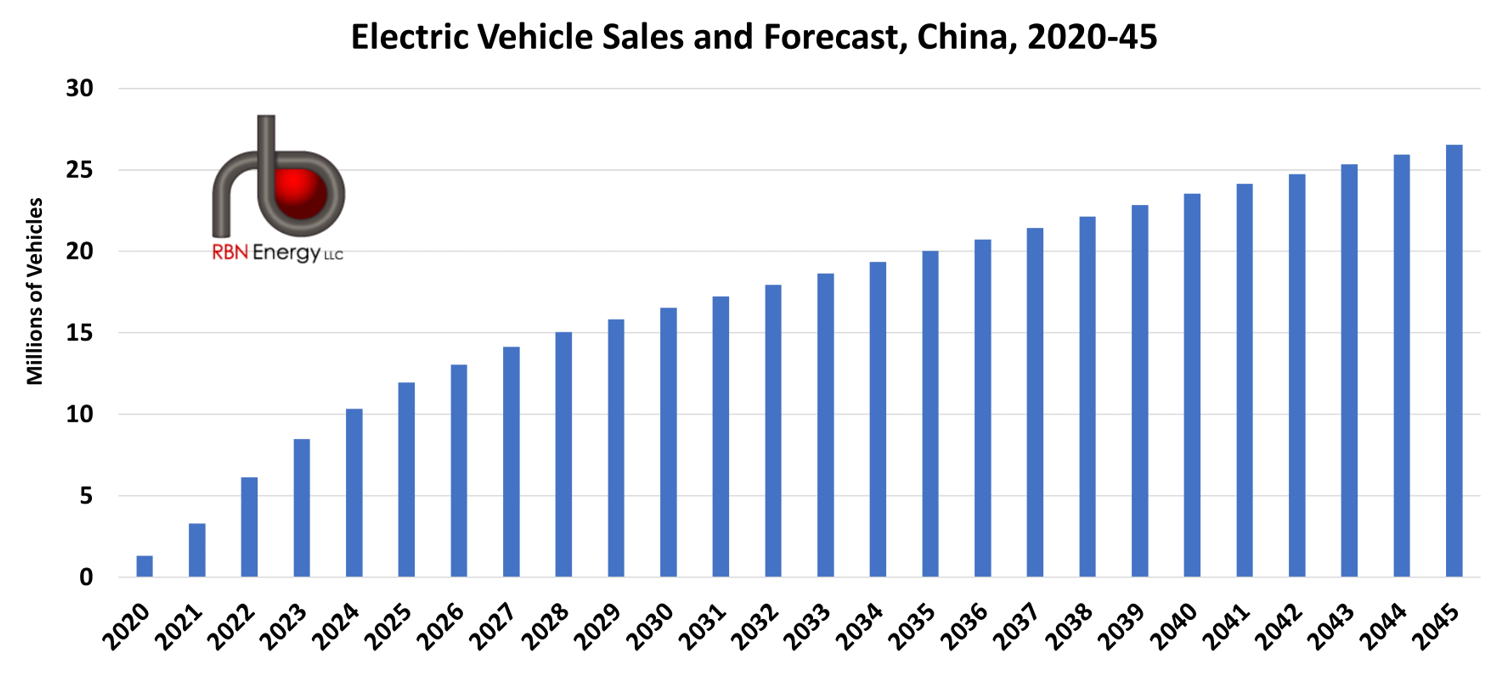
Figure 1. Electric Vehicle Sales and Forecast, China, 2020-45. Source: Refined Fuels Analytics Note: Sales Figures Include Fully Electric Vehicles and Hybrids

About the song
“Trouble” was written by Lindsey Buckingham and appears as the second song on his debut solo studio album, Law and Order. Released as a single in October 1981, it went to #9 on the Billboard Hot 100 Singles chart. Personnel on the record were: Lindsey Buckingham (vocals, guitar, drum programming, percussion), Mick Fleetwood (drum loops) and George Hawkins (bass).
Law and Order was recorded in 1981 at Larabee in West Hollywood and Wally Heider in Los Angeles. The album was produced by Lindsey Buckingham and Richard Dashut. It was made at the same time that Buckingham was working on Fleetwood Mac’s Mirage album. Released in October 1981, the album went to #32 on the Billboard 200 Albums charts. Four singles were released from the LP. Buckingham’s band, Fleetwood Mac, released Mirage eight months later. It went to #1 on the Billboard 200 Albums chart and has been certified 2x Platinum by the Recording Industry Association of America.
Lindsey Buckingham is an American singer, songwriter, musician and record producer. In 1973 Buckingham and his girlfriend, Stevie Nicks, were signed to Polydor Records and released their only album, Buckingham Nicks. The two met Fleetwood Mac members Mick Fleetwood and John and Christine McVie while all of them were working on demos at Sound City Studios in Van Nuys. The pair were asked to join Fleetwood Mac without an official audition. Buckingham was guitarist for Fleetwood Mac from 1975 to 1981 and then again from 1997 to 2018. As a member of Fleetwood Mac, he was inducted into the Rock and Roll Hall of Fame in 1998. As a solo artist, he has released eight studio albums, four live albums, two compilation albums, one EP, and 23 singles. After emergency heart surgery in February 2019, he suffered vocal cord damage, to which he eventually recovered. His last album was Lindsey Buckingham, released in June 2021.







Comments
We've had signals that that is permanent. Sinopec has stated that China hit peak gasoline a few years ago. Chinese oil demand growth has been fueled by petrochemical expansion which is tailing off. An analyst recently said China had hit peak oil and will be seeing declines going forward. So not just a slowing economy, a strutuctual change. And the IEA has highlighted significant surplus of crude through 2030 given new supplies coming on. We are in the green transition and it isn't going to be pleasant as everybody tries to pump oil while they can, doing their best to avoid stranded assets.
In reply to Chinese crude demand by Ross Belot
Thanks for your insight!
I was surprised that the blog about the slowdown in Chinese crude demand growth did not mention the shift in trucking fuel demand to LNG. This shift has been noted by several analysts including WoodMac at, for example, the link below. This development is critical to the US from two perspectives: the decrease in crude demand and the increase in LNG demand, which goes some distance to address the concerns in earlier blogs about an emerging oversupply of LNG.
https://www.woodmac.com/press-releases/lng-truck-sales-impacting-chinese-road-diesel-demand/
In reply to Chinese Crude Demand by Ian MacLean
Ian, you brought up a good point, thanks !