


Enbridge expect their Line 9 reversal to be complete in October 2014. By the end of 2014 this pipeline will deliver 300 Mb/d of mainly light crude to two refineries in Quebec. But the Line 9 reversal will likely not have capacity to ship any crude for export – either from Canada’s East Coast or via the Portland-Montreal pipeline to Maine. Significant crude deliveries east of Quebec will have to wait for TransCanada’s Energy East pipeline in 2018. Today we explain why in the final episode of our series on feeding crude to eastern Canadian refineries.
In Episode One of this series, we reviewed the 9 refineries in eastern Canada with combined capacity of 1.3 MMb/d. These refineries mostly process light crude that until recently has come from offshore Atlantic seaboard production and imports, but they are processing growing volumes of US shale oil today. Extensive upgrades, reversals and expansions to the Enbridge network have begun to change the dynamics of crude supply to these refineries. In Episode Two we began a description of Enbridge expansion plans with the Eastern Access project. In Episode Three we finished up the Eastern Access project plans and started on Enbridge’s Light Oil Markets Access (LOMA) projects with the Sandpiper pipeline. In Episode Four we covered the expansion of the Southern Access line to deliver Sandpiper crude to Flanagan and its extension to Patoka. In Episode Five we covered how new flows on Line 9 will feed refineries in Ontario as well as Warren, PA.
The Enbridge Line 9B reversal brings 300 Mb/d of crude from Griffith, IN to Montreal. There the 137 Mb/d Suncor refinery will consume up to 130 Mb/d. Suncor expect to ship their own equity synthetic crude oil from Alberta to Sarnia via Line 5 and then onto Line 9. Suncor has already built 36 Mb/d of rail unload capacity at their Montreal refinery and can use that capacity to supplement pipeline supplies. Suncor can also still receive crude shipments via the St Lawrence River as we discussed in Episode 1 but this route is constrained in the winter by icy conditions. And as we shall see in a minute, Suncor could also continue to receive crude supplies from the Portland-Montreal pipeline (PMPL).
The second refinery in Quebec province is the 265 Mb/d Valero Jean Gaulin refinery located across the St Lawrence River from Quebec City at Lévis. Valero is also expecting to use crude supplied via Line 9 to feed the Lévis refinery but their logistics will be considerably more complicated. That’s because Lévis is 155 miles up the St Lawrence River from Montreal, so Valero has to ship crude there from their existing Montreal East storage terminal by tanker. To that end, the company has purchased two 500 MMBbl capacity Panamax class tankers to shuttle crude back and forth from Montreal to Lévis. The two vessels will be limited to moving 350 MBbl depending on St. Lawrence water levels and both have Ice Class 1A certification, allowing them to navigate the river during the winter. Valero anticipate three vessel trips per week between Montreal and Lévis.
If Suncor is using 130 Mb/d of capacity on Line 9B, in theory that leaves up to 170 Mb/d that Valero can ship to Lévis – 95Mb/d less than full refinery capacity (265 Mb/d). So they need to source other crude supplies beyond what Line 9B can provide. Valero already have in place a 60 Mb/d crude by rail unloading terminal at Jean Gaulin that can fill most of that supply gap. They can also continue to receive waterborne imported crude supplies at their Lévis deepwater dock. Valero has been using that route to bring cargoes up the East Coast from the US Gulf on foreign flagged vessels (such as Light Louisiana Sweet or Eagle Ford crude). Valero could also source crude from the PMPL pipeline into their East Montreal storage terminal and ship that up to Lévis along with Line 9 crude as just described.
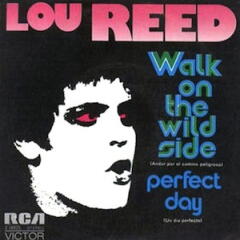
About the song
“Walk on the Wild Side” was written by Lou Reed and appears as the fifth song on side one of Lou Reed's second solo studio album, Transformer. Released as a double A-side single with “Perfect Day” in November 1972, “Walk on the Wild Side” went to #16 on the Billboard Hot 100 Singles chart. The song’s lyrics describe the misadventures of several of the “superstar” regulars at Andy Warhol’s New York City studio, The Factory. Lou Reed has said that Nelson Algren’s 1956 novel, “A Walk on the Wild Side,” was the launching point for the song. In 2013, The New York Times described the song as “an unlikely cultural anthem as a siren song bringing a generation of people to a New York so long forgotten as to seem imaginary.” Personnel on the record were: Lou Reed (lead vocals), Herbie Flowers (fretless Fender Jazz Bass), Ronnie Ross (baritone sax — Ross was David Bowie’s sax instructor during his childhood), David Bowie (acoustic guitar), Mick Ronson (string arrangements), and Dari Lalou, Karen Friedman, and Carey Synge (background vocals).
Transformer was recorded during August 1972 at Trident in London with David Bowie and Mick Ronson producing. Released in November 1972, it went to #29 on the Billboard 200 Albums chart. The album is considered an influential LP in the 1970s glam rock genre. The striking front cover picture is from a photograph of Reed by Mick Rock. Three singles were released from the LP.
Lou Reed was an American singer, musician, songwriter, and poet. He started playing music in doo-wop groups while in high school. After graduating from Syracuse University, he went to work for Pickwick Records in New York City, where he met fellow musician John Cale. Together with Sterling Morrison and Angus MacLise, they would form the original Velvet Underground band in 1965. They soon added Moe Tucker as their drummer and German singer/model Nico as their singer. In 1966 they started being managed by Andy Warhol and became the house band at The Factory. The Velvet Underground released their debut album in 1967. Ten different people passed through the group before its final breakup in 1996. Reed left the band in 1970 to pursue a solo career. As a solo artist, he released 21 studio albums, 15 live albums, 16 compilation albums, and 46 singles. Reed was inducted into the Rock and Roll Hall of Fame twice: as a member of the Velvet Underground in 1996 and posthumously as a solo artist in 2015. Reed died in New York City in October 2013 at the age of 71.




Comments
Note that the Korea National Oil Company refinery is located in Come By Chance, Newfoundland & Labrador, not Nova Scotia. The sole remaining refinery in Nova Scotia owned by Imperial Oil was closed last year.
Speak of the devil re- Come By Chance
http://www.marketwired.com/press-release/harvest-operations-announces-sale-newfoundland-refinery-related-marketing-retail-operations-1944406.htm
Will be interesting to see if the new owners look to more aggresively imports barrels from the US re- Jones Act restrictions given their background in the trading world.
In reply to Speak of the devil re- Come by Christopher MacCulloch
Thanks for the corrections re the Come by Chance refinery. As noted in the link in the above comment, this refinery has been sold by Harvest Operations Corp (owned by Korea National Oil) to Silver Range Financial Partners - a New York energy and commodities focussed merchant bank (Sep 5, 2014).
top Silver Point guy on the deal, Mr. Harsh Rameshwar, got a nautical degree from an India maritime academy. Happy to take bets that tanker docks at Come By Chance will be busy