
- Blog

The Shape I'm In - Rising Canadian Production, Takeaway Constraints and WCS Price Discounts, Part 5

Author Pete Howard

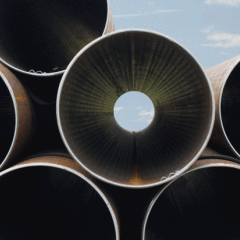
Three major crude oil pipeline projects now under development would add nearly 1.8 MMb/d of much-needed takeaway capacity out of the Western Canadian Sedimentary Basin (WCSB), a region hit hard by pipeline constraints and widening price differentials. But each of the three projects — Kinder Morgan’s Trans Mountain Expansion (TMX), Enbridge’s Line 3 Replacement Project and TransCanada’s Keystone XL — continues to face regulatory challenges and it remains unclear how many of the projects will advance to construction and how soon the first of them might come online. It’s also possible that one or more may go the way of Northern Gateway and Energy East, two major pipeline projects that went belly-up after years of planning. Today, we continue our blog series on Western Canadian crude oil with a look at Keystone XL and its prospects.


- Blog

Watching The Defections – How Energy East Competes for Bakken Crude-by-Rail Barrels

The latest estimates from North Dakota show production edging up in March 2015 after a two-month decline. But the heady days are over for the moment - in the wake of lower crude prices - as even optimistic forecasts project flattened growth. Meanwhile combined rail and pipeline crude takeaway capacity out of North Dakota are already far higher than production – but new projects like the TransCanada Upland pipeline continue to be pitched to shippers. Today we describe how that could result in producers switching from existing routes.

- Blog

Watching The Defections – Is Too Much Bakken Crude Pipeline Takeaway Capacity Planned?

Crude oil production is expected to be slowing down in U.S. shale basins in the wake of lower oil prices and drastic cuts in the number of working rigs. Most forecasts for future growth are far more conservative now. Yet new midstream pipeline projects continue to emerge. The latest proposal in the Bakken would add a minimum of 220 Mb/d of takeaway capacity sometime after 2018. At that point, between rail and pipeline, North Dakota takeaway capacity will be more than double RBN’s Growth Scenario production forecast – suggesting new pipelines will need to attract defectors from existing routes to market. Today we examine the rationale behind the proposed TransCanada Upland pipeline.

- Blog

Take a Pipe on the East Side – Feeding Crude to Quebec Refineries

Enbridge expect their Line 9 reversal to be complete in October 2014. By the end of 2014 this pipeline will deliver 300 Mb/d of mainly light crude to two refineries in Quebec. But the Line 9 reversal will likely not have capacity to ship any crude for export – either from Canada’s East Coast or via the Portland-Montreal pipeline to Maine. Significant crude deliveries east of Quebec will have to wait for TransCanada’s Energy East pipeline in 2018. Today we explain why in the final episode of our series on feeding crude to eastern Canadian refineries.

- Blog

What Becomes of the Empty Pipelines – Markets for TransCanada’s Mainline Oil Conversion

The Energy East pipeline project proposes to convert part of the TransCanada Mainline natural gas system and add new pipeline in eastern Canada to connect oil receipts in Alberta with refineries in Ontario, Quebec and on the Atlantic seaboard. The proposal competes with existing plans by Enbridge to feed eastern Canadian refineries with light crude but does offer the prospect of supplying heavy crude for export from Canada’s East Coast. Today in Part 2 of a series on the project we review destination markets.