Eastern Canadian refineries are importing record volumes of light US crude - 263 Mb/d in May 2014 according to the Energy Information Administration (EIA). By the end of 2014, pipeline reversals and expansions to the Enbridge network will increase the flow of light crude to eastern refineries from Western Canada and North Dakota. The result could be even more imports from the US. Today we continue our series reviewing the extent and impact of Enbridge projects to move crude east.
In Episode One of this series, we reviewed the 9 refineries in eastern Canada with combined capacity of 1.3 MMb/d. These refineries mostly process light crude that until recently has come from offshore Atlantic seaboard production and imports, but they are processing growing volumes of US shale oil today. Extensive upgrades, reversals and expansions to the Enbridge network have begun to change the dynamics of supply to these refineries to include more Canadian and Bakken crude. In this episode we begin a description of the Enbridge upgrades with the Eastern Access project.
The huge Enbridge Mainline system (made up of multiple pipelines) can deliver up to 2.5 MMb/d of hydrocarbon liquids (mainly heavy crude from Western Canada) to the US border in Minnesota where the system name changes to Lakehead. At Clearbrook, MN Enbridge Lakehead receives incoming crude from the Enbridge North Dakota system. Once it reaches the Great Lakes at Superior, WI, the Lakehead system winds its way around Lake Michigan in two directions - flowing light crude north on Line 5 direct to Sarnia, Ontario but the majority of its payload south along two routes – one through Chicago that mostly feeds refineries in the Windy City and the other further west to Flanagan, IL. The Flanagan terminal in Pontiac, IL is the central pivot point in the Enbridge US system with crude flowing from there either north and east through Illinois to Griffith, IN and then back into Canada at Sarnia or southwest to Cushing, OK. This series details Enbridge initiatives to increase eastbound flows. See our recent series “Promised Land” Part 1 and Part 2 for details of the Enbridge Western Gulf Coast Market Access initiative to flow more Mainline crude to Cushing and south to Houston.
Enbridge Eastern Access and Light Oil Markets Access Initiatives
Figure #1 below show the Enbridge Eastern Access (left map) and the Light Oil Markets Access (LOMA - right map) initiatives. Although these are separate projects, it is hard to make sense of them without looking at both to start with. As we explain below, the Eastern Access projects are nearing completion and should be in operation by the end of 2014. These projects really lay the groundwork for increased supplies of both light and heavy crude to flow eastbound on Enbridge’s main pipeline corridor across the Midwest from Flanagan, IL to Montreal. Bear in mind here that many of these pipelines have been in place since the 1950’s and that they have been feeding refineries in the Midwest for decades. The big challenge for Enbridge has been to increase the flows of crude along these routes to meet new demand and deliver increased Canadian and Bakken supplies to market. To accomplish that Enbridge had to expand, replace and reverse sections of that corridor of pipelines through the Midwest before they could move higher volumes of crude south through the Mainline and Lakehead systems. The second set of initiatives – LOMA – that will be completed by mid-2016 is designed to facilitate increased flows of light crude oil out of North Dakota via the Sandpiper project (we cover that in the next episode) and to deliver that crude to Flanagan so that it can flow east on the expanded corridor. LOMA also makes further incremental expansions to the corridor from Flanagan to Montreal to provide enough capacity to meet expected demand for crude in eastern Canada as well as feeding refineries in the US Midwest that these pipelines have been supplying for decades. We are going to walk through both of these major initiatives, starting with Eastern Access.
About the song
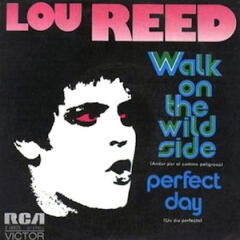
“Walk on the Wild Side” was written by Lou Reed and appears as the fifth song on side one of Lou Reed's second solo studio album, Transformer. Released as a double A-side single with “Perfect Day” in November 1972, “Walk on the Wild Side” went to #16 on the Billboard Hot 100 Singles chart. The song’s lyrics describe the misadventures of several of the “superstar” regulars at Andy Warhol’s New York City studio, The Factory. Lou Reed has said that Nelson Algren’s 1956 novel, “A Walk on the Wild Side,” was the launching point for the song. In 2013, The New York Times described the song as “an unlikely cultural anthem as a siren song bringing a generation of people to a New York so long forgotten as to seem imaginary.” Personnel on the record were: Lou Reed (lead vocals), Herbie Flowers (fretless Fender Jazz Bass), Ronnie Ross (baritone sax — Ross was David Bowie’s sax instructor during his childhood), David Bowie (acoustic guitar), Mick Ronson (string arrangements), and Dari Lalou, Karen Friedman, and Carey Synge (background vocals).
Transformer was recorded during August 1972 at Trident in London with David Bowie and Mick Ronson producing. Released in November 1972, it went to #29 on the Billboard 200 Albums chart. The album is considered an influential LP in the 1970s glam rock genre. The striking front cover picture is from a photograph of Reed by Mick Rock. Three singles were released from the LP.
Lou Reed was an American singer, musician, songwriter, and poet. He started playing music in doo-wop groups while in high school. After graduating from Syracuse University, he went to work for Pickwick Records in New York City, where he met fellow musician John Cale. Together with Sterling Morrison and Angus MacLise, they would form the original Velvet Underground band in 1965. They soon added Moe Tucker as their drummer and German singer/model Nico as their singer. In 1966 they started being managed by Andy Warhol and became the house band at The Factory. The Velvet Underground released their debut album in 1967. Ten different people passed through the group before its final breakup in 1996. Reed left the band in 1970 to pursue a solo career. As a solo artist, he released 21 studio albums, 15 live albums, 16 compilation albums, and 46 singles. Reed was inducted into the Rock and Roll Hall of Fame twice: as a member of the Velvet Underground in 1996 and posthumously as a solo artist in 2015. Reed died in New York City in October 2013 at the age of 71.