A study released yesterday (August 4, 2014) by the North Dakota Petroleum Council (NDPC) details the final results of work they commissioned to extensively sample and test North Dakota crude oil. The goal was to establish the quality characteristics of Bakken crude oil to determine if it is more risky to transport by rail than other crudes. The results show Bakken crude to be similar to other light sweet crudes, to be consistent across the producing region and that it meets all the current hazardous materials transportation requirements. Today we review the report’s findings.
We have followed the debate on safe transportation of crude by rail in RBN blogs since regulators in Canada and the US began to respond to a number of serious accidents involving crude trains last year (see Could New Tank Car Rules Derail the Bakken Crude Boom?). The oil industry, railroads and regulators have proposed and in some cases implemented, a series of measures designed to increase the safety of crude by rail transportation. Some of these measures require the adoption of new tank car standards (see The Trains They are A Changin’ Part 1 and Part 2) and others involve speed restrictions, notifications and greater testing. As we have also discussed, in the region where most crude by rail traffic occurs – North Dakota - new pipelines opening up (see Gimme All Your Barrels) changing crude differentials and concerns with the cost and logistics of rail have led to a recent decline in the use of rail to get crude to market (see I Can’t Stand the Train?). The report released yesterday by the NDPC represents the most comprehensive scientific study yet designed to clearly identify the characteristics of Bakken crude and whether they meet safety requirements set by the U.S. Department of Transportation’s (DOT) Pipeline and Hazardous Materials Safety Administration (PHMSA).
Existing rules for carrying crude by rail
We’ll start with a quick summary of the existing rules. PHMSA issues the Hazardous Materials Regulations that set requirements for the safe transportation of hazardous materials like crude oil. Any hazardous material has to be properly identified and classified prior to shipping. Shippers must determine which of nine hazard classes characterizes the material. Once classified, hazardous materials are assigned to one of three packing groups (PGs) based on their degree of hazard, from great hazard (PG I) to minor hazard (PG III). Typically crude oil is classified and transported as a Class 3 (flammable liquid) with a PG II or PG III identification. A flammable liquid means a liquid having a flash point of not more than 140 °F. A liquid’s flash point is the lowest temperature at which it can vaporize to form an ignitable mixture in air. The initial boiling point (IBP) D86 distillation test is used to determine the appropriate PG for a flammable liquid. The D86 test consists of distilling a liquid to observe the temperature at which the first drop of liquid condenses – the IBP. The PHMSA rules have been in operation for years but have come into question lately because crude oil involved in recent rail accidents has ignited. The concerns have led to increased regulation of the procedures for carrying crude by rail. On March 6, 2014, DOT issued an amended Emergency Order requiring all rail shippers to test product from the Bakken region and to treat crude as a Class 3 PG I or PG II hazardous material even if it tests as PG III. The DOT issued a more recent notice of proposed rules on tank car standards and crude volatility a couple of weeks ago (July 23, 2014) to tighten tank car standards and restrict the use of older DOT – 111 tank cars. These rules would come into effect next year if finalized.
Goals of the NDPC Study
The immediate goal of the NDPC study was to undertake comprehensive scientific testing and analysis of Bakken crude to determine its characteristics. The analysis is designed to clearly identify the characteristics of Bakken crude so that transport regulations can be based on science rather than conjecture. NDPC also wants to establish a Bakken crude quality baseline and to recommend best practices to North Dakota producers for field treating to reduce the quantity of light ends (the more volatile components) in crude prior to transportation. The project was coordinated by Turner Mason & Company using a qualified team of engineers, a chemist, and the global leaders in petroleum quality inspection and testing, SGS. Crude samples for the study were collected from seven rail terminals and 15 well sites. The crude producers that provided the well samples account for over 50% of total North Dakota (ND) production, and the rail facilities sampled represent a similar proportion of total ND crude-by-rail capacity. The sampling locations covered the entire producing region and included both “old” and “new” wells.
Key Findings
The study highlighted the following:
- Bakken crude is a light sweet crude oil with an API gravity between 40° and 43° and a sulfur content <0.2 wt.%. The Energy Information Administration (EIA) categorizes light sweet crude oil as having an API gravity between 35° and 50° and less than 0.3 wt% sulfur. Bakken falls in the middle of those ranges for both properties.
- The results indicate that the well-to-well quality of Bakken is very consistent. Testing across the geographic area showed very limited geographical variation in key properties such as API, vapor pressure and light ends content.
- Test results showed no evidence of “spiking” with Natural Gas Liquids (NGLs) before rail shipment. In other words the volatility of railed Bakken crude was not being increased by the deliberate or unintended addition of NGLs.
- The data supports the current DOT PHMSA classification for Bakken crude as a Class 3 Flammable Liquid (similar to other crude oils, as well as gasoline, ethanol and other materials containing light components). As a result, Bakken crude oil meets all current specifications for transport using existing DOT-111 tank cars.
- Consistent with the report, the NDPC encourages all members to classify their crude as a Class 3 PG I flammable liquid.
- The test results were consistent with other recent reports including the American Fuel & Petrochemical Manufacturers (AFPM) Bakken Report, the PHMSA Operation Safe Delivery Report, NDPC member gathered data and other recent studies and presentations on the quality of Bakken crude oil. The properties measured show that Bakken crude meets all the requirements for safe transport of crude by rail or by truck.
- The NDPC report is critical of the D86 distillation method used to test the flammability of crude by determining its initial boiling point (IBP) because the method results in wide variability of values for the IBP, making it harder to classify the packing group (PG).
Table #1 below summarizes the results. The tests took place over a 30-day period from March 25 to April 24, 2014 and samples were collected from rail loading terminal storage tanks as well as stock tanks at the wellhead. The results measured four characteristics of Bakken crude. The first is the API – found to be within range for a light sweet crude as discussed above under key findings. Second is the vapor pressure – a measure that indicates the quantity of volatile components in the crude. Vapor pressure was found to be in a fairly tight range, averaging between 11.5 and 11.8 pounds per square inch (psi), with over 90% of well and 100% of rail samples measuring below 13 psi (the limit for shipping in DOT-111 tank cars is 43 psi). The third characteristic is the D86 IBP measure that the study found to be unreliable as we just mentioned. The IBP results showed a range of approximately 15°F suggesting it would be difficult to determine if Bakken crude should be consistently classified in PG I (≤95oF) or PG II (>95oF). The fourth characteristic was the light ends content test. This test indicates the volume of NGL’s in the crude in the range C2 (ethane) to C4 (butanes). The presence of these light ends increases the volatility of the crude. The results showed that light ends averaged just below 5.5 liquid volume percent, or within 1 or 2 percent of other light crudes and generally consistent with and in many cases lower than most of the light crudes produced from shale.
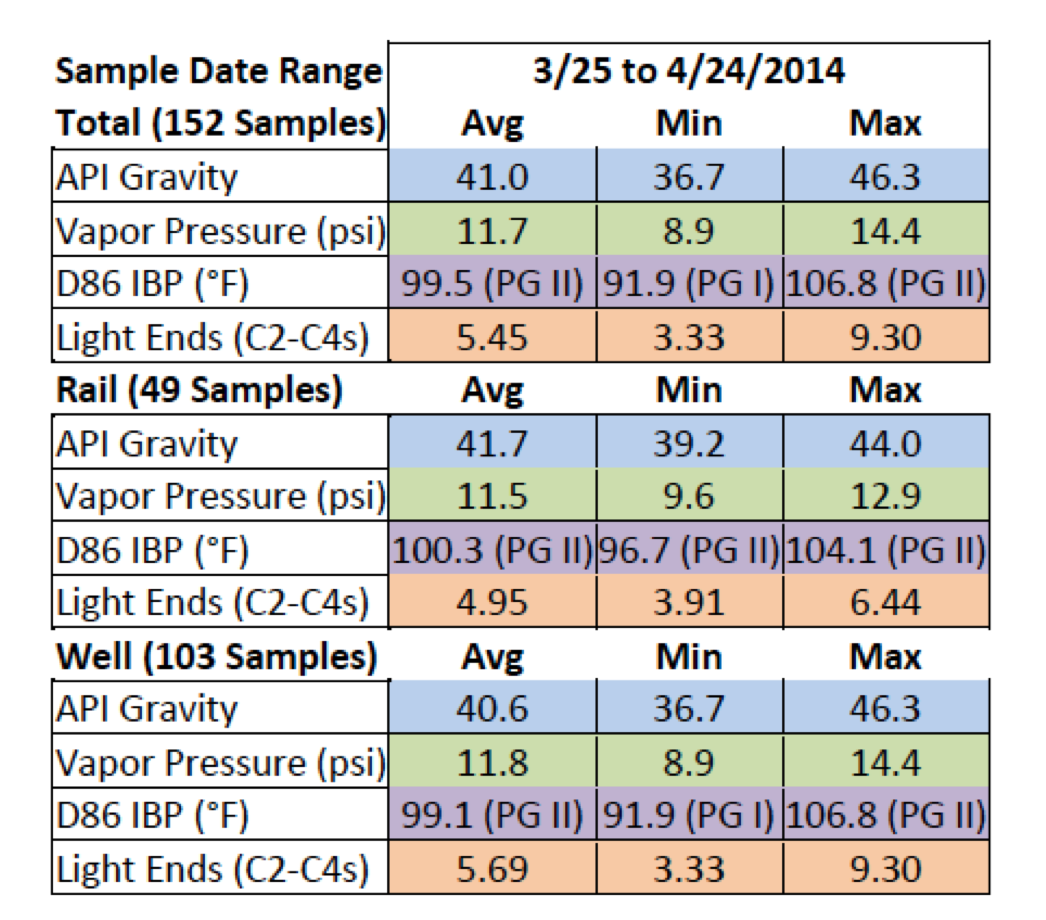
Figure #1