


The recent tragic spate of four rail accidents involving crude-by-rail, three of them carrying crude from North Dakota, have increased pressure for regulation of rail tank car standards. The railroad industry- through the Association of American Railroads (AAR) - proposed improved safety standards in 2011 for tank cars carrying hazardous materials including crude oil. These standards have been adopted by US tank car builders and were mandated this week by the Canadian Government for new tank car construction. If the new standards applied to all existing tank cars then at least 75,000 cars manufactured before 2011 would require retrofitting. Today we examine the impact hastily implemented new regulatory requirements might have on Bakken crude oil takeaway.
As we discuss in the newly released Backstage Pass – Crude-by-Rail Drill Down Report, safety is and has always been the top priority for those involved in the transportation of crude oil by rail. The rail industry regularly quotes a safety record of 99.998 percent. Safety is a key aspect of any discussion about crude-by-rail.
Over the past few months however, that excellent safety record has been marred by four tragic, high-profile accidents. The first was on July 6, 2013 when a run-away train exploded in Lac-Mégantic, Quebec, killing 47 people and devastating the town. Then on November 8, 2013, about a dozen cars derailed from a unit train of 90 cars near Aliceville, Alabama, about 45 miles southwest of Tuscaloosa. Three cars exploded. No one was hurt, but it was a big explosion and fire. At the end of the year on December 30, 2013, a 106 car crude unit train in southeastern North Dakota was hit by derailing cars from an adjacent train hauling grain resulting in an 18 car derailment of the crude train with several cars exploding in a huge fireball. In the latest incident on January 7, 2014 a Canadian National (CN) train carrying propane and crude oil jumped the tracks in Plaster Rock, New Brunswick. At least fifteen cars and a locomotive were derailed and caught fire. The CN train was carrying crude oil from Western Canada.
We have extensively covered the growth of crude by rail in RBN Energy blogs (see for example Year of the Tank Car). Our analysis has included descriptions of the tank car business (see The Tank Cars are Coming) and the maintenance of tank cars (see Bad Orders in the Crude-by-Rail Market). We have also provided insight into the rail logistics business from our friends at PLG Logistics (see You’ve Got Another Thing Coming).
The U.S. Department of Transportation’s (DOT) Pipeline and Hazardous Materials Safety Administration (PHMSA) establishes safety regulations relating to crude-by-rail transportation. In Canada, Transport Canada performs a similar function. In addition, the Association of American Railroads (AAR) Tank Car Committee (TCC) is a key participant in the setting of industry standards regarding the design and construction of tank cars. Members of the TCC include rail car owners, manufacturers, rail customers and the Committee also has active participation from the DOT, Transport Canada and the National Transportation Safety Board (NTSB).
The rail industry had already moved toward more stringent requirements for rail tank car design before the recent accidents. In 2011, the TCC asked PHMSA to adopt upgraded design requirements for new tank cars carrying hazardous materials such as crude oil (PHMSA Petition – 1577). These design upgrades include thicker, more puncture resistant tanks, thicker walls at both ends of the tanks, and more protection for the fittings and valves on top of the rail cars. Although PHMSA has not mandated these new requirements, the TCC adopted the new designs for new rail tank cars in 2011. Thus far, more than 14,000 cars have been ordered to this more stringent standard. On January 11, 2014 the Canadian Government published rules that will go into effect in July, setting a new Canadian rail tank car standard called TP14877, based on the US PHMSA Petition – P1577. The new requirements apply to the majority of rail tank cars used to transport light sweet crude - built to a design known as DOT 111A. Rail tank cars constructed with insulation and heated coils and designed to carry heavy crude are already compliant with the new standards.
The requirements only apply to newly constructed railcars – meaning that as many as 75,000 existing rail tank cars, built before 2011 will not comply with the new safety standard until they are retrofitted. The cost of retrofitting existing rail tank cars varies by design but has been estimated by tank car manufacturer National Steel Car at between $20,000 and $40,000 each (November 2013 Industry Presentation). Regardless of cost, the rail tank car industry lacks available capacity to carry out such retrofitting. The backlog of new orders for rail cars in 3Q 2013 was 61,000 of which 49,000 were tank cars (source: Railway Supply Institute). That backlog is expected to take 4 years to clear, leaving little capacity for retrofitting work. Smaller tank car repair shops also have limited capacity to do retrofitting work.
In the circumstances, we wanted to understand the impact on crude takeaway capacity in North Dakota – where crude-by-rail is most established – if shippers decide to limit themselves to using rail tank cars that meet the new standards. The need to carry out this analysis is prompted by two very real concerns. First it is our understanding that some companies are already taking this precaution – of only using newer tank cars - to reduce their shipping risk. And second, (although there is no indication yet that this might happen) regulators could impose a hard ban on using older rail tank cars that are not retrofitted to meet the new regulations. In either case, the impact in North Dakota if all rail shippers stopped using DOT 111A rail tank cars built before 2011 would be to throw Bakken crude oil transportation into chaos.
That’s because we know that at least 500 Mb/d of Bakken crude is leaving North Dakota by rail today (source: Genscape). And the latest data from the North Dakota Pipeline Authority (NDPA - for October 2013) puts that figure much higher – at 69 percent of North Dakota crude production or 650 Mb/d being shipped by rail. In fact as you can see from the chart below, the volume of North Dakota crude being moved by rail (dark green line) has increased rapidly in the past three years from just 65 Mb/d in January 2011 to 650 Mb/d in October 2013.
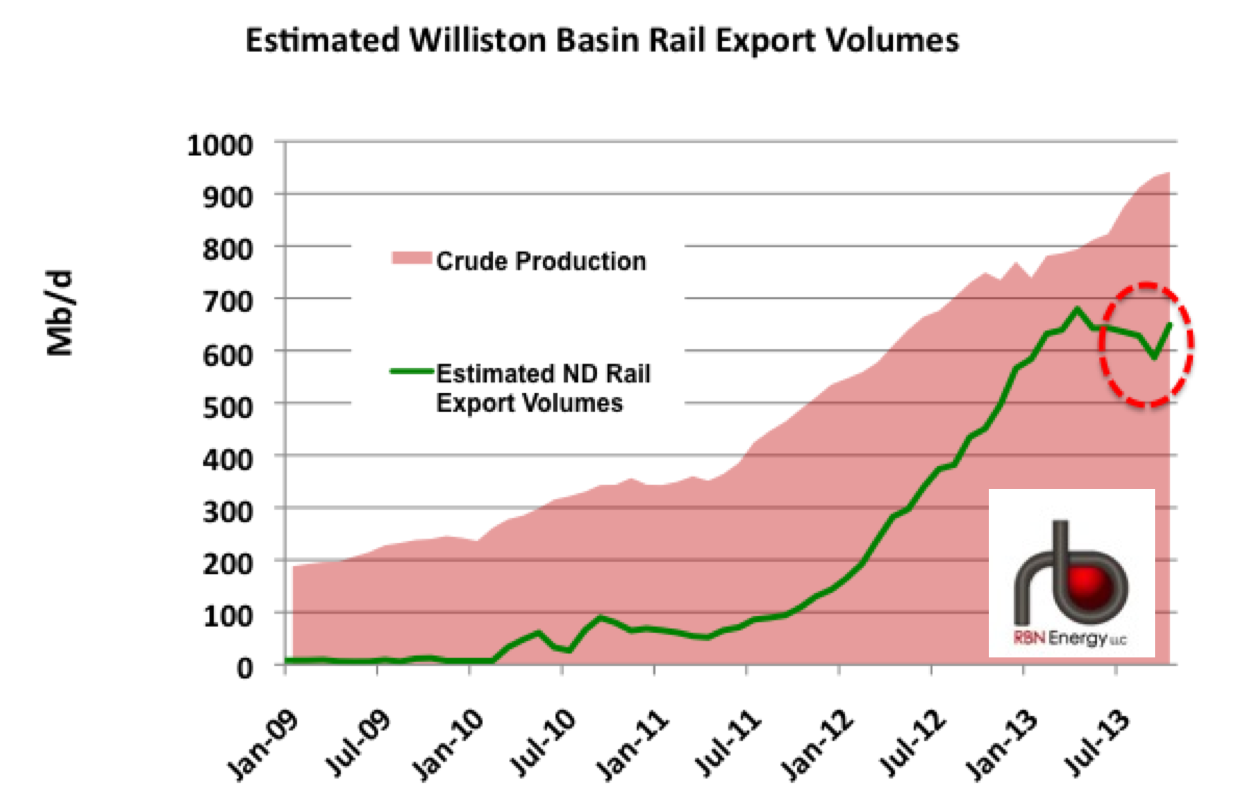
Source: NDPA and RBN Energy
And as regular RBN blog readers will know, the reason for that increase in rail transport out of North Dakota was that crude production in the State (pink shaded area on the chart) overwhelmed pipeline takeaway capacity in early 2011. The resulting price discounts for Bakken crude together with pipeline congestion in the Midwest led to a major build out of crude rail loading terminals (see From a Famine of Pipeline to a Feast of Rail). Over 600 Mb/d of rail loading capacity was added during 2011 and 2012. Since then North Dakota producers have mostly preferred to use rail capacity to ship their oil to market because crude prices were generally higher at coastal destinations that could only be reached by rail (see Railing Against the Pipelines). Only when price differentials no longer favored rail economics for transport to the Gulf Coast in the third quarter of 2013 did rail volumes dip (red dotted circle on the chart) as shippers shifted their barrels back to the pipeline (see Netback, Netback to Where You Started From).






Comments
Hello Sandy,
Before the Megantic explosion, insurance rates for carrying crude on a 50 rail-cars unit train was around $ 135,000. In the insurance market, premiums charged can increase dramatically (or certain coverage may not be available in the future) after a catastrophic event since one or two events can modify a probability distribution. Insurance premias are likely to change rail lease rates so shippers margins. Rail-cars retrofiting, increase regulatory oversight, costs can only go up. The Crude Bartender, Crude By-Rail is here to stay in the North-American landscape, but the free-lunch is over with rising ( insurance premia, operating costs, Degasification units for light crudes, car retrofit and a new regulatory burden).
I've watched this market and I came to the conclusion that if you want to stay alive in this business you'd better be big or stay away. BNSF was quite lucky that nobody was hurt in Casselton. They paid $8 million/hour (in contractual obligations) to have their Norther Line shut after the explosion. The Line is expected to reopen after 5 days of work. The loss incurred exceeds by several times what BNSF gets for transporting hazardous commodities. According to 10-Q filling, during Q3 BNSF did $989 Millions ( or net income at a rate of $451,000/hour). One quarter of earnings is gone in only 5 days. Is it possible that railways have written series of “Naked puts” on Crude-By-Rail ?
I'm curious about how much premiums were collected by insurers since the birth of Crude by rail vs Losses created since by the 4 last accidents. As an investor you already know that the business was profitable yesterday because of economics. You want to know what will be the price of risk offered by risk underwriters tomorrow. If hauling costs are higher, and demand doesn't change because of rising supply and producers have no other alternatives in the near term, then spreads must be wider to move this oil by rail and accomodate rising bbl freight cost/1000 miles, so a possible mr. contango return, I stop it now :P
Simon Jacques
On the destructive power of the Bakken crude rail car explosions at Lac-Megantic:
Rail cars built to DOT-111 standards are designed for non-pressure service. Supposedly, they have vent valves and safety relief valves but those can be set as high as 75 psi.
Is it safe to use tank cars designed for non-pressure service to transport a "light crude" such as Bakken crude which can have a relatively high vapour pressure, due to high condensate and light ends content, and with safety relief valves set so high as to create a very dangerous situation in case of an accident, especially on very hot days as was the case at Lac-Megantic?
Evidence at Lac-Megantic suggests the answer is no.
It's not just that it's light but the chemical makeup.
At the Conoco refinery in Westlake (Lake Charles), LA, crude oil tankers had no problems with Libyan Ras Lanuf blends in the early 1980's but when the embargo came and imports to the same refineries were changed to "Brent" the cargo pumps aboard ships had difficulty achieving more than 15,000 Barrels per hour flow rates due they became vapor locked. The exact same ships were acheiving 28,000-30,000 BPH with a crude oil of similar API gravity.
The risk profile of crude by rail (CBR) for all transactional parties (producers, traders, railroads, tank car companies, refineries, et al) is now paramount, obviously, and the general public's valid concerns (see today's WSJ article) only amplify the magnitude of this issue.
One can only speculate about the actual or implicit risk profiles measured or assumed by the transactional parties, and up until the dramatic incidents of recent months it is safe to assume that the general public had no meaningful view of the risks generated by the rapidly increasing volumes of CBR passing through their vicinities.
The one somewhat relevant statistic perhaps most widely publicized came from the Association of American Railroads. In a recent AAR paper on the transportation of hazardous materials it was stated that: "Railroads have a strong record for safely moving hazardous materials (hazmat), with 99.9977 percent of all shipments reaching their destination without a release caused by an accident."
The initial simple visual impression of this statistic is, to my eyes and perhaps those of many in the general public, of a vanishingly small risk to be attached to growing volumes of CBR. And yet .... The AAR estimates that in 2013 approximately 400,000 loads of CBR moved. Apply the AAR statistical "risk profile" to that number of loads and the result is: 9 loads of CBR did not reach their destination without a release caused by an accident.
Perhaps it is not unreasonable to attach some geography to that statistical exercise: Aliceville and Casselton.
Informal internet railroad blog commentary has suggested a not uncommon response to many accidents: It's just a "one off" thing. Won't happen again any time soon. (May one be justified in wondering if some of the CBR transactional parties may have this type of implicit risk profile?)
So, rather than simply accepting the AAR's statistical approach, revealing as it is, I did another simple desk analysis using Federal Railroad Administration accident data for Jan - Oct., 2013. Those data show a Train Accident Rate of 1.2 accidents per million train-miles on "other track", i.e., other than yard track. (I used this statistic not because accidents on yard track are of no concern, but because there is no clear statistical showing of the number of train-miles that accrue in yards. Further, I make the assumption that mainline accidents at track speed are more likely to be "catastrophic" in impact.)
Again, a vanishingly small number when applied to CBR, right?
CBR now moves mostly in unit trains. Using the AAR's stat of 400,000 loads of CBR in 2013, and an assumed average unit train size of 100 cars per train and an average loaded haul of 1,000 miles (conservative, given the many trains to East, West and Gulf Coasts), plus the return empty haul of 1,000 miles, we see that CBR generated roughly 8 million train-miles in 2013.
Apply the FRA stat of 1.2 accidents per million train-miles to 8 million CBR train-miles: ~9.6 accidents. Let's round to 10, as there are no fractional accidents. But, then, let's divide by 2, as our major concern is with loaded trains.
Statistics from AAR and FRA, massaged (or mangled) by me suggest 5 "train accidents" of loaded CBR trains in 2013.
Geography? Lac Megantic, Aliceville, Casselton. Those were the ones I am aware of, but perhaps there were less dramatic, non-explosive line-haul accidents. (Ok, I know, the Lac Megantic accident was in Canada, but it was U.S. crude from North Dakota hauled many miles in the U.S. by a U.S.-type railroad.) In any event, the statistical result appears to be roughly consonant with actual experience.
IF 2014 experience parallels that of 2013, i.e., if 2013 was not merely a "one off" year ("bad luck"?), but with 20% growth in CBR unit train miles, using the AAR metric, we will see 11 cars of CBR not reach their destination without a release caused by accident. Using the my FRA 2013 train accident experience metric, we will see approximately 6 loaded CBR train accidents.
Geography? If only that could be accurately predicted!
What are the risk profiles applied by the transactional parties? Would be fascinating to know.
I am reminded of the analyses done by Richard Feynman and others after the loss of the shuttle Challenger: NASA management's implicit loss ratio was around 1 lost shuttle in 100,000 missions ("airline-type safety"), while a realistic engineering risk profile suggested 1 loss every 50 to 100 missions. Actual experience: 2 lost in 130 missions.
Feynman's closing words in his "dissenting" addendum to the Challenger report: "For a successful technology, reality must take precedence over public relations, for nature cannot be fooled."
In reply to The risk profile of crude by by Paul Nelson
Paul Nelson, your data dive into the FRA accident data base was well done, but you only see the frequency of accidents there, not the severity. The threshold for reporting an accident to the FRA in 2013 was $9,600, which means that a train crew that damages a car picking it up along the line between two terminals, causing more than $9,600 in damage, is included in the accident count that produces the 1:1,200,000 rate. A crude-by-rail incident that doesn't result in a release isn't going to get added to the risk profile, since no insurance claim will be made. So in your frequency analysis where there are 5 "train accidents" involving crude oil on an annual basis, how many of those, statistically, would result in a release, and if there is a release, how many would result in casualties? Well, in the same FRA statistical analysis (I looked at it too), 0.88% of the accidents resulted in a release of any kind of hazmat, not just crude oil. So, if you took 1% of your five annual accidents involving crude by rail, the statistical probability is that there would be one crude oil release every 20 years. Can we then conclude that 2013 was an outlier?
I am a career railroad manager, involved in handing crude by rail, and a repeat of 2013 is unacceptable to me and to the rest of the industry. Changes are being made to handling practices, tank car design, and product classification to reduce accidents, reduce severity, reduce releases.
In re: My post on "Risk Profiles"
This picture was taken just a few days ago in Colorado:
Thank you Mr. Nelson, I enjoyed each lines above and the logic.
I said that in 2014 there will be a lot of re-structuring in Crude-By-Rail. Some who wait for such opportunities will be served.
Bankruptcy judges in Quebec and Maine have approved the sale of the insolvent railway involved in Lac-Megantic, Que. Thursday.
New York-based Fortress Investment Group, will pay $14,250,000 for 478 miles of track in VT, ME. less than 30,000$/Miles.
Try to build a railways at this price. About only 15 cents in the Dollar, this is a deal what a Bust....
Simon
Has anyone taken into consideration the amount of water that is being shipped with oil some of these locations out here such as NTR dont have any monitors for bs&w so when you bring a load of oil into the rail you hook your hose directley ro the valve on the rail car. Now think about that for a minute...crude weighs around 8 bs a gallon and water s around 10lbs ,now if a rail car typicaly is a 660 bbl car they figure for the weight of oil not water.