The Atlantic hurricane season often evokes worries about the oil and refined products industry, even far up the East Coast, thanks to the widespread impact of Superstorm Sandy a dozen years ago. But electricity production could also be at risk should a major storm once again make its way up the Eastern Seaboard thanks to the large-scale wind farms under development there. In today’s RBN blog, we’ll examine the threats, how they might impact Atlantic Coast wind power, and how offshore turbines are designed to withstand severe storms.
The RBN Crude Oil Analytic Suite gives you access to four weekly reports covering crude oil markets, including: Crude Billboard, Crude Permian, Crude TradeView, and Crude Voyager.
Before we dive in, let’s do a quick rundown of the 2024 Atlantic storm season, which has been fairly typical despite the La Nina effect, with 17 named storms. Since it began officially on June 1, six hurricanes have made landfall — one in Bermuda and the rest along the U.S. Gulf Coast (USGC; gray-shaded rows in Figure 1 below). Florida has borne the brunt of storm activity, taking on three hurricanes, with the last two — Helene and Milton — arriving just two weeks apart. Their tracks varied, though, with Helene heading north to strike several states, notably North Carolina. In contrast, Milton cut across Florida to the Atlantic Ocean and spawned a barrage of tornadoes, dealing a double blow to areas still reeling from Helene. Both storms discharged powerful winds and heavy rains, while tidal surges caused significant onshore damage. Because Florida doesn’t have much in the way of above-ground oil facilities like refineries, the impact on oil-related infrastructure was limited. However, the storms shut power supply, damaged wind and solar facilities, and closed ports, upending supply chains and fuel deliveries. The hurricane season won’t be over until November 30, so these areas are still at risk. (It’s also worth noting that storms have formed outside of the usual May-to-November period, as we discussed in Gimme Shelter and Riders On The Storm. And the Northeastern U.S. is also susceptible to Nor'easters, tropical-storm-like events that often occur during the September-through-May period.)
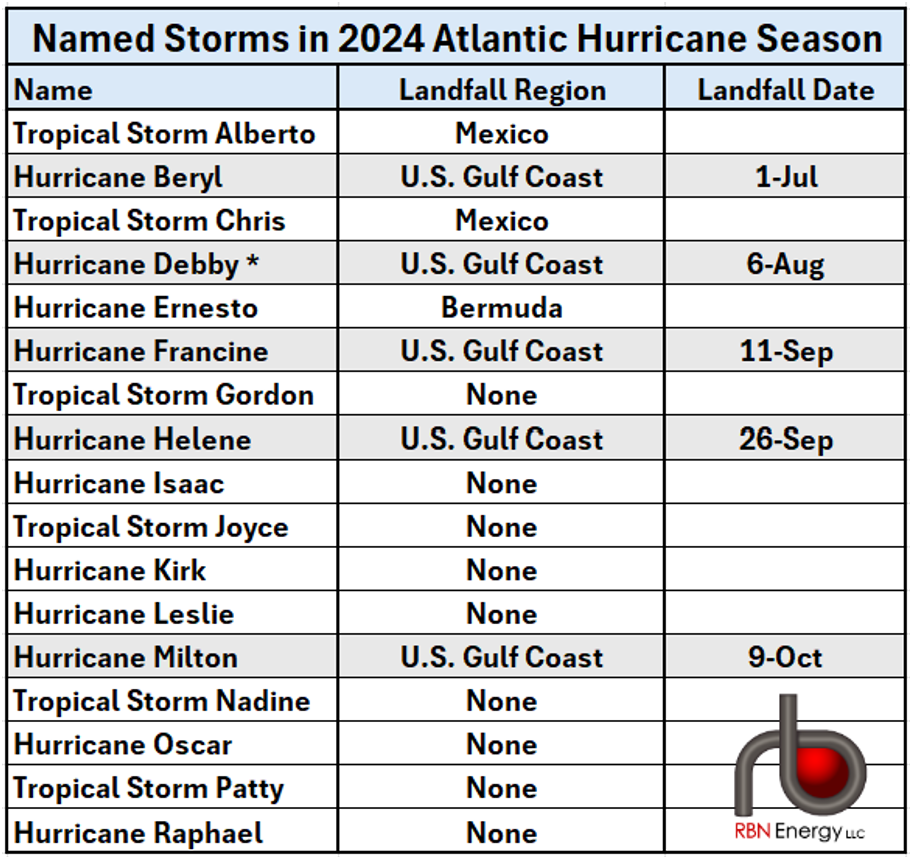
Figure. 1. Named Storms in 2024 Atlantic Hurricane Season. Source: National Hurricane Center. Note: Gray-Shaded Rows Indicate Storms That Made a U.S. Landfall * Debby Made a Second Landfall in South Carolina
This storm season has so far spared the East Coast from a direct hit, including the Atlantic coast of Florida. In Don’t You (Forget About Me), we examined how storms have tended to strike the Southeast much more frequently than the Northeast, which last came up against a major hurricane a dozen years ago. That was Superstorm Sandy, which affected as many as 24 states by some accounts, mostly along the Atlantic Coast but also farther inland, causing substantial damage, particularly to New York and New Jersey. Fuel supply chains were so badly impaired for the two states that gasoline was rationed for the first time since the 1973 oil embargo (for more on that, see The Hard Way Every Time). The storm had racked up roughly $65 billion in damages, with some estimates even higher, making Sandy among the Top 10 costliest hurricanes.
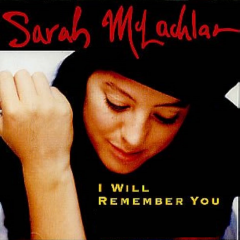
About the song
“I Will Remember You” was written by Sarah McLachlan, Seamus Egan and Dave Merenda and appears as the fourth song on Sarah McLachlan’s 1999 live album, Mirrorball. It first appeared as the first song on the soundtrack for the 1995 film The Brothers McMullen. It also appears on the 1996 collection album, Rarities, B-Sides and Other Stuff. It was first released as a single from The Brothers McMullen soundtrack in 1995 and went to #65 on the Billboard Hot 100 Singles chart. In July 1999, the live version from Mirrorball was released as a single and went to #14 on the Billboard Hot 100 Singles chart. It has been certified Gold by the Recording Industry Association of America. It won a Grammy Award for Best Female Pop Vocal Performance in 2000. Personnel on the live record were: Sarah McLachlan (lead vocal, piano), Brian Minato (bass), David Sinclair, Sean Ashby (guitar, backing vocals), Ashwin Sood (drums, percussion, backing vocals), Vincent Jones (keyboards, backing vocals), and Camille Henderson (backing vocals).
Mirrorball is a live album by Sarah McLachlan taken from live performances recorded at the Rose Garden Arena in Portland, Oregon in April 1998 during her Surfacing Tour. Released in June 1999, it went to #3 on the Billboard 200 Albums chart and has been certified 3x Platinum by the RIAA. One single was released from the LP.
Sarah McLachlan is a Canadian singer and songwriter. She studied at the Maritime Conservatory in Halifax. After moving to Vancouver, she signed her first record deal with Nettwerk and released her first studio album, Touch, in 1987. She founded the highly successful Lilith Fair, a tour that featured female solo artists and female-led bands in 1997. She has released nine studio albums, three live albums, seven compilation albums, three EPs, and 53 singles. She has sold more than 40 million records worldwide. She has won three Grammy Awards, 12 Juno Awards, and is a member of the Canadian Songwriters Hall of Fame. She released her last studio album to date, Wonderland, in October 2016. In April 2024, McLachlan stated she was working on new music with producer Tony Berg.