Total U.S. LNG export capacity is around 12 Bcf/d, including the still-commissioning-but-nearly-complete Calcasieu Pass. About 13.5 Bcf/d of U.S. natural gas supplies, or feedgas, is required to produce that much LNG, but feedgas demand has averaged just 10.5 Bcf/d over the past week despite still-soaring global gas prices and an undersupplied global LNG market. Two U.S. terminals are currently offline: Freeport LNG, which has been out of service since an explosion and fire in June, and now Cove Point LNG, which shut for annual maintenance October 1. Beyond those outages, which have taken about 2.75 Bcf/d of demand out of commission, LNG feedgas volumes have been extremely volatile, swinging as much as 2 Bcf/d within a week. Don’t expect this to last, however — with winter approaching, the return of both Freeport and Cove Point on the horizon, and the full startup of Calcasieu Pass in sight, feedgas demand will likely rise to new heights and soon consistently top 13 Bcf/d. In today’s RBN blog we take a closer look at the recent volatility in LNG feedgas and the potential demand coming this winter.
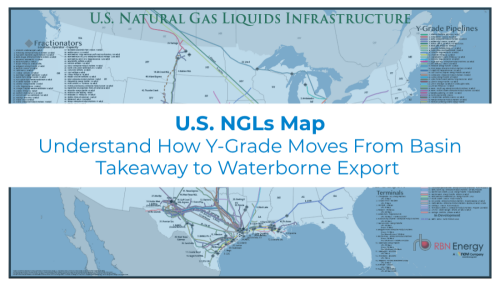
Visualize the infrastructure behind U.S. NGL movement.
The U.S. NGLs Map provides a comprehensive view of the transport, processing, and export networks moving NGLs across the U.S.
As we said in the intro, Freeport and Cove Point’s outages have taken about 2.75 Bcf/d of feedgas demand offline, but the situations at the two terminals are by no means the same. Freeport has been offline since early June (black vertical line in Figure 1) after a rupture in the LNG transfer line caused an explosion at the terminal (see Shut Down). The incident was in a relatively isolated area of the terminal near the storage tanks and there was no damage to any of the liquefaction trains, storage tanks, or docking infrastructure. By most accounts, the repairs needed to fix the damaged line are complete, but the terminal must get the approval of the Pipeline and Hazardous Materials Safety Administration (PHSMA) before resuming operations. Freeport expects to ramp up operations in November and have most of its facilities back online by the end of that month. The terminal will be able to produce about 2 Bcf/d of LNG at that time, enough to fulfill all its long-term contracts; however, no peak capacity (more on that shortly) will be available until after winter, with the terminal likely to resume full operations in March 2023. Freeport had previously expected a return to service in October and the restoration of full operations by the end of 2022, but the timing of Freeport’s restart remains at PHSMA’s discretion. The outage has cost the global market about 74 cargoes, or 251 Bcf, of LNG so far. These were cargoes that individual offtakers and the global market were depending on, and this has further constrained an already tight global market and been particularly hurtful to Europe (see Beyond the Sea), which is trying to replace as much Russian gas as it can ahead of, during and beyond this winter.
About the song
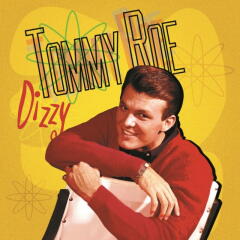
“Dizzy” was written by Tommy Roe and Freddy Weller. It appears as the 10th song on Tommy Roe’s eighth studio album of the same name. Released as a single in November 1968, it went to #1 on the Billboard Hot 100 Singles chart. It has been certified Gold by the Recording Industry Association of America. The bubblegum/pop song featuring modulating key signatures and funky drum breaks has been covered by artists such as Vic Reeves and the Wonder Stuff, Billy J. Kramer, Boney M, and Wreckless Eric. Personnel on the record were: Tommy Roe (lead vocals), Ben Benay, Mike Deasy (guitars), Butch Parker, Don Randi (piano), Mike Henderson (organ), Joe Osborn (bass), Hal Blaine (drums), Clydie King, Ginger Blake, Shelley Clark (backing vocals), and Jimmie Haskell (strings and horn arrangements).
The album, Dizzy, was recorded at Western Studios in Hollywood, with Steve Barri producing. Released in November 1968, it went to #25 on the Billboard 200 Albums chart. Three singles were released from the LP.
Tommy Roe is an American singer and songwriter who had several chart-topping pop singles in multiple countries in the 1960s. He has released 13 studio albums, five compilation albums and 59 singles. His last album was Devil’s Soul Pie, released in 2012. Roe continues to perform in concert.