Fundamental changes in U.S. crude oil production, crude transportation patterns, refinery sourcing of oil, import volumes and other factors have undermined the ability of the Strategic Petroleum Reserve to mitigate the domestic impact of a world energy crisis. Worse yet, the Department of Energy’s planned fix for the SPR will take at least several years—assuming it’s allowed to proceed according to plan. Today we consider current shortfalls in the SPR’s crude-delivery network, the potential effect on U.S. refineries in the event of an emergency, and the DOE’s plan to fix things.
Few of us give much thought to the jack in the truck, the flashlight in the drawer, or the blue tarp in the garage until a tire goes flat, the lights go out, or a tree falls on the roof. Similarly, it’s easy to forget about the federal government’s Strategic Petroleum Reserve (SPR), which was set up more than 40 years ago after the 1973-74 oil embargo but whose emergency use has been only occasional (thankfully). As we said in our Save It For a Rainy Day series a couple of years back, the SPR, which currently stores about 695 million barrels (MMbbl) of sweet and sour crude at four underground salt dome storage facilities along the Gulf Coast, has been tapped for emergency drawdowns only three times since it was created. The first time was during the Persian Gulf War in 1991, when—at President H.W. Bush’s order—the Department of Energy (DOE) implemented a plan to sell 33.75 MMbbl to help stabilize world oil markets. In the end, only about half of that amount—17.3 MMbbl—needed to be sold to achieve the desired effect. Next, in the aftermath of Hurricane Katrina (and its damage to oil production facilities, terminal pipelines and refineries) in 2005, up to 30 MMbbl was authorized for sale. Again, much less was actually bought—about 11 MMbbl. Finally, in 2011, about 30 MMBbl of SPR crude was authorized for sale—and sold to 15 companies—because of supply disruptions in Libya and other countries. Technically, there was a fourth use of the SPR. In 2013, the SPR conducted an emergency exchange with Marathon Oil after Hurricane Isaac disrupted Gulf Coast oil production, refining and distribution systems. By contract, Marathon repaid the 1 MMbbl in three months.
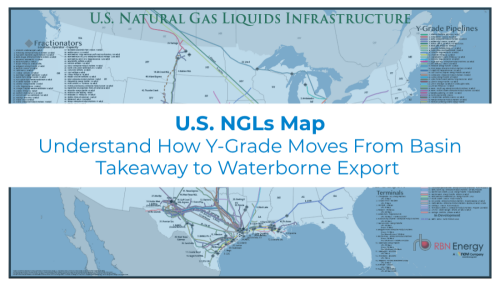
Visualize the infrastructure behind U.S. NGL movement.
The U.S. NGLs Map provides a comprehensive view of the transport, processing, and export networks moving NGLs across the U.S.
The initial purposes of the SPR were to help reduce the impact of severe energy supply interruptions (like the 1973-74 embargo) on U.S. refineries, and to meet the U.S.’s obligations under the International Energy Agency’s (IEA) International Energy Program (IEP), which requires IEA members that are net oil importers to maintain crude oil inventories equal to at least 90 days of domestic demand. These purposes remain, but the SPR also came to be used to minimize the price shocks that come with major supply interruptions, whether they be the result of far-away wars or major hurricanes in the Gulf of Mexico. The SPR consists of 60 underground salt caverns (with capacities totaling 714 MMbbl) at four sites: Bryan Mound in Freeport, TX (capacity, 247 MMbbl); Big Hill in Winnie, TX (170 MMbbl); West Hackberry in Hackberry, LA (220 MMbbl); and Bayou Choctaw in Plaquemines, LA. Each of the four is currently between 96% and 99% full.
Fortunately, there’s been no instance so far in which the SPR has needed to go into what you might call “full-bore” operation. The SPR system is designed for an initial maximum drawdown (or oil-withdrawal) rate of 4.415 million barrels a day (MMb/d) —that rate could be sustained for 90 days (by which time ~400 MMbbl would have been withdrawn), after which the maximum rate would gradually drop. It would take a total of more than 150 days to drain the system’s 695 MMbbl if the spigots were left wide open. Figure 1 shows the maximum pace of withdrawals and how much crude (and which types—sweet or sour) would come from each SPR facility.

About the song
“Need You Now” was written by Josh Kear, Hillary Scott, Charles Kelley and Dave Haywood. It appears as the first song on Lady Antebellum‘s (now known as Lady A) second studio album of the same name. Released as a single in August 2009, it went to #1 on the Billboard Hot Country Songs, Adult Contemporary, and Adult Top 40 Singles charts and has been certified 11x Platinum by the Recording Industry Association of America (RIAA). The song, featuring lead vocals from Hillary Scott and Charles Kelley, won four Grammy Awards in 2011. Personnel on the record were: Hillary Scott, Charles Kelley (lead vocals), Dave Haywood (backing vocals, acoustic guitar), Chad Cromwell (drums), Jason Gambill (electric guitar), Rob McNelley (electric guitar, slide guitar), Michael Rojas (piano, synthesizer), Craig Young (bass), and Paul Worley (acoustic, electric guitar).
The album, Need You Now, was recorded during 2009 in Nashville with Paul Worley and Lady Antebellum producing. Released in January 2010, it went to #1 on the Billboard 200 and Top Country Albums charts and has been certified 4x Platinum by the RIAA. It was Lady Antebellum’s first album to debut at #1 on the Billboard 200 Albums chart. Four singles were released from the LP.
Lady Antebellum (Lady A) is an American country music group formed in Nashville in 2006 by Hillary Scott, Charles Kelley and Dave Haywood. The band abbreviated their name to Lady A in June 2020. They have released nine studio albums, two EPs and 23 singles. They have won eight ACM Awards, four American Music Awards, two Billboard Music Awards, six CMA Awards, and seven Grammy Awards. The band continues to record and tour and will begin a new tour starting with an appearance at the Grand Ole Opry House in Nashville on September 20, 2023.