At first glance, it would appear that President Biden’s announcement regarding the release of up to 180 MMbbl of crude oil from the Strategic Petroleum Reserve over the next six months could have a significant impact. After all, it would, in a sense, increase the flow of U.S. oil into the market by almost 9% –– 11.7 MMb/d of current U.S. production plus an incremental 1 MMb/d from the SPR — and boost global supply by about 1%, which is no small thing. There are a few unknowns, though, such as (1) how much sweet crude oil and how much sour will be released, (2) where the pipelines connected to the four SPR sites could take that oil, (3) whether those pipelines have sufficient capacity to absorb the incremental flows out of SPR, and (4) what the ultimate market impacts of the SPR releases will be. In today’s RBN blog, we look at the president’s announcement and its implications.

Canadian crude output is rising, requiring new export routes. As traditional pathways face constraints, the U.S. Rockies—especially the Guernsey, WY hub—are emerging as key corridors for moving Canadian heavy crude to downstream markets, including the Gulf Coast.
The U.S. SPR is the largest emergency stockpile of crude oil in the world, with an authorized capacity of 714 MMbbl. It was established in the mid-1970s in response to the 1973 oil crisis to mitigate domestic supply disruptions. In the past few decades, it has been used to store crude for a rainy day — that is, to help deal with unpredictable events such as embargoes or devastating hurricanes that interrupt supply. Now, as President Biden announced on Thursday, the U.S. Department of Energy (DOE) will coordinate the release of 1 MMbbl per day for 180 days from the SPR to help restore the global oil supply/demand balance and put downward pressure on oil prices. If the releases continue for more than a month, they would represent the largest single withdrawal from the SPR ever.
The SPR contains both domestic and foreign crude oils and, for the most part, these are of light gravity (30 to 40° API) and contain less than 2% sulfur. The DOE commingles the crudes according to their sulfur content –– sweet (less than 0.5% sulfur) or sour (greater than 0.5% but less than 2%). There are currently four SPR storage sites in operation. Moving from west to east in the map in Figure 1 below, they are:
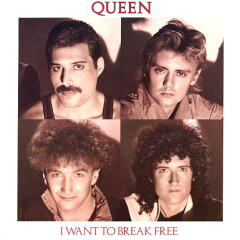
About the song
“I Want to Break Free” was written by Queen’s bassist, John Deacon. It appears as the second song on side two of Queen’s 11th studio album, The Works. Released as the second single from the album in April 1984, the song went to #45 on the Billboard Hot 100 Singles chart. Four different versions of the single were released. The video for “I Want to Break Free” was a parody of the long-running British television soap opera, Coronation Street, featuring the members of Queen dressed as women. MTV banned the video as they considered it too controversial. Personnel on the record were: Freddie Mercury (lead and backing vocals), Brian May (electric guitar), John Deacon (bass, acoustic guitar, synthesizer), Roger Taylor (drums), and Fred Mandel (synthesizer solo).
The Works was recorded between August 1983 and January 1984 at the Record Plant in Los Angeles and Musicland in Munich, Germany. The title of the album comes from a comment Roger Taylor made as they started recording it. Referring to the fact that the record would be a combination of old-style Queen hard rockers and newer-style Queen electronic synth-pop, he said, “Let’s give them the works.” The Works was produced by Queen and Reinhold Mack and was released in February 1984. It went to #23 on the Billboard Top 200 Albums chart. Four singles were released from the album. It has been certified Gold by the Recording Industry Association of America.
Queen is a British rock band formed in London in 1970 by singer Freddie Mercury, guitarist Brian May, drummer Roger Taylor and bassist John Deacon. May and Taylor had previously played together in the London-based rock band Smile. Queen has sold more than 250 million records worldwide and has released 15 studio albums, 10 live albums, 15 compilation albums, two soundtrack albums, two EPs, and 73 singles. The band has won four Brit Awards, four Ivor Novello Awards, a Grammy Award, and a Grammy Lifetime Achievement Award. They are members of the Rock and Roll Hall of Fame, Songwriters Hall of Fame, and UK Music Hall of Fame. Brian May and Roger Taylor have continued to tour with supporting musicians as Queen. The band has featured both Paul Rodgers and Adam Lambert as their lead vocalist since the death of Freddie Mercury in 1991. Founding member John Deacon retired from the band in 1997. Queen, with Adam Lambert on lead vocals, last appeared live at five concert dates in Japan in February 2024.