The Shale Revolution has caused big changes in U.S. crude oil production, in domestic flows of crude via pipelines, ships and rail tankcars, and in crude import volumes. Flow changes in particular have negatively affected the Strategic Petroleum Reserve’s ability to accomplish its two primary goals: protecting U.S. refineries from the worst effects of a major crude oil supply interruption, and—when called upon by the International Energy Agency—quickly injecting large volumes of crude into global markets. A fix now in the works would add Gulf Coast marine terminals dedicated specifically to moving SPR-stockpiled crude to those who need it, both within the U.S. and overseas. Today we conclude a two-part blog series on challenges and coming changes at the SPR.
Crude oil helps drive economies around the world, and the world was—and still is—chock full of risk. The U.S., like other net oil-importing members of the International Energy Agency (IEA), has two obligations under the agency’s International Energy Program (IEP), which was established in the wake of the 1973-74 OPEC oil embargo. First, the U.S. needs to maintain crude oil inventories equal to at least 90 days of its net imports. Second, if the IEA calls for a collective response by its members to an international crude oil supply crisis, the U.S. is obligated to contribute to that effort volumes of crude equal to its share of total oil consumption by IEA’s members. That share is currently ~44%, which means that if there were a 4 million barrel/day (MMb/d) interruption in supply (from, say, a war in the Middle East), the U.S. would need to inject nearly 1.8 MMb/d (4 million barrels times 0.44) to keep its promise to IEA/IEP.
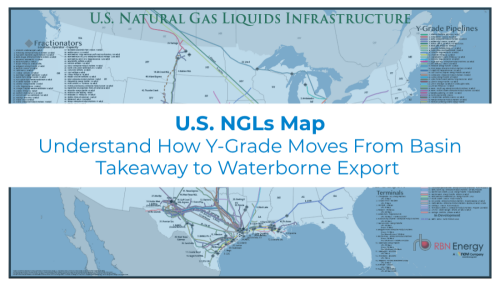
Visualize the infrastructure behind U.S. NGL movement.
The U.S. NGLs Map provides a comprehensive view of the transport, processing, and export networks moving NGLs across the U.S.
As we said in Part 1, the Strategic Petroleum Reserve (SPR) was set up by the federal government more than 40 years ago as an insurance policy of sorts, and as the mechanism for meeting the U.S.’s IEA/IEP obligations to maintain crude inventories and to provide its share of collective action by IEA members to help avert an oil-supply crisis. The SPR consists of 60 underground salt caverns (with capacities totaling 714 MMbbl) at four Gulf Coast sites: Bryan Mound in Freeport, TX (capacity, 245 MMbbl); Big Hill in Winnie, TX (163 MMbbl); West Hackberry in Hackberry, LA (212 MMbbl); and Bayou Choctaw in Plaquemines, LA (74 MMbbl). Each of the four is currently between 96% and 99% full.

About the song
“Need You Now” was written by Josh Kear, Hillary Scott, Charles Kelley and Dave Haywood. It appears as the first song on Lady Antebellum‘s (now known as Lady A) second studio album of the same name. Released as a single in August 2009, it went to #1 on the Billboard Hot Country Songs, Adult Contemporary, and Adult Top 40 Singles charts and has been certified 11x Platinum by the Recording Industry Association of America (RIAA). The song, featuring lead vocals from Hillary Scott and Charles Kelley, won four Grammy Awards in 2011. Personnel on the record were: Hillary Scott, Charles Kelley (lead vocals), Dave Haywood (backing vocals, acoustic guitar), Chad Cromwell (drums), Jason Gambill (electric guitar), Rob McNelley (electric guitar, slide guitar), Michael Rojas (piano, synthesizer), Craig Young (bass), and Paul Worley (acoustic, electric guitar).
The album, Need You Now, was recorded during 2009 in Nashville with Paul Worley and Lady Antebellum producing. Released in January 2010, it went to #1 on the Billboard 200 and Top Country Albums charts and has been certified 4x Platinum by the RIAA. It was Lady Antebellum’s first album to debut at #1 on the Billboard 200 Albums chart. Four singles were released from the LP.
Lady Antebellum (Lady A) is an American country music group formed in Nashville in 2006 by Hillary Scott, Charles Kelley and Dave Haywood. The band abbreviated their name to Lady A in June 2020. They have released nine studio albums, two EPs and 23 singles. They have won eight ACM Awards, four American Music Awards, two Billboard Music Awards, six CMA Awards, and seven Grammy Awards. The band continues to record and tour and will begin a new tour starting with an appearance at the Grand Ole Opry House in Nashville on September 20, 2023.