Nearly every energy-related discussion these days, regardless of the particular topic, eventually turns to data centers and AI, where speed to market has emerged as the major focus. As one panelist noted during March’s CERAWeek energy conference in Houston, of a data center developer’s top priorities, the first three are now speed, speed and speed, with cost and other factors coming next. In today’s RBN blog, we look at how developers must solve the issues around permitting, siting, offtake agreements and — most importantly — power generation in the race to get their data centers online as soon as possible. We’ll also preview our newest Drill Down Report on the data center buildout.
The substantial growth in data center capacity has been driven largely by the increasing demand for AI and what are generally classified as AI-powered tasks, such as speech recognition, image recognition, predictive analytics, personalized diagnostics/treatments, logistics/mapping applications, fraud detection and generative AI (see Smarter Than You). The rapid rise in generative AI is particularly noteworthy, catalyzed by the sudden success of ChatGPT and a few other AI chatbots riding that wave, including Claude, Copilot and Perplexity. The revolutionary potential of AI is hard to overstate and, correspondingly, so too is the potential money to be made. That has kicked off an all-out, no-holds-barred race to win market share. With so much competition in the market and the speed at which the machinery is advancing, developers have come to believe that getting their data center capacity online as quickly as possible is essential.
The first set of challenges around a data center’s development is fairly straightforward, if not always easy to navigate. Being able to secure the needed amount of electricity to power a site is the dominant issue (much more on that below) but there are many other factors to consider, including obtaining the available land, the ability to connect to fiber-optic networks, assessing weather and climate risks, local transportation and workforce issues, and access to water for cooling. Our new report breaks down the leading seven hubs for data center development — Arizona, California, Georgia, Illinois, Ohio, Texas and Virginia — and compares their relative strengths and weaknesses in several categories (see Figure 1 below), including market maturity, the regulatory environment and power grid capacity. (The report also does the same for four states that are emerging as hubs — Indiana, North Carolina, Ohio and Pennsylvania.)
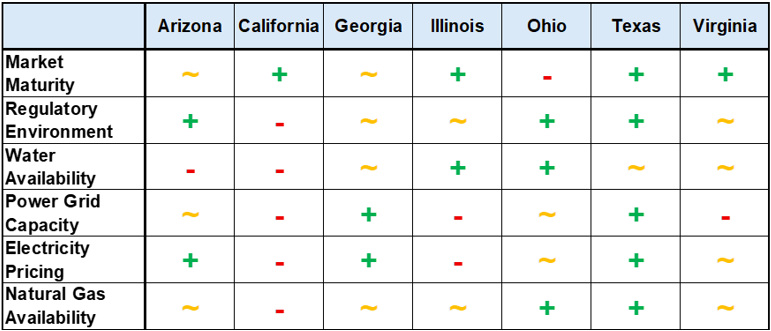
Figure 1. Relative Strengths and Weaknesses of Key Data Center States. Source: RBN
USGC Crude Oil Exports Hit New Record High
Crude oil exports out of the U.S. Gulf Coast rose sharply for the week ended April 24, jumping to 5.8 MMb/d, the highest weekly volume observed by RBN.
About the song
“Go Speed Racer Go” was written by Peter Fernandez, Nobuyoshi Koshibe and Yoshida Yoshiyuki. Speed Racer, also known as Mach GoGoGo, was a cartoon series created by Tatsuo Yoshida, who got the idea for the character from the cars featured in the films Viva Las Vegas and Goldfinger. Speed Racer’s image was drawn from Elvis’s black pompadour and white racing clothes, and his car the Mach 5 was inspired by the gadget-filled Aston Martin DB5 driven by James Bond. Fifty-two episodes were produced for the show, which ran in Japan from 1967 to 1968. English adaptations were overseen by Peter Fernandez, who also rewrote the theme song melody and English lyrics for release in the U.S. The series gained a large American audience when MTV began airing it in the mornings in 1992.
The lyrics of the series’ theme song describe Speed Racer’s adventures chasing bad guys, fighting corruption and participating in high-speed races. Peter Fernandez and Danny Davis put together the English adaptation of the theme song and recorded a 1:06 version for the series at an unnamed New York City recording studio in 1967. “Go Speed Racer Go” is available as a digital download. The song has been covered by Sponge, Matthew Sweet, The Mr. T Experience, and Ali Dee and the Deekompressors. Personnel on the record were: Danny Davis, Billy Mure, Don Burkenheimer, Jane Lederman (vocals), Danny Davis (trumpet), Billy Mure (guitar), and unnamed session musicians (keyboard, bass, drums).
Danny Davis and the Nashville Brass were formed in Nashville in 1967 by Danny Davis (George Joseph Nowlan), a Nashville-based trumpeter, vocalist and producer. At various times, the band included Nashville session stalwarts Floyd Cramer, Grady Martin, Buddy Harmon, John Hartford, Bob Moore and Buddy Thompson. In the 1980s, Davis became a member of the “Million Dollar Band,” featured on the weekly television series Hee Haw. He released 21 studio albums, one live album, three compilation albums and 11 singles. He won a Grammy Award in 1970. Davis died in Nashville in June 2008 at 83.
"About the Song" -- written by Mickey McMahan , RBN Director of Musicology