There’s good reason to be bullish about a skyrocketing trajectory for US methanol production. Natural gas prices are relatively low and likely to stay so; domestic demand for methanol continues to increase; and overseas demand—especially in China—is rising even faster. More than a dozen methanol mega-projects are in various stages of planning, design and construction, most of them along the Gulf Coast. If they were all built (they probably won’t be), US methanol production capacity would increase more than 10-fold to nearly 30 million metric tons per year, and turn the US from a methanol importer to an exporter within two or three years. Today, we look into why methanol demand is rising, what new capacity is under development in the US, and what it all means for natural gas producers.
Methanol, which can be produced from natural gas, coal or other hydrocarbons, has two primary uses. About two-thirds of worldwide demand (which now totals about 60 million metric tons per year, or 60 MTPA) is tied to methanol’s traditional use a basic chemical feedstock for making formaldehyde, acetic acid and petrochemical intermediates that, in turn, are used to make plastics, synthetic fibers, paints, resins and solvents, among many other things. The balance of methanol produced annually is used either in “methanol-to-olefins” (MTO) plants (most of them in China) that directly convert methanol into ethylene or polyethylene; as a fuel (again, mostly in China); or as a fuel additive. For example, methanol can be blended into gasoline; it can be used to produce dimethyl ether (DME), an alternative motor fuel and sometimes replacement for propane; and it can be used to produce methyl-tertiary-butyl ether (MTBE), an octane booster the US has banned for domestic use but still produces for export. Methanol’s fast-growing use in MTO and as a fuel is what’s driving worldwide demand, which by the early 2020s may top 100 MTPA—a full 40 MTPA higher than current demand.
Just as abundant, low-cost US shale gas and natural gas liquids (NGLs) have spurred development of export markets for those hydrocarbons, cheap gas has led a growing list of companies to propose methanol mega-projects (by our definition, 1 MTPA or more) that, if all built, would make the US “methanol independent” (that is, no longer a methanol importer) by 2017, and a major exporter (mostly to China) by 2018-19. As we said a year or so ago in our Cheap Trick: I Want You to Want Me(thanol) blog, the US was once a methanol production powerhouse. In the mid-1990s, domestic methanol capacity totaled about 10 MTPA (nearly five times what it is now), but by 2005, with natural gas prices on the rise, more than 90% of that capacity had been taken offline. In the past two or three years, a handful of methanol plant restarts and small-scale expansions have boosted US capacity to about 2.1 MTPA, but the era of US methanol production growth is really just beginning.
Before we get into what’s being planned and built, let’s take a moment to discuss the significance of rebounding methanol production to natural gas producers. On average it takes about 32 Bcf of natural gas to produce one million metric tons of methanol. So, if the US is currently producing, say, 2 MTPA, methanol plants would need about 64 Bcf per year, or (dividing by 365), about 175 MMcf/d. If the roughly 27 MTPA of new US methanol capacity planned to come online by the end of 2018 were actually built (and then operated at or near full capacity), another 2.4 Bcf/d of gas (for a total of nearly 2.6 Bcf/d) would be required. Even if only half of the plants were built (a more likely proposition), the methanol production sector’s gas demand would rise to 1.4 Bcf/d. Admittedly, those aren’t huge numbers when you consider that US gas production is expected to reach more than 72 Bcf/d in 2014, and to continue rising through the rest of this decade. Still, methanol appears to be emerging as another significant market for the incremental gas coming out of US shale plays.
About the song
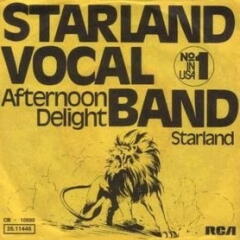
"Afternoon Delight" was written by Bill Danoff and appears as the eighth cut on Danhoff's band's debut album, Starland Vocal Band. The title of the song came from the happy hour menu at Clyde's restaurant in Washington, DC, where Danoff was eating dinner. "Skyrockets in flight, afternoon delight" was just one of the double-entendre couplets Danoff used throughout the lyrics. The song was released as a single in April 1976 and went to #1 on the Billboard Hot 100 Singles chart. It has been certified Gold by the Recording Industry Association of America, and won two Grammy Awards in 1977 for Best Arrangement for Voices and Best New Artist. Billboard magazine rated it #20 on its list of "The Sexiest Songs of All Time" in 2010. Personnel on the record were: Bill Danoff, Taffy Danoff, Jon Carroll, and Margot Chapman (vocals).
The album Starlight Vocal Band was recorded in November 1975 and was produced by Milt Okun. Released in April 1976, it went to #20 on the Billboard Top 200 Albums chart. Four singles were released from the LP.
Starland Vocal Band started in 1969 as a Washington, DC, folk duo called Fat City, which was Bill Danoff and Taffy Nivert (later to become Danoff). They released two studio albums under the Fat City moniker: Reincarnation and Welcome to Fat City. The Danoffs also released two studio albums under the name Bill & Taffy: Pass it On and Aces. The pair had co-written songs with John Denver, included the hit, "Take Me Home, Country Roads," which led to Denver signing them to his label, Windsong Records. Now expanded to a quartet act, Starland Vocal Band, riding high on the success of "Afternoon Delight," hosted a weekly television variety show during the summer of 1977 called The Starland Vocal Band Show. One of the featured writers and performers on the show was a young David Letterman. The band released five studio albums and 10 singles before officially disbanding in 1981. All four members went on to pursue solo careers.