


Times are tough in the methanol market. Posted and spot prices for methanol have continued falling (to levels not seen since 2010). New methanol capacity, planned during the good ol’ days, has been coming online, further depressing prices. And while more methanol-to-olefins (MTO) plants are starting up in China—the product’s biggest market—they are running at far less than full speed. But one bright spot for U.S. methanol producers is dirt-cheap natural gas, providing U.S. plants a competitive advantage versus those in the rest of the world. Today, we examine recent developments in the methanol market and consider what may be coming next.
We begin with a brief recap of what methanol is, and how it’s produced and used. As we said more than two years ago in Cheap Trick, methanol is a basic chemical feedstock. It looks like clear water (if only we could have worked that into today’s CCR-related blog title!) and it’s produced primarily from natural gas using a steam methane reformer process (though it also can be made from coal and other hydrocarbons). About two-thirds of methanol’s worldwide demand is tied to its traditional use in the petrochemicals market, making formaldehyde, acetic acid and petrochemical intermediates that, in turn, are used to make plastics, synthetic fibers, paints, resins and solvents, among many other things. The balance of the methanol produced annually is used either in MTO plants (most of them in China) that directly convert methanol into ethylene or polyethylene; in methanol-to-propylene (MTP) plants; as a fuel (again, mostly in China); or as a fuel additive. For example, methanol can be blended into gasoline. It also can be used to produce dimethyl ether (DME), an alternative motor fuel and sometimes replacement for propane; methyl-tertiary-butyl ether (MTBE), an octane booster (banned in U.S. markets); or tert-amyl methyl-ether (TAME), a fuel oxygenate.

The chart in Figure 1 shows historical and forecast methanol consumption by demand sector from a recent Methanex Investor Presentation (Methanex is the largest methanol producer). Chemical feedstock use (blue bars) and MTBE/TAME (light gray bars) dominate prior to 2010 but use in fuel (dark grey bars) and DME (purple bars) expanded significantly between 2010 and 2014. Consumption in new MTO plants (and, to a lesser extent, MTP plants; (yellow bars) took off in 2015 and is expected to continue growing through 2019 as more new plants come online in China. Overall methanol demand grew at a 7% compound annual growth rate (CAGR) between 2006 and 2015 and Methanex expects that growth rate to be maintained through the end of 2019 (though that optimism is contingent on a number of factors).
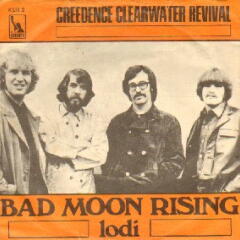
About the song
“Bad Moon Rising” was the lead single from Creedence Clearwater Revival’s third album, Green River. Written and produced by John Fogerty, the song was recorded at Wally Heider’s Studio in San Francisco in March 1969. The single reached #2 on the Billboard Hot 100 singles; the Green River LP went to #1 on the Billboard 200 album chart.
John Fogerty has said he wrote “Bad Moon Rising” after watching “The Devil and Daniel Webster,” and was inspired by a scene in the movie involving a hurricane. The last line of the chorus — “There’s a bad moon on the rise” — has often been misheard as "There’s a bathroom on the right," and Fogerty has been known to sing that line sometimes in concert. The song has been used in numerous films and television shows.
Creedence Clearwater Revival, also referred to as CCR, included John Fogerty (lead and backing vocals, lead guitar and piano), Tom Fogerty (rhythm guitar), Stu Cook (bass) and Doug Clifford (drums). The band was formed in the San Francisco Bay area in 1967 and released seven studio albums from 1968 to 1972 — they disbanded in October of that year. John Fogerty went on to have a successful solo career and still tours today. Tom Fogerty (John’s older brother) released several solo albums before passing away in 1990. Stu Cook and Doug Clifford still tour today as Creedence Clearwater Revisited, playing a repertoire of CCR songs. Creedence Clearwater Revival was inducted into the Rock and Roll Hall of Fame in 1993.







Comments
The swing demand driver in Asia - essentially China - is not only MTO/MTP but also DME relative to Propane. There will be incremental demand pull only when methanol price relative to naphtha is atractive (it's trivial) and DME in terms of $/mmbtu is cheaper than propane. About 20% of china's methanol consumption is in a form of DME, and unlike gasoline pool there's no strict regulation (like octane rating) about blending in China's liquid gas market so it's all about energy value. The heat contents of DME is roughly about a half of propane, so as a rule of thumb in equilibrium methanol price in Asia is 0.5x propane. Such relationship has held well over a decade, and at oil 35 the propane is about $300/t so methanol price should see pressure to $150/t.