


Many in the Northeast are digging out from what turned out to be a typical snowstorm – not a “Superstorm”. Thanks to worse crises in the past, however, a federal Northeast Home Heating Oil Reserve was set up in 2000 and--thanks to Superstorm Sandy--federal and New York gasoline strategic reserves were put in place much more recently. The winter propane crisis of 2013-14 also sparked talk of a possible strategic reserve for propane. The theory behind establishing these stockpiles is that in markets that depend heavily on steady, reliable flow of energy products it’s important to have a cushion, a squirreled-away supply to avoid the price spikes and near-panic that can follow the words, “Sorry folks, we’re all out.” Today we examine what’s been done, how it’s worked, and what might be next.
There are three sure-fire ways to spur interest in establishing a strategic reserve of hydrocarbons: people waiting in long lines at the gas pump, people shivering in unheated homes in the dead of winter, or prices spiking in times of shortage. (Provide two or, better yet, all three of these and action will be swift and bi-partisan!) The granddaddy of all strategic reserves, of course, is the Strategic Petroleum Reserve (SPR), which was set up 40 years ago after the 1973-74 oil embargo. The idea of stockpiling crude for an emergency was first floated during World War II; it was considered again in the 1950s and in 1970, but the huge market and economic dislocations caused by the oil embargo soon thereafter finally made the SPR happen. It took a few years for the feds to buy and fill the four underground salt dome storage facilities along the Gulf Coast that now hold a total of about 692 MMBbl of crude (see Figure #1 for a summary of SPR sites and pipeline connections to refining centers). An expansion of the SPR (current capacity, 727 MMBbl) to 1 BBbl by 2018 was authorized by the Energy Policy Act of 2005, but no funding is in place to make the expansion a reality.
About the song
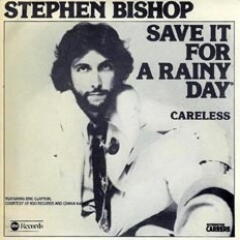
"Save It for a Rainy Day" was written by Stephen Bishop, and appears as the 10th song on Bishop's debut studio album, Careless. The song was released in December 1976 and went to #6 on the Billboard Adult Contemporary chart and #22 on the Billboard Hot 100 Singles chart. Personnel on the recording were: Stephen Bishop (lead vocals, acoustic guitar), Eric Clapton (lead electric guitar), Jeff Staton Jones (bass, rhythm electric guitar), Russ Kunkel (drums), Barlow Jarvis (acoustic piano, electric piano), Chaka Khan (backing vocals, lead vocal at end of song), and Ian Freebairn-Smith (horn arrangements). Country artist Kenny Chesney had a #1 hit on the country charts with a different song of the same title. Americana band, The Jayhawks, had a different song with the same title on their album, Rainy Day Music.
Bishop’s Careless LP was recorded at ABC Studios and A&M studios in Hollywood, CA, with Henry Lewy and Stephen Bishop producing. Released in December 1976, the album went to #32 on the Billboard Top 200 Albums chart. Two singles were released from the album, the other being “On and On,” which peaked at #11 on the Billboard Hot 100.
Stephen Bishop is an American singer-songwriter, musician, and actor. He is also known as playing the folk singer on the stairway in the movie National Lampoon's Animal House, where John Belushi grabs his guitar and smashes it to pieces. Bishop has contributed many songs to motion pictures, and a long list of recording artists have covered his songs over the years. Bishop has released 19 albums and 16 singles. He continues to record and tour to this date, with all touring plans on hold until 2021 due to COVID.





Comments
How do the managers of these massive storage volumes deal with the degradation of refined products over time -- gumming, etc?