The federal Renewable Identification Number (RIN) and California’s Low Carbon Fuel Standard (LCFS) have long served as tools to force renewable fuels like ethanol into the U.S. fuel supply. They are environmental credits that subsidize production of renewable fuels that would not otherwise be economically justified. Nuances embedded in the design of these credit systems have again kicked in to surprise the markets, this time with a hit to renewable diesel (RD) margins. Today’s RBN blog zeroes in on two root causes for that hit.
The replay of our Fall 2026 School of Energy (September 9 & 10, Houston) is now available online!
Learn from RBN experts, participate in hands-on Excel modeling, connect with industry peers, and gain a stronger understanding of today's interconnected energy markets.
In Part 1 of this series we provided a general overview of the RD market and an update regarding two important bio-feedstocks — soybean oil and used cooking oil. In Part 2, we examined the economics of a representative plant that makes RD from soybean oil for sale in California. In that blog, we said that in our plant it cost $5.30 to make a gallon of RD that sold for $1.90, giving it a “free market margin” of minus $3.40/gal (red-shaded box in left-hand chart of Figure 1 below). That sounded like a really unattractive business. But the plant received government subsidies of $4.30/gal that brought its final margin (after subsidies) to $0.90/gal (green-shaded box in left-hand chart), quite attractive by normal investment standards.
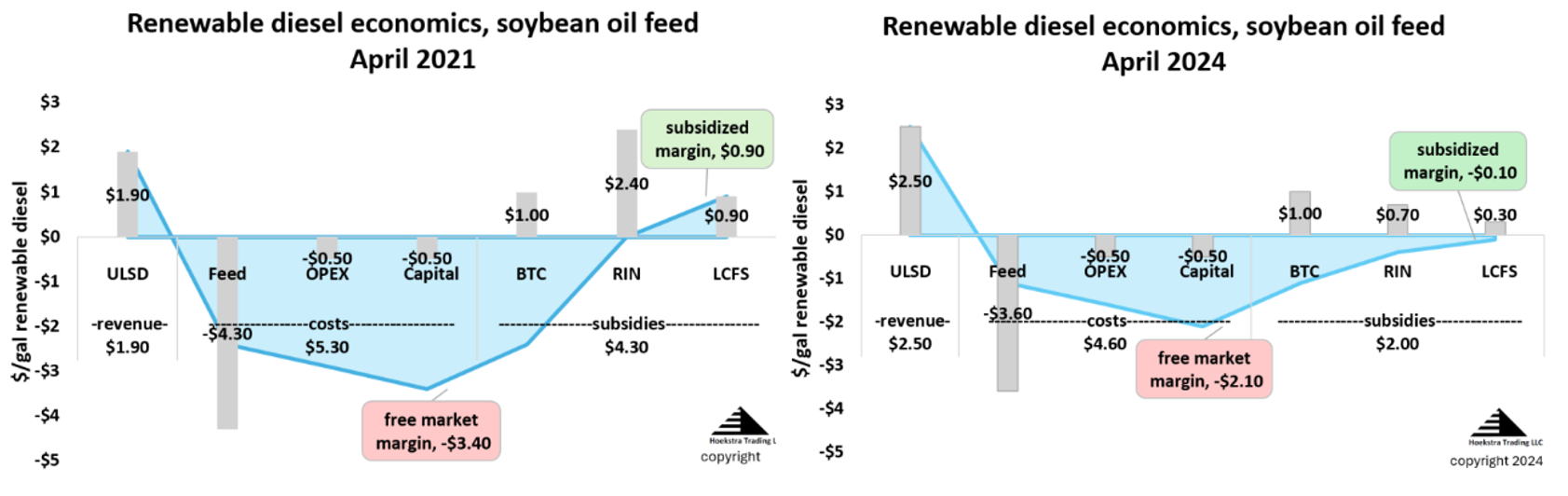
Figure 1. Renewable Diesel Economics, Soybean Oil Feed, April 2021 and April 2024. Sources: Hoekstra Trading LLC, RBN Energy
About the song
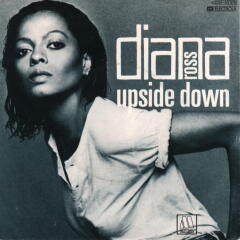
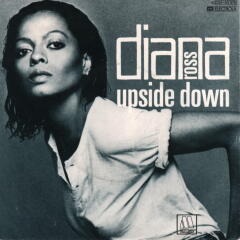
“Upside Down” was written by Nile Rodgers and Bernard Edwards (Chic) and appears as the first song on side one of Diana Ross’s 11th studio album, diana. Released as the first single from the album, the song went to #1 on the Billboard Hot 100, Disco, and Soul Singles charts. It has been certified Gold by the Recording Industry Association of America. Personnel on the record were: Diana Ross (lead vocals), Bernard Edwards (bass), Nile Rodgers (guitar), Tony Thompson (drums), Andy Barrett (piano), Raymond Jones (keyboards), and Alfa Anderson, Fonzi Thornton, Luci Martin, Michelle Cobbs (backing vocals).
Recorded between December 1979 and March 1980 at the Power Station in New York, diana was produced by Bernard Edwards and Nile Rodgers. Ross and her production team had a falling out over the mixes, and she and Russ Terrana rerecorded her vocals and remixed the album at Electric Lady in New York, and Motown/Hitsville USA studio in Hollywood. The album was released in May 1980 and went to #1 on the Billboard Top R&B/Hip-Hop Albums, and #2 on the Billboard 200 Albums charts. It has been certified Platinum by the RIAA. Three charting singles were released from the LP.
Diana Ross is an American singer, songwriter and actress from Detroit. Ross rose to fame as the lead vocalist for The Supremes, Motown’s most successful act in the ’60s. She left The Supremes in 1970 to embark on a solo career that continues to this day. As a solo artist, she has released 25 studio albums, five live albums, 30 compilation albums, one EP, four soundtrack albums, and 91 singles. As an actress, Ross has starred in five motion pictures and been featured in 35 television shows. She has won seven American Music Awards, one Grammy Award, one Golden Globe Award, and one Tony Award. She has been awarded a Lifetime Achievement Grammy Award, a Presidential Medal of Honor, a Kennedy Center Honor, and has a star on the Hollywood Walk of Fame. She still records and tours, and released her 25th studio album, Thank You, in November 2021.