Strategic Petroleum Reserve (SPR) inventories have been climbing over the past year as the Department of Energy (DOE) advances plans to replenish it following the record 180-MMbbl drawdown after Russia’s invasion of Ukraine in 2022. But DOE officials have said its refilling efforts are complicated by upgrades at three of the four SPR storage sites. In today’s RBN blog, we look at the scope of these “life-extension” projects, the completion timetable, and how it might drag out restocking efforts.

Before we dive in, let’s recap some key aspects of the SPR, the largest emergency crude stockpile in the world (see I Want To Break Free). As shown in Figure 1 below, the federal crude oil storage program is located at four sites: Bryan Mound and Big Hill in Texas and West Hackberry and Bayou Choctaw in Louisiana. Oil is kept in underground salt caverns — 61 in all — with a total authorized capacity of 714 MMbbl. The DOE maintains that the national crude oil reserve is always drawdown-ready, which means it can release barrels to the market within 13 days of presidential direction. (That is the time needed to conduct the sale/exchange process, award contracts, and arrange the logistics for oil transportation. The DOE estimates an additional 6-8 days of transit to ship barrels to PADD 1 and 16-18 days to ship barrels to PADD 5, with pipeline connections to the rest of PADD 3, PADD 2 and PADD 1.)
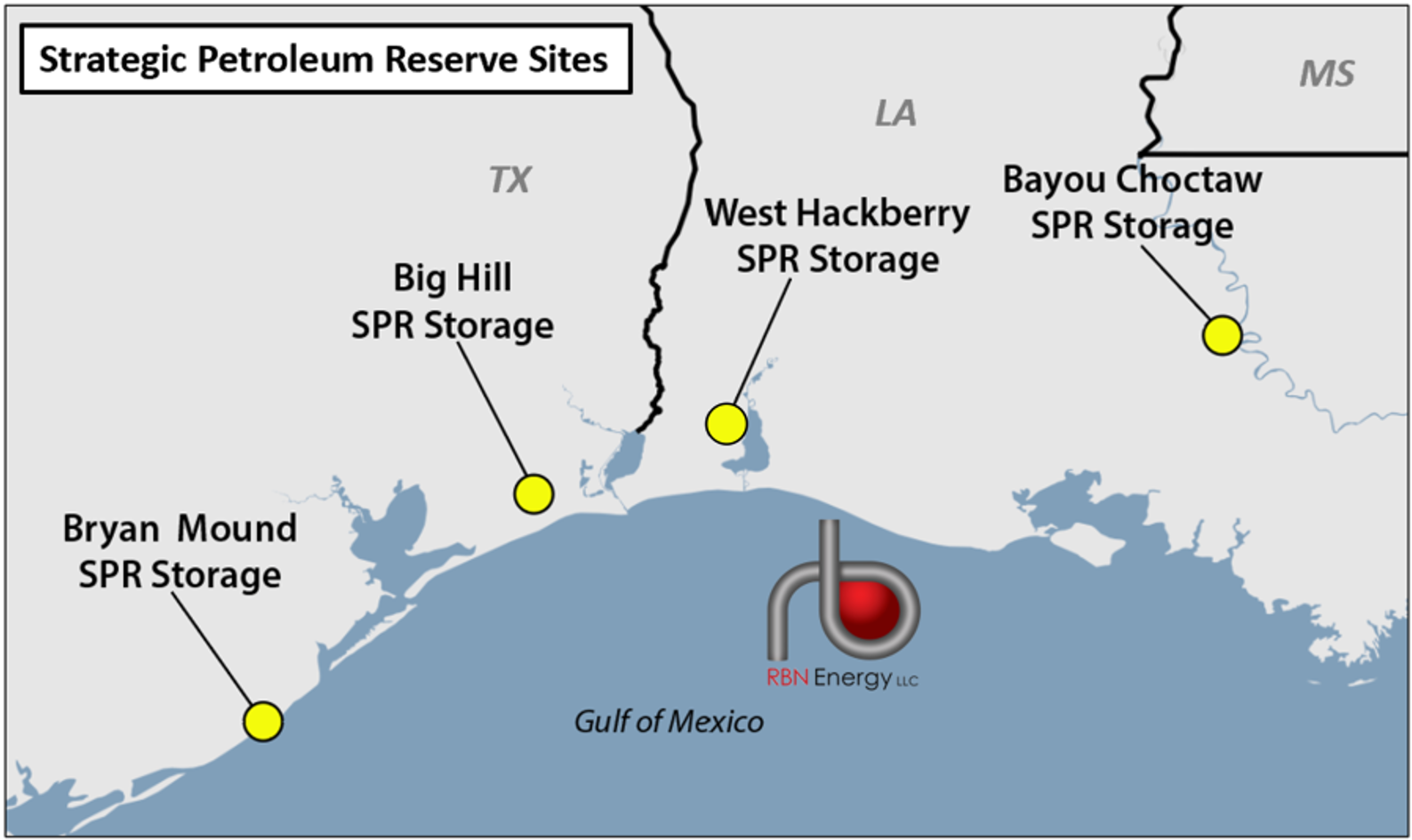
Figure 1. Strategic Petroleum Reserve Sites. Source: RBN
Following Russia’s invasion of Ukraine in February 2022 (red line in Figure 2 below), the Biden administration released 180 MMbbl of crude oil — or about 1 MMb/d over six months — to temper surges in crude and refined product prices. As we noted in Running Up That Hill, crude oil futures rallied to a 14-year high — West Texas Intermediate (WTI) crude oil zipped past $100/bbl shortly after the invasion and traded as high as $123.70/bbl — as supply uncertainty rattled markets and caused spikes in gasoline and diesel prices. President Biden also ordered the release to fill supply gaps until domestic output grew enough to fill them (see All I Need To Get By). The historic release began about three months after the war started and concluded in December 2022, adding to a drawdown already underway from government-mandated sales for bills passed in previous years. The SPR fell to its lowest level in 40 years — 346.8 MMbbl — in July 2023. (We should note that each SPR site can release barrels to the market much faster than it can add them. More on each of the four sites below.)
About the song
“It’s All Coming Back to Me Now” was written by Jim Steinman and appears as the first song on Celine Dion’s 14th studio album, Falling Into You. Meat Loaf, who had worked with Steinman on many of his hit records, wanted to record the song, but Steinman said he envisioned it as a “woman’s song.” The girl group Pandora’s Box first recorded the song but Celine Dion had a Top 10 hit record with it. Released as a single in July 1996, it went to #2 on the Billboard Hot 100 Singles chart and has been certified 2x Platinum by the Recording Industry Association of America. Personnel on the record were: Celine Dion (vocal), Roy Bittan (grand piano), Jeff Bova (keyboards, programming), Tim Pierce, Eddie Martinez (guitars), Steve Buslowe (bass), Jimmy Bralower, Kenny Aronoff, Bashiri Johnson (drums, percussion), and Todd Rundgren, Eric Troyer, Rory Dodd, Glen Burtnick, Kasim Sulton (backing vocals).
The album, Falling Into You, was recorded at Capitol, Record Plant, and Westlake in Los Angeles; Compass Point in Nassau, Bahamas; at Cove City Sound Studios on Long Island; and MEGA Studios, Dream Factory, Hit Factory, and Power Station in New York City during 1995-96. It was produced by Jim Steinman, Roy Bittan, Jeff Bova, David Foster, Humberto Gatica, Jean-Jacques Goldman, Rick Hahn, Dan Hill, John Jones, Rick Nowells, Aldo Nova, Steven Rinkoff, Billy Steinberg, and Ric Wake. Released in March 1996, it went to #1 on the Billboard 200 Albums chart and has been certified 12x Platinum by the RIAA. Five singles were released from the LP.
Celine Dion is a Canadian pop singer known as the “Queen of Power Ballads.” She was discovered by her future manager and husband, Rene Angelil, when she was 13 and putting out French-language records. She had her first Top 10 hit, “Where Does My Heart Beat Now,” in 1990. She has released 27 studio albums, seven live albums, two soundtrack albums, 20 compilation albums, and 137 singles. She has sold more than 200 million records worldwide. She has won seven American Music Awards, nine Billboard Music Awards, five Grammy Awards, 20 Juno Awards, and 12 World Music Awards. In December 2022, Dion announced she had been diagnosed with stiff-person syndrome, a neurological disease affecting movement and her vocal cords. Her last public appearance was singing “Hymne a l’amour” at the 2024 Summer Olympics in Paris.