There are two primary drivers for consuming more natural gas close to where it emerges from production wells. One is to eliminate routine gas flaring, which is wasteful and environmentally detrimental, and the other — especially true in takeaway-constrained plays like the Permian — is to add value to gas that otherwise would be sold downstream at steeply discounted prices. In today’s RBN blog, we discuss some innovative approaches to maximizing gas value by consuming it “in-basin” — and the potential for a lot more gas to be used in West Texas and southeastern New Mexico.
We first blogged about gas flaring a dozen years ago, in the RBN blogosphere’s Stone Age, noting that one-third — yes, one-third! — of the associated gas then being produced in the booming Bakken was being flared. The main culprit was a dire lack of gas gathering systems, gas processing plants and long-haul gas pipelines, whose development was far outpaced by the increases in crude oil and associated gas production. Gas flaring wasn’t a new thing, of course. In fact, crude-oil-focused E&Ps have been flaring gas in the U.S. since the first oil was produced in western Pennsylvania more than 160 years ago, both for safety reasons and — then as now — for lack of infrastructure.
As we’ve discussed often (see It Don’t Come Easy and Cover Me), there’s a big push in the U.S. — and globally — to reduce greenhouse gas (GHG) emissions, with a special focus on both carbon dioxide (because of the gargantuan volumes involved) and methane (because of its heat-trapping potency). And that’s spurred broad efforts to eliminate all “routine” (non-emergency/non-safety-related) flaring of natural gas by 2030 (if not sooner). The U.S. and more than 30 other countries have agreed to work toward that target, as have more than 50 large oil and gas companies.
About the song
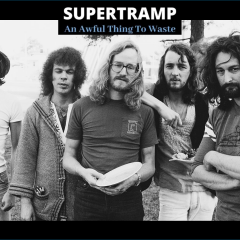
“An Awful Thing to Waste” was written by Rick Davies and appears as the fourth song on side two of Supertramp’s ninth studio album, Free as a Bird. The song addresses the advantage of taking the positive road in life and not letting negativity get in the way of opportunities. Personnel on the record were: Rick Davies (lead vocals, keyboards), John Helliwell (saxophone), Dougie Thompson (bass), Bob Seibenberg (drums), Mark Hart (keyboards, guitar, backing vocals), Marty Walsh (guitar, backing vocals, Lee Thornburg, Nick Lane, Scott Page, Lon Price, David Woodford (horn section), Steve Reid (percussion), and Linda Foot, Lise Miller, Evan Rogers, Karyn White (backing vocals).
Free as a Bird was recorded in 1987 at Ocean Way Recording in Hollywood and The Backyard in Encino, CA, and produced by Rick Davies and Tom Lord-Alge. The album was released in October 1987 and went to #101 on the Billboard 200 Albums chart. Two singles were released in the U.S. from the LP.
Supertramp was a British pop band formed in London in 1970. The band blended pop sensibilities with progressive rock, utilizing pronounced use of the Wurlitzer electric piano. They had their greatest success with their sixth album, Breakfast in America, released in March 1979, which reached 4x Platinum in sales as certified by the Recording Industry Association of America. They released 11 studio albums, six live albums, four compilation albums and 28 singles and have sold over 60 million records worldwide. Eighteen people passed through the band before their latest breakup in November 2012. Supertramp vocalists Rick Davies last toured in 2015 and Roger Hodgson in 2019.