Permian crude production is up over 1.5 MMb/d today and headed to 1.7 MMb/d by the end of 2014. Current hot spots include the Bone Spring, Avalon and Wolfcamp horizontal shale plays in the northern Delaware Basin located in Northwest Texas and Southeast New Mexico. Today we look at new and proposed gathering systems in the Delaware Basin that will transport over 200 Mb/d of crude from truck terminals to regional pipelines, rail hubs and refineries.
Recap
In Episode 1 of this series we reviewed crude prices and takeaway capacity in the booming Permian Basin. As soon as the new 300 Mb/d BridgeTex pipeline – a joint venture between Magellan Midstream and Occidental – comes online (now expected in June/July of this year) we can expect the Midland/LLS spread to narrow. In the meantime, the price spreads are generally too low to justify more expensive rail transport out of the Permian. In Episode 2 we provided an overview of mainline pipelines out of the Permian and the current centers of production activity and then started our survey of gathering systems with the new Cline Shale pipeline lateral expected online in June of this year that will deliver up to 75 Mb/d of crude to the Centurion and BridgeTex pipelines in Colorado City. In Episode 3 we covered pipeline additions and expansions planned by Plains All American who own and operate the Basin pipeline that runs from Jal, NM through the Permian and delivers up to 450 Mb/d from Colorado City, TX to Cushing, OK. Plains are in the process of building extensions and expansions to increase the flow of crude to the Basin system as well as their latest project the Cactus pipeline, due online in mid-2015 that will deliver Permian crude south to the Eagle Ford. In Episode 4 we covered gathering system developments to deliver new crude production in the Midland basin to Colorado City and Crane.
Today’s episode of our series on crude gathering in the Permian describes new infrastructure being built to deliver booming crude production in the Delaware Basin to market. Production economics in Permian Basin shale plays are the focus of RBN’s latest drill-down report for our Backstage Pass subscribers – see the ad below for details.
Rangeland RIO System
Two weeks ago (May 13, 2014) Rangeland Energy, a midstream infrastructure development company, announced that construction of the Rangeland Integrated Oil System (RIO System) in Southeast New Mexico and West Texas has started. RIO is designed to transport crude and condensate production to multiple downstream markets across the U.S. via outbound rail and pipeline.
The rail terminal - known as the RIO Hub is located near Loving, NM, in the center of the Delaware basin’s drilling and production activity and served by BNSF railroad. The RIO Hub will provide storage, blending and rail loading facilities for outbound crude oil and condensate as well as for the unloading of frac sand. Truck-to-rail transload operations are expected to begin in October 2014 with an initial capacity of 10 Mb/d. Rangeland has future plans to build unit train loading facilities to increase capacity to over 100 Mb/d.
The RIO Pipeline project is planned to connect the RIO Hub at Loving to market centers in Midland, TX, and beyond (see Figure 1 below). The first 30-mile leg of the RIO Pipeline will connect the RIO Hub to the RIO State Line Terminal, a gathering hub at the TX-NM border where Rangeland will provide storage and truck unloading facilities. An additional 104 miles of pipeline will connect the RIO State Line Terminal to the RIO Midland Terminal, which will provide connections to various long-line pipes to Cushing and Gulf Coast markets. The pipeline is planned to have 75 Mb/d capacity. The company is working with potential customers to obtain the volume support required to begin construction of the pipeline. Rangeland has also publically presented further plans for a RIO Colorado City Extension pipeline from Midland to Colorado City that would link to the Permian Express 2 and BridgeTex pipelines.
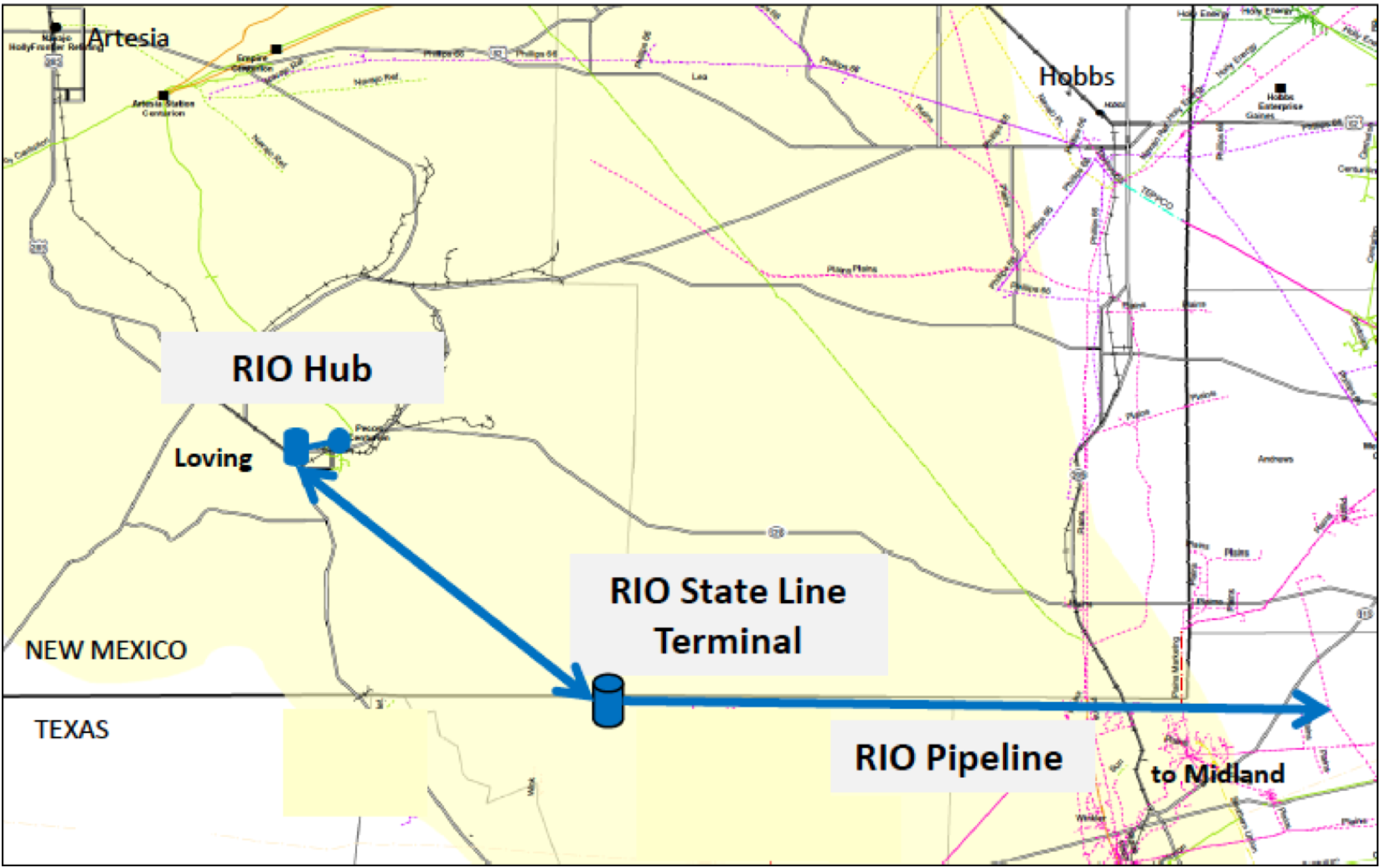
Figure #1