


The next six months look set to be quite turbulent for Permian Basin producers. Crude production is now over 1.5 MMb/d and supplies trying to get to market are facing congested pipelines leading to price discounts. New capacity is due online in June in the shape of the 300 Mb/d Magellan/Occidental joint venture BridgeTex pipeline. But many Permian producers are also awaiting the build out of gathering systems to deliver their crude to regional hubs in Crane, Midland and Colorado City where the major takeaway pipelines originate. At least a dozen of these systems are currently being developed. Today we start a new series on the build out of Permian gathering infrastructure.
Recently on the Permian
Last month we looked at the delicate balance between crude supply and takeaway capacity in the Permian Basin at the moment (see Eight Bucks Low in the Permian). We have previously covered the growth in production and build out of pipeline capacity to get Permian crude to market – starting in 2012 with our “New Adventures of Good Ole Boy Permian” series. Last year (2013) in our “Rock the Basin” series we covered plans to open up new takeaway capacity (see Tight Pipeline Balance) and the market impact of new pipelines to Houston (see Opening the Permian Crude Floodgates and Can Houston Refineries Absorb New Permian Crude Supplies?). Permian crude production this year (April 2014) is already estimated at more than 1.5 MMb/d and headed to 1.7 MMb/d by the end of the year. In spite of the addition of 335 Mb/d of new pipeline capacity out of the Permian in 2013, there is still not enough room to comfortably ship growing production to market. But new pipelines and expansion expected online this year and next will add 750 Mb/d of capacity out of the region and should exceed crude production growth until the early 2020’s. In preparation for the huge increase in pipeline capacity out of the Permian between 2013 and 2015 there has been a necessary build out of gathering infrastructure to feed growing production to the new mainline pipes or to redirect it to local refineries. This blog series provides an update on this infrastructure build out by producers, refiners and midstream operators in West Texas and New Mexico.
Current Permian Prices
We start this series by bringing you up to speed on two important parts of the Permian crude takeaway equation- the prices that producers get for their crude and the balance between production and takeaway capacity. First the crude price situation. Permian crude production is mostly categorized as one of two grades – the light sweet West Texas Intermediate (WTI) or the sour West Texas Sour (WTS). Figure 1 shows the discounts paid over the past year for WTI and WTS delivered to pipelines in Midland, TX (in the Permian Basin) versus the price of WTI and WTS delivered to the Cushing, OK trading and storage hub. If there is adequate capacity available on pipelines out of Midland into Cushing the discount should reflect the $0.70/Bbl pipeline tariff between Midland and Cushing. At the moment the pipeline capacity to Cushing is tight because of growing production, refinery maintenance reducing local West Texas crude demand and recent pipeline outages, so that Midland prices are discounted heavily. The blue line in the chart is WTI crude at Midland and the orange line is WTS at Midland. Between last April and mid-September the discount was minimal with WTI Midland averaging 18 cnts/Bbl below and WTS about 1 cnt/Bbl above WTI at Cushing. Since last September the discount has ballooned out – averaging about $4.25/Bbl for WTI and $4.50 for WTS and falling close to $11/Bbl in March of 2014. The discounts are still running at around $8/Bbl on average this year - suggesting that the congestion continues at the moment.
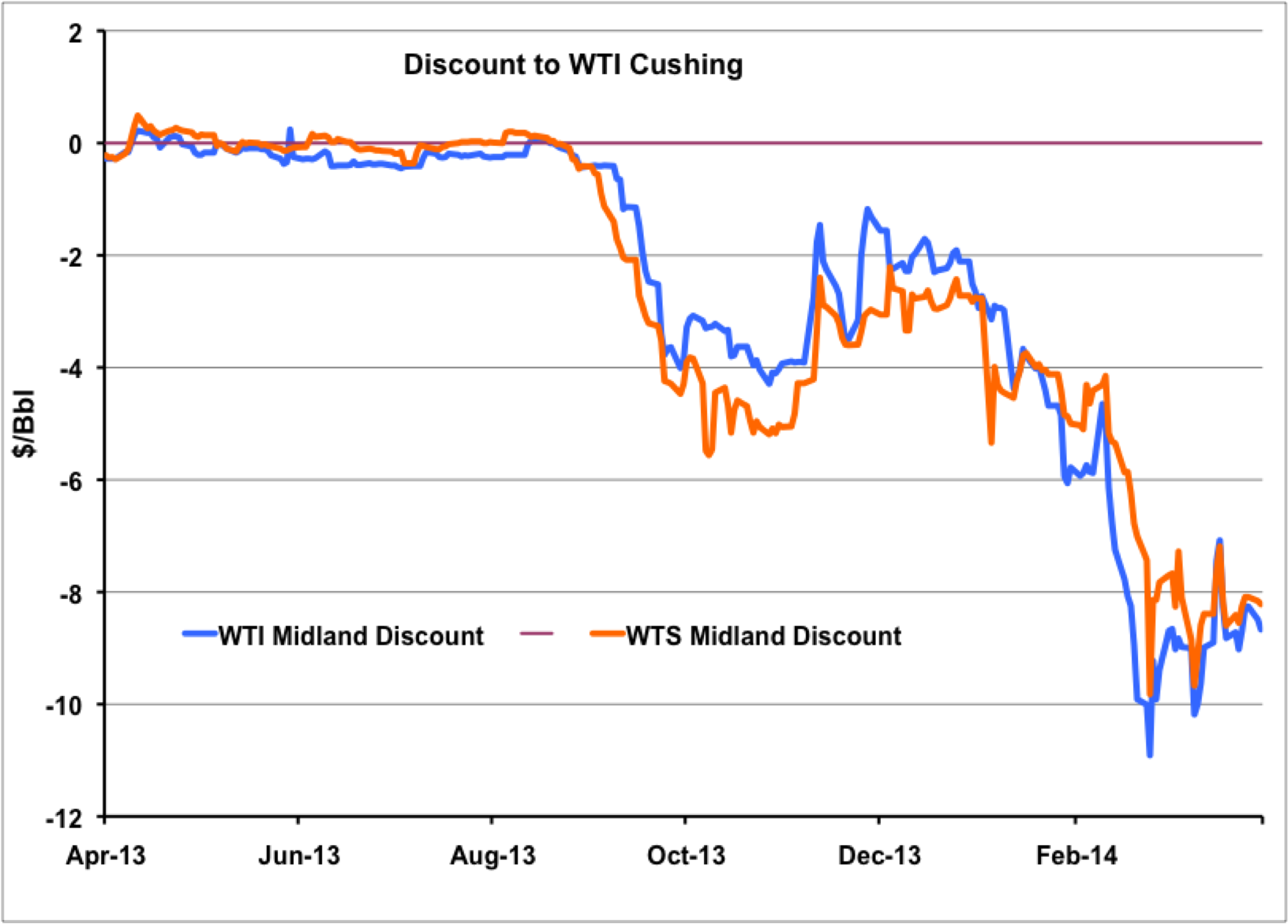
Figure 1

About the song
“The Times They Are a-Changin’” was written by Bob Dylan and appears as the first song on side one on Bob Dylan’s third studio album of the same name. Dylan wrote the song to be an anthem for change. It became a rallying cry for the civil rights and anti-war movement in the U.S. in the 1960s and remains a timeless classic song of strength for troubled times. It was released as a single in the U.K. in 1965, where it went to #9 in the U.K. Singles chart. Surprisingly, it was not released as a single in the U.S. The song has been covered by many artists, including Peter, Paul and Mary; Joan Baez, The Byrds, Bruce Springsteen, and Brandi Carlile. In December 2010, Dylan’s hand-written lyrics of the song sold at auction at Sotheby's in New York City for $422,500. Personnel on the record were: Bob Dylan (lead vocal, acoustic guitar, harmonica).
The album, The Times They Are a-Changin', was recorded between August and October 1963 at the Columbia 7th Ave. studio in New York City and produced by Tom Wilson. Released in February 1964 (days after The Beatles appeared on Ed Sullivan), it went to #20 on the Billboard 200 Albums chart and has been certified Gold by the Recording Industry Association of America. No singles were released from the LP in the U.S.
Bob Dylan is an American singer and songwriter. He has been an iconic international figure in popular culture for over six decades and has released 40 studio albums, 16 live albums, 31 compilation albums, seven soundtrack albums, 24 EPs, and 102 singles. He is a member of the Rock and Roll Hall of Fame and the Songwriters Hall of Fame and is a recipient of Kennedy Center Honors, a Presidential Medal of Freedom, a Polar Music Prize, France’s Legion d’Honneur, and a Nobel Prize in Literature. Dylan is also known for his paintings, drawings and books. His most recent book, “The Philosophy of Modern Song,” contains essays on 66 songs by artists who have influenced him. Dylan still records and tours and is appearing with Willie Nelson, Robert Plant and Alison Krauss at the Outlaw Music Festival Tour in the U.S., which began in late June 2024 and continues through September 2024. Dylan’s archives are housed at the Bob Dylan Center in Tulsa, which opened in May 2022.







Comments
What about the Permian Express Phase I? Is that figured into the stack?
In reply to Permian Express Phase I by Chris DiPaolo
The Permian Express Phase 1 runs from Wichita Falls, TX to Nederland and, as such, does not increase takeaway capacity out of the Permian - only allowing existing barrels on the Basin pipeline to flow south from Wichita Falls. So it is not included in the stack.
Sandy