The Rocky Mountain region (PADD 4), with a population that is both smaller and more spread out than other parts of the Lower 48, consumes only around 650 Mb/d of refined products — just one-fourth the volume of the next-smallest PADD. That limits the need for refinery capacity, which matches the region’s average annual consumption and is only outstripped in the summer months. Yet, the Shale Revolution has impacted the Rockies as much as any other region, boosting production in the Denver-Julesburg (DJ) and Uinta basins, and the Montana portion of the Bakken. At the same time, the area has also seen increasing volumes coming in from PADD 2 and Canada. In today’s RBN blog, we’ll look at how PADD 4 dispenses these barrels and its role in balancing continental crude oil supply and demand.

Crude Oil TradeView provides up-to-date data and insights into the behavior of differentials for 33 crude assessments across North America. Each week, it also walks you through the reasoning of why differentials widen, narrow, flip (premium vs. discount), or blow out.
In Part 1 of this series, we explained how the U.S. is divided between five Petroleum Administration for Defense Districts, or PADDs (see Figure 1 below). With no production to call its own, PADD 1 relies on imported crude oil to supply its shrinking refinery base. But the East Coast’s population density also makes it the largest consumer of refined products. In Part 2, we put the spotlight on PADD 2 and how a 10% tariff on U.S. imports of Canadian crude oil could impact refineries in the Midwest and Great Plains. PADD 2 pipelines transport most Canadian exports, and its 25 refineries (combined capacity of 4.3 MMb/d) are, in many cases, significant consumers of heavy and light crudes from up north. In our PADD 3 blog, we looked at the critical role the Gulf Coast plays in crude oil and refined products markets, with its refineries being, on average, the most efficient and cost-advantaged in the world and its geography and infrastructure providing it ample export opportunities.
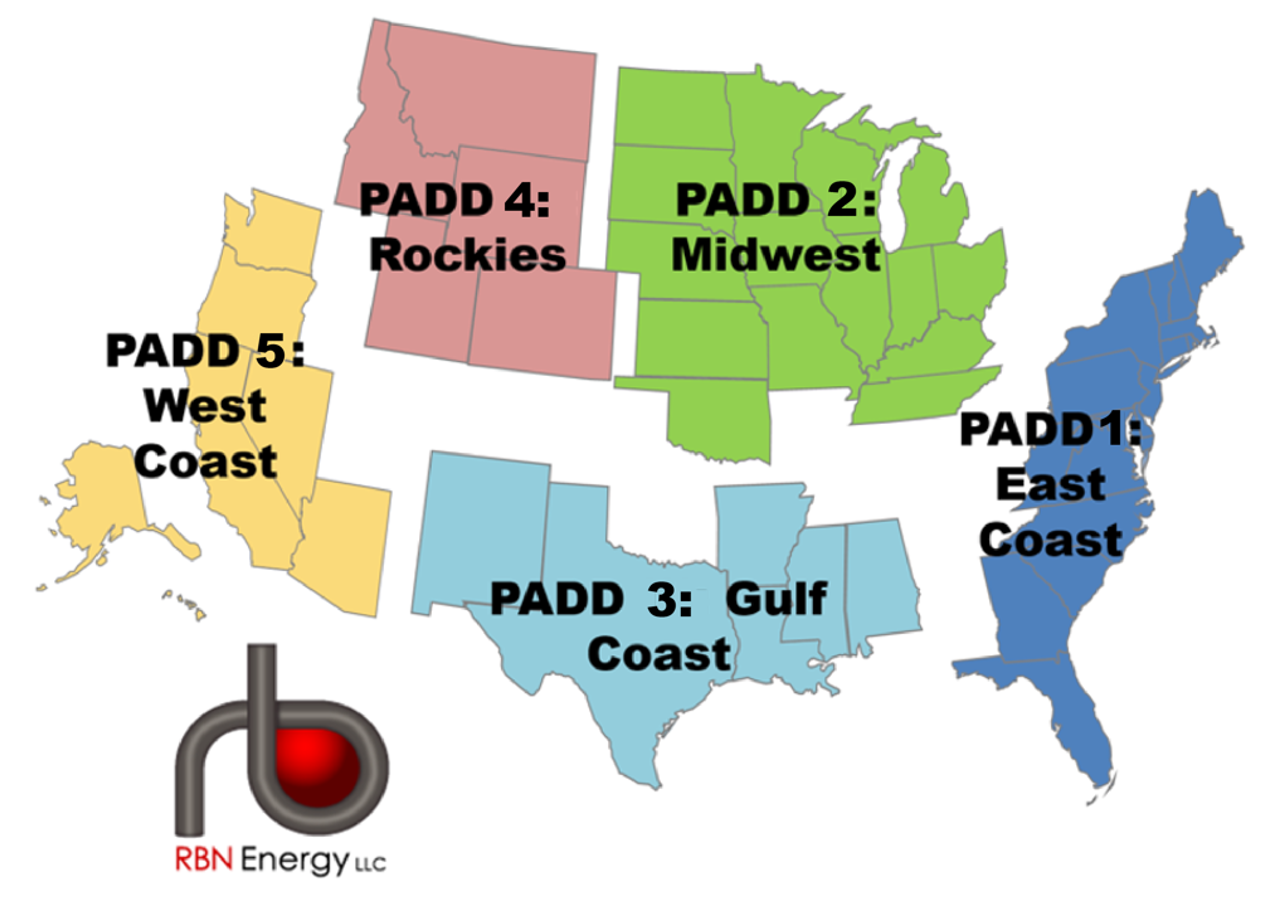
Figure 1. U.S. PADD Map. Source RBN
Today, we will look at PADD 4, the Rockies, a region without much refined product consumption but which has been expanding its crude oil production since the Shale Revolution. The five states in the Rockies consume about 650 Mb/d, which is evenly matched with its 644 Mb/d of in-region refinery capacity (see Figure 2 below). A little less than a third of that, 209 Mb/d, is in the Salt Lake City area, positioning “The Crossroads of the West” as PADD 4’s top refining center. Close behind is Billings, MT, host to 191 Mb/d of refinery capacity, which benefits from Canadian crude oil imports. The rest of the region’s capacity is spread across Colorado, Montana and Wyoming, with the largest refinery in the region being in Commerce City, CO. However, it is actually a combination of two or three smaller refineries, depending on how you count them.
About the song
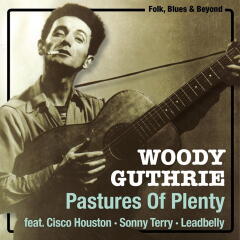
“Pastures of Plenty” was written by Woody Guthrie and first published in 1941. He first recorded the song in New York City in May 1941 for the Bonneville Power Association for a promotional film about providing public power and development of the Columbia River in Oregon. The song is sung modally to the traditional English folk song “Pretty Polly.” The song describes the trials and struggles of Okie and migrant farm workers during the Dust Bowl era in America. The storyline is derived from the world John Steinbeck portrayed in his 1939 novel, The Grapes of Wrath. Guthrie’s recorded versions of the song can be heard on This Land is Your Land, the Asch Recordings Volume One, and on Folkways: The Original Vision Songs of Woody Guthrie and Leadbelly.
The original lyrics to the song are housed in the archives at the Woody Guthrie Center in Tulsa, OK. Many artists have covered the song, including Bob Dylan, Odetta, Harry Belafonte, Pete Seeger, Judy Collins. Alison Krause and Union Station, Dave Van Ronk, Jesse Colin Young, and Ramblin’ Jack Elliot. Personnel on the record was: Woody Guthrie (vocal, acoustic guitar, harmonica).
Woody Guthrie was an American singer, songwriter and musician born in Okemah, OK. He is one of the most influential figures in American folk music. He wrote hundreds of songs focused on themes such as freedom, anti-fascism, labor issues, big government, and other social issues. His most well-known song is “This Land is Your Land.” Most of his songs are archived at the Library of Congress in Washington, DC, and the Woody Guthrie Center in Tulsa. His published recordings are collected from a series of recordings he made in the 1940s and 1950s. Many are available on collections issued by Smithsonian/Folkways Records. Guthrie has influenced songwriters such as Bob Dylan, Joan Baez, Bruce Springsteen, Lou Reed, Johnny Cash, Joe Strummer, and his son, Arlo Guthrie. There is an annual folk festival held in his hometown of Okemah in July called the Woody Guthrie Folk Festival. Guthrie is a member of the Rock and Roll Hall of Fame and has a Grammy Lifetime Achievement Award. He died in New York City in October 1967 at the age of 55 from Huntington’s disease.