The looming threat of a 10% tariff on U.S. imports of Canadian crude oil hasn’t just angered Canadians — and understandably so, we might add. It’s also put a spotlight on PADD 2 — the Midwest/Great Plains region — whose pipelines transport the vast majority of Canadian exports and whose 25 refineries (combined capacity 4.3 MMb/d) are, in many cases, significant consumers of heavy and light crudes from up north. Put simply, to assess the impacts of the still-possible trade war on U.S. refiners and producers on both sides of the border, you need to understand PADD 2’s crude oil supply/demand balance and the options Midwestern refineries that currently run Canadian crude would have if a tariff were put in place. In today’s RBN blog, we’ll discuss these dynamics.

The monthlong truce between President Trump and Prime Minister Trudeau is just that: an agreement to pause a possible trade war for a few weeks to give both sides an opportunity to come to a longer-term meeting of the minds. Trump has famously said that “tariff” is his favorite word, so assuming a 10% levy on imports of Canadian crude is off the table would be a mistake. All bets are still off, and even if things are settled once and for all, Canadians might reasonably ask, “Why the heck would the U.S. turn on its best friend like that?”
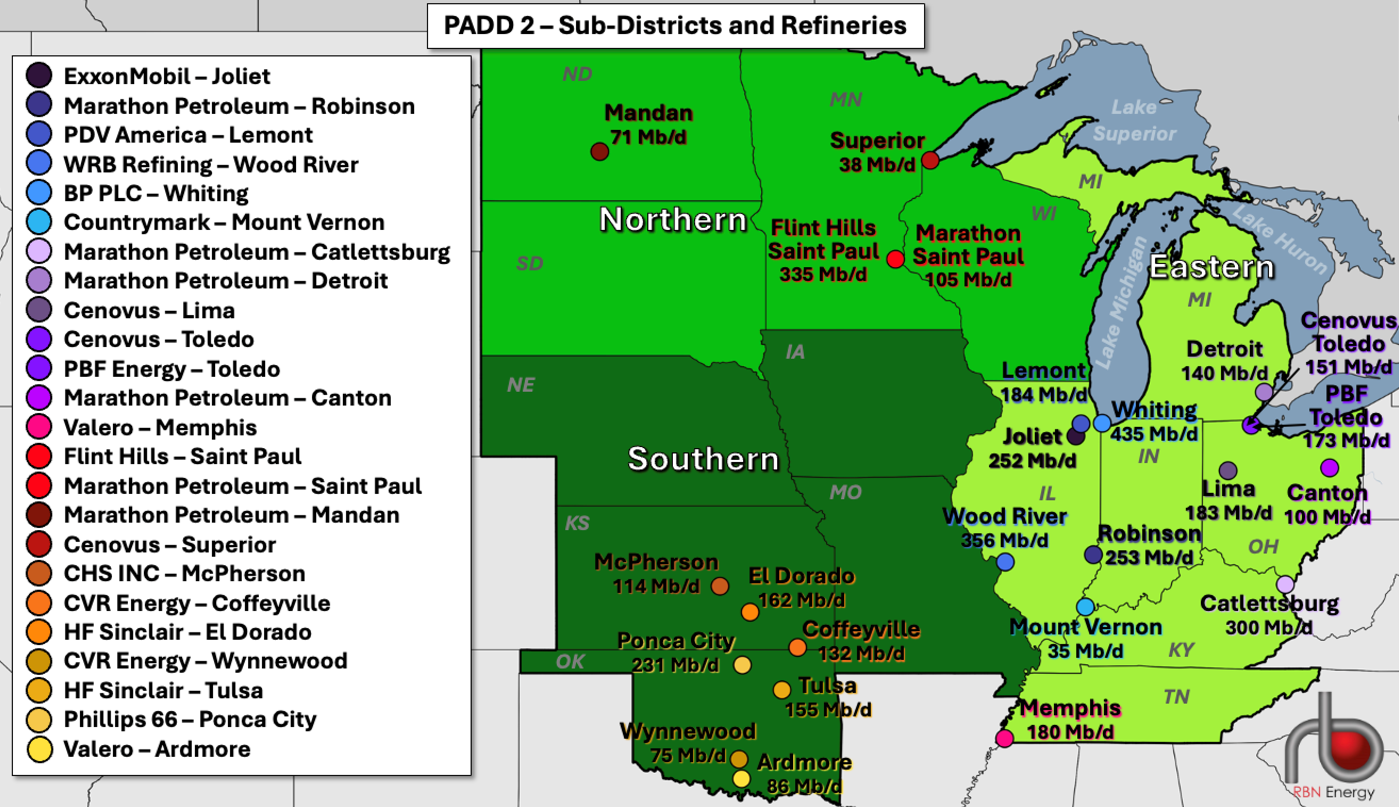
Figure 1. PADD 2 Sub-Districts and Refineries. Source: RBN
Note: Refineries represented by colored dots
The Big Picture
Before we discuss the specifics of how a sampling of PADD 2 refineries might react to a 10% tariff on U.S. imports of Canadian crude oil, we’ll take a quick big-picture look at the region. Stretching from North Dakota to Oklahoma to Ohio, PADD 2 is, first of all, a crude oil production powerhouse (~1.8 MMb/d in recent months), led by the Bakken Shale (~1.2 MMb/d) in the northwestern corner of the PADD’s Northern sub-district (medium-green area in Figure 1 above), the mature Anadarko Basin across Oklahoma in the Southern sub-district (dark-green area), and even burgeoning supplies of condensate (~100 Mb/d) from the Utica play in eastern Ohio, situated near the eastern edge of the Eastern sub-district (light-green area). Additionally, PADD 2 currently receives ~2.5 MMb/d of Canadian imported crude oil — mostly via Enbridge’s massive Mainline system and South Bow’s Keystone Pipeline — but we estimate that about one-fifth of that, or ~500 Mb/d, passes through the Midwest/Great Plains region on its way to refineries and export docks in PADD 3 (Gulf Coast). PADD 2 also receives inflows from the Permian and other production areas in PADD 3 (~750 Mb/d, on average, in the second half of 2024) and the Denver Julesburg (DJ) and other basins in PADD 4 (Rockies; ~930 Mb/d in the second half of 2024), though a good bit of the latter simply flows through PADD 2 (most of it through Cushing) to the Gulf Coast.
About the song
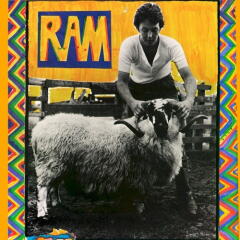
“Heart of the Country” was written by Paul and Linda McCartney and appears as the first song on side two of Paul and Linda McCartney’s first studio album, Ram. The song is a mid-tempo acoustic tune, possibly about Paul and Linda’s calmer life at their Scotland farm post-Beatles. The guitars are tuned down a full step to give the tune a funkier and fuller sound. It was released as the B-side to the single, “The Back Seat of My Car,” released in the U.K. in August 1971, where it went to #39 on the U.K. Singles chart. Personnel on the record were: Paul McCartney (lead vocal, acoustic guitar, bass), Linda McCartney (backing vocals), Hugh McCracken (acoustic guitar), and Denny Seiwell (snare drum with brushes).
Ram was recorded at Columbia Studio B and A&R Recording Studio in New York City between October 1970 and March 1971 and was produced by Paul and Linda McCartney. It is the only studio album credited to Paul and Linda McCartney and Paul’s second studio album released after the Beatles broke up. John Lennon perceived a slight to him on the song from the album, “Too Many People,” and responded with his song, “How Do You Sleep?” The album was released in May 1971 and went to #2 on the Billboard 200 Albums chart and has been certified Platinum by the Recording Industry Association of America. Three singles were released form the LP.
Paul McCartney (Sir James Paul McCartney) is an English singer, songwriter and musician who gained worldwide fame and fortune as a member of The Beatles. The Beatles would go on to change music and culture during their decade together before breaking up in 1970. As a solo artist, McCartney has released 26 studio albums, 10 live albums, four compilation albums, two EPs and 111 singles. He has won two American Music Awards, an Academy Award, eight Brit Awards, an Emmy Award, 18 Grammy Awards, an MTV Video Music Award, an MBE, a CH, and a Gershwin Prize, and is a member of the Rock and Roll Hall of Fame as a member of The Beatles and as a solo artist. He is one of the wealthiest musicians in the world with a net worth of over $1 billion dollars. Linda McCartney died in April 1998 at the age of 56. Paul McCartney continues to record and tour.