Crude oil production in the Permian’s Midland and Delaware basins continues to rise, and producers in the red-hot shale play are hoping there will be enough pipeline takeaway capacity to handle all that growth. This is serious stuff—the Permian’s success the next few years will depend to a considerable degree on whether producers and the midstream sector can avoid the major constraint-driven price differentials between the Midland, TX hub, and destination markets like the Gulf Coast and Cushing, OK, that already have hit the Permian twice this decade. Today we discuss the prospects for another round of takeaway/price-differential trouble in the Permian as soon as late 2017/early 2018 and again in 2020-21.
In our new Drill Down Report, “With a Permian Well, They Cried More, More, More,” we said that the Permian for the past two years has been the engine that has propelled U.S. crude oil production upward. As we’ve seen in fast-growing plays in the past, though—including the Permian itself—production growth sometimes outpaces the ability of takeaway pipelines to transport hydrocarbons to market, resulting in price differentials between the local hub and other, destination hubs that (1) hurt producers and (2) spur them to rein in output gains until enough incremental pipeline capacity comes online to bring production and takeaway capacity into balance.
Fortunately for today’s Permian producers, the region has been a significant producer of crude oil (and natural gas and natural gas liquids—NGLs—for decades), and therefore had significant pipeline takeaway capacity in place before the play entered the current period of renewed growth. Conventional drilling in the Permian peaked in the mid-1970s at just over 2.0 MMb/d and then started a long, steady decline that accelerated when oil prices collapsed in 1986; by the mid-2000s, Permian crude oil production was down to less than 900 Mb/d. But then in 2010, the first significant use of the newly developed techniques—a combination of horizontal drilling and hydraulic fracturing—to produce hydrocarbons from previously unrecoverable formations started to show results. By the end of that year, Permian production was back over 1.0 MMb/d, and over the next six-plus years, volumes more than doubled. Today the Permian is producing more than 2.2 MMb/d—an all-time record—with more than 200 Mb/d in growth in the last six months alone. And production growth continues to accelerate: according to RBN’s Growth Scenario, Permian crude production will continue to ramp up toward 3.7 MMb/d in 2022, and it’s certainly possible that the pace of production growth will be even faster.

About the song
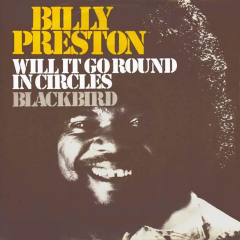
“Will It Go Round in Circles” was written by Billy Preston and Bruce Fisher and appears on Preston’s 1972 album, Music Is My Life. The song was released in March 1973 and became Preston’s first #1 solo single, topping the Billboard Hot 100 singles chart that year. Personnel on the record were: Billy Preston (keyboards, bass guitar, vocals), George Johnson (guitar), Louis Johnson (bass guitar), Hubert Heard (drums), Tom Scott (horn), John Horn (horn, George Bohanon (horn), Buck Monari (horn), and Paul Hubinon (horn).
Music Is My Life was the 7th studio album for Preston and was recorded in 1971-72 and released in 1972.
Billy Preston is an American musician British singer, songwriter, musician, songwriter and producer with works crossing the R&B, rock, soul, funk and gospel genres. He was the only non-Beatle musician to be credited on a Beatles recording, namely the 1969 single “Get Back.” He continued to serve as a member of George Harrison’s band after the Beatles broke up, including performing “Will It Go Round in Circles” on Harrison’s 1974 Dark Horse tour.