Crude oil production in the Permian Basin is coming on strong — faster than midstreamers can build pipeline takeaway capacity out of the basin. You can see the consequences in price differentials. On Friday, the spread between Midland, TX and the Magellan East Houston terminal (MEH) on the Gulf Coast hit almost $5.00/bbl, a clear sign of takeaway capacity constraints out of the Permian. We’ve seen different variations of this scenario play out in recent years, most recently last fall, just before the first oil started flowing through the new Midland-to-Sealy and Permian Express III pipelines, and it’s not good news for Permian producers. Now Permian output is again bouncing up against the capacity of takeaway pipelines and in-region refineries to deal with it. As we’ve seen in the past, that’s a warning sign for possible price-differential blowouts. Today, we discuss the fast-changing market dynamics that put Permian producers at risk for another round of depressed Midland prices.
The nexus among Permian crude oil production, takeaway capacity and price differentials has been a frequent topic in the RBN blogosphere, especially in the past year or so as upstream and midstream activity in the West Texas/southeastern New Mexico play has really ramped up. In early February, in We Gotta Get Out of This Place, we looked at the latest machinations of the price differentials between Midland and destination markets on the Gulf Coast and in Cushing, OK. We’ve also been closely tracking developments on the Permian crude takeaway front, most recently in Help on The Way. There we provided updates on a long list of proposed pipeline projects out of the Permian, including the Phillips 66/Enbridge Gray Oak Pipeline; an expansion of the Magellan Midstream Partners/Plains All American BridgeTex Pipeline from Midland to Houston; EPIC Pipeline’s Permian-to-Eagle-Ford-to-Corpus pipe project, and several others.
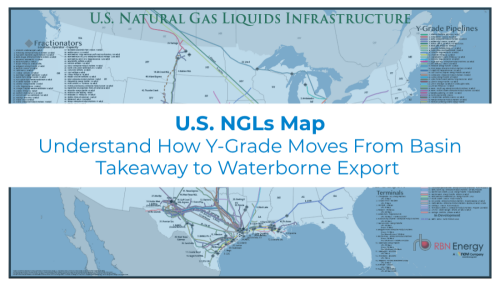
Visualize the infrastructure behind U.S. NGL movement.
The U.S. NGLs Map provides a comprehensive view of the transport, processing, and export networks moving NGLs across the U.S.
What all those projects have in common, though, is that they won’t come online until 2019 or 2020 — the distant future compared with the nearer-term focus of today’s blog: namely, could we see a blowout this year in the price spread for light domestic crude between Midland and Magellan East Houston (MEH) – that we call the MM or M&M spread. MEH has become the de facto benchmark for Houston-area light sweet crude, particularly barrels from that area targeting export markets. (For more about MEH, see We Gotta Get Out of This Place).
First, a little history to help explain why the differential between Midland and MEH has become a more important barometer than that old standby, the Cushing-Midland spread (a.k.a. the MidCush). Up until the past few years, the marginal barrel produced in the Permian was piped to Cushing; little capacity existed to move Permian oil on pipes that could eventually get barrels to the Gulf Coast, other than via Cushing. Since then, however, the vast majority of the new, incremental pipeline capacity out of the Permian heads for the Houston area and, to a lesser extent, Corpus Christi. Permian production wants to make a bee-line to the Gulf Coast now because it’s more valued there — that’s where the refinery demand and crude-export terminals are. One thing remains constant, though: crude price differentials can widen (often dramatically) when there is barely enough — or worse yet, not enough — pipeline capacity available to move oil to where it wants to go.
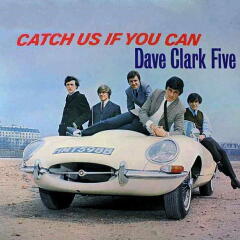
About the song
“Here They Come Again, Mmmm-mm-mm” is the opening line in "Catch Us if You Can," a hit song by the English pop-rock band, The Dave Clark Five. The song, written by band members Dave Clark and Lenny Davidson, was the title song to John Boorman's 1965 pop movie of the same name, which featured the The Dave Clark Five (DC5). "Catch Us if You Can" was one of many top hits for the DC5, rising to #4 on the U.S. singles charts and #5 in the band’s native UK.
The DC5 consisted of Dave Clark (drums), Mike Smith (lead vocals and keyboards), Lenny Davidson (guitar), Rick Huxley (bass) and Denis Payton (sax). Dave Clark formed the band in Tottenham, England, in 1957. The group’s first U.S. single, "Glad All Over," had the distinction of knocking The Beatles' "I Want to Hold Your Hand" off of the top of the UK single charts in January 1964. The DC5 were the second group of the British Invasion to appear on “The Ed Sullivan Show,” appearing in March,1964 for two Sunday nights in a row after The Beatles appeared for three straight weeks in February 1964.
Dave Clark’s band would go on to make a total of 18 appearances on the Ed Sullivan Show over the course of their career, the most of any British Invasion group. The band released 17 albums and 36 singles in the U.S. during their tenure from 1964 to 1970, when they broke up. Seventeen of their singles were Top 40 hits in the U.S., and 12 were Top 40 hits in the UK. The DC5 were inducted into the Rock and Roll Hall of Fame in 2008.