The shutdown of natural gas production from the Sable Offshore Energy Project on Canada’s East Coast as of January 1, 2019, increased the Canadian Maritimes’ reliance on gas exports from New England this winter as consumers worked to link up with fresh supply to replace SOEP. The tightening supply in the region has prompted expansion plans from TransCanada to move more Western Canadian and Marcellus/Utica gas to New England utilizing its Mainline and other eastern systems. Today, we conclude our series examining the potential impacts of SOEP’s demise by examining new plans to bring more gas to the region.
These plans involve increasing capacity on existing pipelines that link the New England market to Canada from the north, whereas pipeline expansions that have been attempting to bring Marcellus/Utica gas more directly from the south and west continue to face strong environmental and regulatory resistance. Before explaining these incremental developments from the north, let’s review the first two blogs in this series.
In Part 1, we reviewed the shutdown of SOEP on New Year’s Day 2019. Originally intended as a stepping stone to a much larger offshore gas supply presence, SOEP and its little brother, Deep Panuke, eventually went into terminal decline, and with no further commercial discoveries of natural gas reserves in the region, water encroachment, economics and declines sealed their fates. The end of this supply has had two major implications. The first is that the provinces of Nova Scotia and New Brunswick, which were already fairly isolated in terms of gas supply, now only have two remaining supply options: piped imports from the U.S. and LNG imports. The second implication is that New England, which itself lacks sufficient pipeline connectivity, will increasingly be competing with Eastern Canada for supply, particularly in the winter months, when demand is highest.
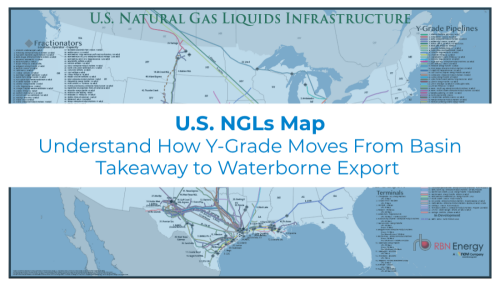
Visualize the infrastructure behind U.S. NGL movement.
The U.S. NGLs Map provides a comprehensive view of the transport, processing, and export networks moving NGLs across the U.S.
In Part 2, we discussed the increasing competition for these more limited gas supplies. The Maritimes’ now-full reliance on imported gas means that as much as 120 MMcf/d in summer months and 240 MMcf/d in the winter months must flow into the New Brunswick gas grid, either as pipeline gas from Maine or re-gasified LNG from the Canaport LNG import terminal in Saint John. Last year, U.S. gas exports from Maine hovered in the 80-100 MMcf/d range, including in the winter months, which means that as much as an additional 100-150 MMcf/d might need to flow north during the peak winter demand periods. That may sound like a small amount, but for the constrained New England market, even that much can send the market into fits and push prices into the stratosphere. The problem, as we discussed in the previous episode, is that there are only a handful of routes that can deliver gas into the six-state region — the most significant being Tennessee Gas Pipeline (TGP; black line in Figure 1), Algonquin Gas Transmission (AGT; purple line) and Maritimes & Northeast Pipeline (MNP; green line) — all of which hit capacity constraints during peak demand periods in the winter, and efforts to install new pipeline capacity into New England have been largely thwarted by legal challenges and permitting delays.

About the song
Written by Glenn Frey and Don Henley, “The Last Resort” is the ninth and final track on The Eagles’ 1976 studio album, Hotel California, which was released in December of that year. Recorded at the Criteria Studios in Miami, and produced by Bill Szymczyk, the song had to be re-recorded several times due to noise interference from an adjacent studio where British heavy metal band Black Sabbath were recording an album. Hotel California went on to become one of the best-selling LPs of all time. Henley recalled the song as being of one his favorites from the album.
The Eagles are an American rock band formed in Los Angeles in 1971 by founding members Glenn Frey, Don Henley, Bernie Leadon, and Randy Meisner. Combining a range of styles from rock, folk rock, and country music, the Eagles have gone through several personnel changes over the years and two break-ups. After the death of founding member Glenn Frey in 2016, the band reformed in 2017 and continues to tour to this day.