Handling the flood of Marcellus/Utica gas headed to Gulf Coast LNG export terminals and to Mexico will require pipeline reversals and expansions, new pipe and a coordination of interstate and intrastate pipeline capacity. That’s a tall order in itself, but there’s more: Texas’s intrastate pipelines operate under an entirely different set of regulations than their interstate counterparts––different rules on pipeline tariff rates, pipeline rules, permitting, eminent domain, you name it. In today’s blog we continue our look at developmental history of the Lone Star State’s two gas pipeline systems––one regulated in Washington, DC and the other in Austin––and how it may affect the transformation of the overall natural gas transportation grid.
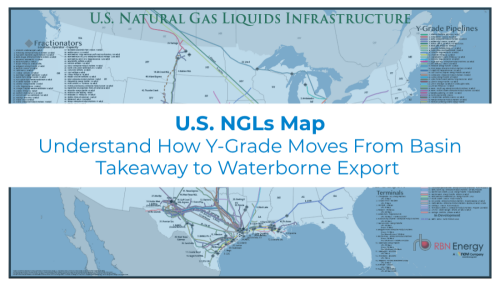
Visualize the infrastructure behind U.S. NGL movement.
The U.S. NGLs Map provides a comprehensive view of the transport, processing, and export networks moving NGLs across the U.S.
As we said in Part 1 of this blog series, Texas’s vast natural gas pipeline network is undergoing a major transformation to enable gas from the Marcellus/Utica shale plays to flow south/southwest into and through Texas to LNG export terminals and to Mexico––the two biggest sources of future incremental gas demand. It’s a complex task because, after all, most of Texas’s existing gas pipeline network was developed to move Texas-sourced gas toward the Gulf Coast Industrial Corridor (and its epicenter around the Houston Ship Channel), and out of the state to the north and east to serve markets in mostly cold, populous regions of the country – not down the coast to Corpus Christi and the international border. Part 1 examined a historical perspective that explains why Texas pipelines move gas as they do ––interstate pipes to move Texas gas to major demand centers in the Northeast, Midwest and West Coast, and intrastate pipelines to serve in-state industrial, commercial and residential customers. The two systems grew side-by-side, with the development of the surprisingly extensive and robust intrastate system driven in part by the fact that for decades, federal price regulation kept the price of gas flowing on interstate pipes low and hands-off state oversight allowed the price of gas flowing on intrastate pipes to rise to whatever the market would bear––often to levels several times higher than the price of the gas sent out of state. The ability to sell intrastate gas at huge premiums spurred the construction of a vast system of intrastate pipelines.
Certainly the most significant region for both intrastate and interstate pipelines is the Gulf Coast Industrial Corridor, the largest single natural gas industrial market in the U.S. Most interstate pipelines traversing the region were originally built in the 1940s, ’50 and ‘60s to move Texas Gulf Coast natural gas production on long-line transmission systems running from Texas through other producing states (Louisiana, Oklahoma) and finally delivering gas to weather-sensitive markets in the Northeast and Midwest. In contrast, most intrastate systems were built in the 1960s and ‘70s to deliver Texas production to Gulf Coast industrial consumers during the period of federal price controls described above. Gas supplies for the intrastate pipes moved in from the West (Permian Basin), south from East Texas, and into the system from Texas producing regions along the Gulf Coast. Following market decontrol in the 1980s, intrastate and interstate pipelines expanded commerce between the systems, allowing supplies gathered on the interstates to move to intrastates, and vice versa. Small volumes of production, mostly sourced in South Texas, moved on both intrastate and interstate pipelines to Mexico.

About the song
"Texas Flood" was written by Larry Davis and Joseph Wade Scott. It appears as the third song on Stevie Ray Vaughan and Double Trouble's debut album of the same name. The song's co-author, Larry Davis, released a single of "Texas Flood" for Duke records in 1958. It was the first of three blues singles he made for the label. Davis's "Texas Flood" also featured the guitar work of Fenton Robinson.
Texas Flood, the album, was recorded by Stevie Ray Vaughan and Double Trouble in three days at Jackson Browne's personal recording studio in downtown Los Angeles in November 1982. Personnel on the album were: Stevie Ray Vaughan (guitar, vocals), Tommy Shannon (bass), and Chris Layton (drums). The LP was produced by Stevie Ray Vaughan and Double Trouble, with Richard Mullen. It was released in June 1983, and went to #38 on the Billboard Top 200 Albums chart. It has been certified 2X Platinum by the Recording Industry Association of America. Two singles were released from the album.
Stevie Ray Vaughan was an American blues guitarist, singer, songwriter, and record producer from Austin, TX. He was best known as the front man for Double Trouble, and for being one of the main ambassadors of Texas blues guitar. Vaughan released six studio albums, seven live albums, nine compilation albums, four EPs, and 33 singles. He has sold more than 15 million albums in the U.S. alone, and has won six Grammy Awards and five W.C. Handy Awards. He, along with Double Trouble, are members of the Rock and Roll Hall of Fame and the Austin Music Hall of Fame. Vaughan died in a helicopter crash after a concert in August 1990 at the age of 35.