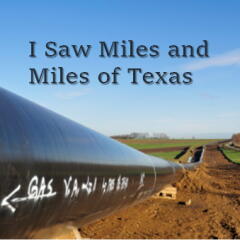
Texas’s vast natural gas pipeline network is undergoing a major transformation to enable gas from the Marcellus/Utica shale plays to flood south/southwest into and through Texas to LNG export terminals and to Mexico. To grasp the complexity of the task at hand, it is critically important to understand how Texas’s “spaghetti bowl” of interstate and intrastate pipeline systems evolved in parallel but under very different regulatory constructs, and with the intention of serving very different market needs. In today’s blog, we begin an examination of the state’s two pipeline systems––one regulated by the Feds in Washington, DC and the other by the Texas Railroad Commission in Austin, TX––and why the intrastate system has taken on a new significance for U.S. natural gas markets.
Texans like to say that everything is bigger in the Lone Star State, and that’s certainly true when it comes to natural gas production, gas consumption, and the nearly 400,000 miles of gas pipelines that crisscross the state. Texas is the largest gas-producing state, contributing 26% of total U.S. supplies in 2015, and about 19.4 Bcf/d as of July 2016, according to the Energy Information Administration (EIA). The state is also responsible for almost 15% of total U.S. demand, or about 10 Bcf/d in 2015. That makes Texas a net gas seller, producing almost twice as much gas as it uses. Gas produced in the state moves across a vast geographical region within an extensive pipeline grid. The state has an area of approximately 270,000 square miles, making it 10% larger than France (which is probably as different from Texas as any place on Earth—Texans and Frenchmen would agree) and almost twice as large as Japan. A 175,000-mile web of gathering pipelines moves gas from the state’s producing basins to treating and processing facilities that prepare the gas for market. There are another 150,000 miles of distribution pipelines delivering gas to industrials, power plants, businesses and consumers. Between these two massive systems are 51,600 miles of transmission pipelines that connect Texas production and inbound natural gas flows from other regions to the state’s demand centers.

Crude Oil TradeView provides up-to-date data and insights into the behavior of differentials for 33 crude assessments across North America. Each week, it also walks you through the reasoning of why differentials widen, narrow, flip (premium vs. discount), or blow out.
As we’ve discussed in the first two parts of our most recent Drill Down Report series (titled Miles and Miles of Texas — Part 1 and Part 2), Texas is again at the center of things (where Texans like it to be), this time as the epicenter of booming natural gas exports, both to Mexico (via pipelines through Texas) and overseas (as LNG, via new liquefaction/export facilities under construction in Freeport and Corpus Christi––and others being planned). While much of this export gas will be produced within Texas, a significant portion will be coming from elsewhere in the U.S., especially the red-hot Marcellus/Utica production region in Pennsylvania, West Virginia and Ohio, which has very favorable production economics and which (as a three-state group) already produces 13% more gas than Texas itself (~22 Bcf/d as of July 2016). The need to move increasing volumes of Yankee-sourced gas south/southwest down Texas’s Gulf Coast to serve the LNG and Mexican export markets is forcing changes on the gas-flow patterns that have prevailed for decades in the state.

About the song
"Texas Flood" was written by Larry Davis and Joseph Wade Scott. It appears as the third song on Stevie Ray Vaughan and Double Trouble's debut album of the same name. The song's co-author, Larry Davis, released a single of "Texas Flood" for Duke records in 1958. It was the first of three blues singles he made for the label. Davis's "Texas Flood" also featured the guitar work of Fenton Robinson.
Texas Flood, the album, was recorded by Stevie Ray Vaughan and Double Trouble in three days at Jackson Browne's personal recording studio in downtown Los Angeles in November 1982. Personnel on the album were: Stevie Ray Vaughan (guitar, vocals), Tommy Shannon (bass), and Chris Layton (drums). The LP was produced by Stevie Ray Vaughan and Double Trouble, with Richard Mullen. It was released in June 1983, and went to #38 on the Billboard Top 200 Albums chart. It has been certified 2X Platinum by the Recording Industry Association of America. Two singles were released from the album.
Stevie Ray Vaughan was an American blues guitarist, singer, songwriter, and record producer from Austin, TX. He was best known as the front man for Double Trouble, and for being one of the main ambassadors of Texas blues guitar. Vaughan released six studio albums, seven live albums, nine compilation albums, four EPs, and 33 singles. He has sold more than 15 million albums in the U.S. alone, and has won six Grammy Awards and five W.C. Handy Awards. He, along with Double Trouble, are members of the Rock and Roll Hall of Fame and the Austin Music Hall of Fame. Vaughan died in a helicopter crash after a concert in August 1990 at the age of 35.