Fundamental, far-reaching changes in natural gas pipeline flows within the Lone Star State to enable increased gas supplies to reach LNG terminals and Mexico cross-border points give new significance to the issue of federal versus state pipeline regulation. Given Texas’s independent streak, it comes as no surprise that federal and state rules are night-and-day, with the Texas regs being largely hands-off and the feds’ being very hands-on. The differences are worth examining because they affect project development, pipeline tariffs, relationships between pipeline owner/operations and gas sellers/buyers—even the degree of transparency regarding shipper contracts and daily pipeline flows. Today we consider the differences between federal and state regulatory oversight of gas pipelines in Texas, and why they matter.
Among the many things that the Shale Revolution has up-ended are the historical pipeline flows of natural gas—in the U.S. as a whole and within the state of Texas. These flow changes, which have required a major reworking (and expansion) of interstate and intrastate pipeline networks, result from new sources of gas supply (especially the Marcellus/Utica region), declining production of gas from “conventional” wells (most recently, from the Eagle Ford), and rising gas demand from U.S. power generators, Mexico and liquefaction/LNG export terminals along the Gulf Coast. Soaring gas exports to Mexico—and the coming rise in LNG exports—are pulling huge volumes of Marcellus/Utica gas south and west to Louisiana through newly reversed interstate pipelines, and now into Texas.
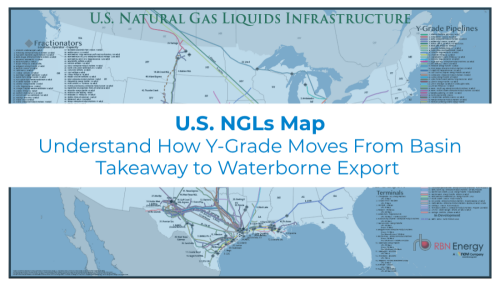
Visualize the infrastructure behind U.S. NGL movement.
The U.S. NGLs Map provides a comprehensive view of the transport, processing, and export networks moving NGLs across the U.S.
As we discussed in Part 1 and Part 2 of this Floodin’ Down in Texas blog series, more than 50,000 miles of major interstate and intrastate gas transmission pipelines crisscross the state, and while there are a number of interconnections between the U.S.- and state-regulated pipes, the two systems were developed under entirely different regulatory constructs, and for different (albeit complementary) purposes. Most interstate pipelines in the state were built decades ago to move Texas gas to major demand centers in the Northeast, Midwest and West Coast, while the state’s vast network of intrastate pipelines was constructed to serve in-state industrial, commercial and residential customers. The two systems grew side-by-side, with the development of the intrastate system driven to a significant degree by the fact that until the late 1970s/early 1980s, federal price regulation kept the price of gas flowing on interstate pipes artificially low, and minimal state oversight allowed the price of gas flowing on intrastate pipes to rise to whatever the market would bear—often to levels several times higher than the price of the gas sent out of state.

About the song
"Texas Flood" was written by Larry Davis and Joseph Wade Scott. It appears as the third song on Stevie Ray Vaughan and Double Trouble's debut album of the same name. The song's co-author, Larry Davis, released a single of "Texas Flood" for Duke records in 1958. It was the first of three blues singles he made for the label. Davis's "Texas Flood" also featured the guitar work of Fenton Robinson.
Texas Flood, the album, was recorded by Stevie Ray Vaughan and Double Trouble in three days at Jackson Browne's personal recording studio in downtown Los Angeles in November 1982. Personnel on the album were: Stevie Ray Vaughan (guitar, vocals), Tommy Shannon (bass), and Chris Layton (drums). The LP was produced by Stevie Ray Vaughan and Double Trouble, with Richard Mullen. It was released in June 1983, and went to #38 on the Billboard Top 200 Albums chart. It has been certified 2X Platinum by the Recording Industry Association of America. Two singles were released from the album.
Stevie Ray Vaughan was an American blues guitarist, singer, songwriter, and record producer from Austin, TX. He was best known as the front man for Double Trouble, and for being one of the main ambassadors of Texas blues guitar. Vaughan released six studio albums, seven live albums, nine compilation albums, four EPs, and 33 singles. He has sold more than 15 million albums in the U.S. alone, and has won six Grammy Awards and five W.C. Handy Awards. He, along with Double Trouble, are members of the Rock and Roll Hall of Fame and the Austin Music Hall of Fame. Vaughan died in a helicopter crash after a concert in August 1990 at the age of 35.