U.S. Gulf Coast LPG exports are sky-high, averaging just under 2 MMb/d in October, with nearly two-thirds of those volumes bound for Asia — a straight-shot trip once a Very Large Gas Carrier (VLGC) has passed through the Panama Canal. But an unprecedented dry spell has left the canal’s operators — and LPG shippers — in a real bind. The century-old maritime shortcut, which was expanded just a few years ago to accommodate more and larger vessels, uses massive amounts of fresh water, and to help conserve what’s left in the system’s main reservoir, the Panama Canal Authority (PCA) is ratcheting down how many ships can pass through each day. Worse yet, VLGCs are a low priority compared to other, larger vessels that pay higher tolls. That means that far fewer Asia-bound LPG ships will be using the Panama Canal for who knows how long. Instead, many shippers will need to make far longer, more costly trips through the Suez Canal or around the southern tip of Africa. In today’s RBN blog, we discuss what LPG shippers in particular are up against.
Earlier this year, in When the Levee Breaks, we examined the steady and spectacular rise in U.S. NGL production since the advent of the Shale Revolution — from 1.8 MMb/d in 2008 to more than 6.5 MMb/d today — and the drivers behind it. These include the related facts that most drilling is crude-oil-focused, most crude-centric basins are experiencing higher gas-to-oil ratios (GORs), and higher GORs mean more associated gas — and, in many basins (including the Permian), associated gas is highly saturated with NGLs. In a number of other recent blogs, including last month’s Connection, we looked at the critical role that rising LPG (propane and normal butane) exports play in balancing the U.S. markets for those products: Put simply, domestic demand for LPG has been close to flat for several years, so virtually all incremental production needs to be sent abroad.
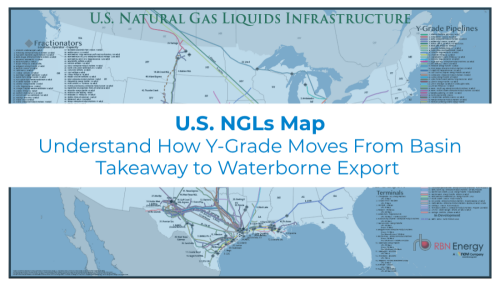
Visualize the infrastructure behind U.S. NGL movement.
The U.S. NGLs Map provides a comprehensive view of the transport, processing, and export networks moving NGLs across the U.S.
To keep up, a handful of large midstream companies — Enterprise Products Partners, Energy Transfer, Targa Resources and Phillips 66 — over the past few years have built out gas processing, pipeline, fractionation and export infrastructure (including several waterfront terminals along the Gulf Coast — see Figure 1) to make ever-increasing LPG exports possible. In RBN’s bi-weekly NGL Voyager report, we monitor LPG exports and keep track of where these cargoes are headed. The dominant international market for LPG is Asia, which depends on imported LPG for heating, petrochemical production and other critical uses. According to the most recent issue of NGL Voyager, Gulf Coast LPG terminals sent out an average of 1.95 MMb/d in October 2023 — 89% of total U.S. LPG exports — and just over 1.2 MMb/d of that (or 62%) was shipped to Asian markets.
About the song
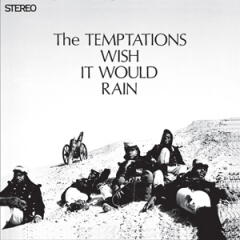
“I Wish It Would Rain” was written by Norman Whitfield, Barrett Strong and Rodger Penzabene and appears as the third song on side one of The Temptations’ seventh studio album, The Temptations Wish It Would Rain. The song was recorded at Hitsville USA Studio A in Detroit in April and August 1967. Released as a single in December 1967, it went to #1 on the Billboard R&B chart and #4 on the Billboard Hot 100 Singles chart. The song has been covered by many artists such as The Faces, Bruce Springsteen, Gladys Knight & the Pips, and Little Caesar. Personnel on the record were: David Ruffin (lead vocals), Eddie Kendricks, Melvin Franklin, Paul Williams, Otis Williams (backing vocals), and The Funk Brothers (instrumentation).
The Temptations Wish It Would Rain was recorded in 1967-68 at Hitsville USA in Detroit with Norman Whitfield, Smokey Robinson, Henry Cosby, Harvey Fuqua, Deke Richards and Johnny Bristol producing. It was the final release from the “Classic 5,” which included Ruffin, Kendricks, Williams, Franklin and Williams. The album was released in April 1968 and went to #1 on the Billboard R&B chart and #13 on the Billboard 200 Albums chart. Three singles were released from the LP. On a dark note, Motown songwriter Rodger Penzabene, who co-wrote the songs “I Wish It Would Rain” and “I Could Never Love Another (After Loving You)” from the album, committed suicide on New Year's Eve 1967 because of the breakup described in the two songs.
The Temptations are an American R&B vocal group from Detroit that had a string of hit singles and albums in the 1960s and ’70s for Motown Records. The group formed in 1960 under the name The Elgins. They changed their name to The Temptations after signing a record deal with Berry Gordy and Motown Records in March 1961. They have released 43 studio albums, four live albums, 15 compilation albums, three soundtrack albums and 109 singles. The group has a Grammy Lifetime Achievement Award and was inducted into the Vocal Group Hall of Fame in 1999. Twenty-seven members have passed through the group since its inception. Original member Otis Williams is in the current version, along with Ron Tyson, Terry Weeks, Tony Grant and Jawan M. Jackson. The Temptations will begin touring the U.S. again in December 2023.