For months, the crude oil market had Canada figured out. Production was growing, bit by bit. Pipelines were maxed out. Railcars were hard to come by but were providing some incremental takeaway capacity. Midwest refineries, a big destination for Canadian crude, went in and out of turnaround season, moving prices as they ramped up runs. Overall, the supply and demand math was straightforward also, tilted towards excess production. Canadian crude prices were going to continue to be heavily discounted for the next year or two, until one of the new pipeline systems being planned was approved and completed. Western Canadian Select (WCS) — a heavy crude blend and regional benchmark — was averaging at a discount to West Texas Intermediate (WTI) near $40/bbl in November, dragging down Syncrude prices with it. As the market was settling in for a long, cold winter in Canada, a bombshell dropped: Alberta’s premier announced on December 2 (2018) that regulators would institute a mandatory production cut, taking 325 Mb/d of production offline, and that the government would invest in new crude-by-rail tankcars. That announcement has had a massive impact on prices, with WCS’s differential narrowing to $18.50/bbl most recently. In today’s blog, we look at several catalysts for the recent swing in Canadian prices, and how the recent governmental intervention will impact differentials.

The Crude Voyager is a weekly analysis of U.S. Gulf Coast loading activity that explains the ebbs and flows of crude loadings, destinations, and geopolitical issues impacting U.S. exports. It outlines the major paths for laden tankers hauling U.S. crude all over the world and reflects the change in tanker departures to the main regions that consume U.S. crude.
The fact that Canadian crude has been heavily discounted to WTI at the Cushing (OK) hub is nothing new. We most recently discussed these price differentials in our Low Budget and Push Me, Pull Me series, and analyzed the price breakdown in our "The Shape I'm In" Drill Down Report last spring. Canadian prices have been subject to massive discounts due to a severe lack of takeaway capacity. WCS (blue line in Figure 1) has been steadily trading at a double-digit discount to WTI for years due to a limited number of outlets for barrels. WCS had averaged a discount of $26/bbl in 2018 before widening even further to $50/bbl on October 11. Syncrude, WCS’s lighter brother (red line), had been averaging a $5/bbl discount before blowing out to $30/bbl in October and $34/bbl in early November. During that time, there was a myriad of bad news engulfing Canadian crude differentials. The Keystone XL pipeline project, which finally appeared to be heading for daylight, was hit with another ruling from a federal judge to halt construction. Canadian producers Canadian Natural Resources, MEG Energy, Cenovus Energy and ConocoPhillips all announced they were going to cut back on some production until prices improved. And many of those same producers also announced they had signed year-or-longer commitments to ship crude via rail, signaling that they were worried enough about long-term pipeline constraints that they would roll the dice on more expensive, binding take-or-pay rail deals.
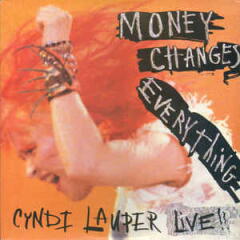
About the song
"Money Changes Everything" was a hit single for Cyndi Lauper in 1984-85. The song was written by Tom Gray, frontman for an Atlanta-based band, “The Brains," and appeared on the band’s self-titled debut album, which was released in 1980. Three years later, the tune was recorded by Lauper and included on her first solo LP, which was titled She’s So Unusual. Cyndi’s version dropped as a single in December 1984, and rose to #27 on the Billboard Hot 100 chart.
The She's So Unusual album was recorded between May and August 1983 at the Record Plant in New York City, and released in October of that year. Rick Chertoff and William Wittman produced the LP. Seven singles were released from Lauper's debut solo album, four of them reaching the top five in the charts: “Girls Just Want to Have Fun,” “Time After Time,” “She Bop” and “All Through the Night.” The LP itself reached #4 on the Billboard Top 200 Albums chart, and has sold 6 million copies in the U.S. and 15 million worldwide.
Cyndi Lauper is an American singer, songwriter and actress. Raised in the borough of Queens in New York City, she started her professional career as the singer for the band Blue Angel, which released one album in 1980. Lauper has released 11 solo albums, and appeared in several television shows and motion pictures. Lauper has won one Grammy Award, one Tony Award, one Emmy Award, and one MTV Video Music Award. She still tours and records to this date.